
Introduction
Biscogniauxia canker, formerly known as Hypoxylon canker, is a fungal disease which impacts hardwood trees throughout the southern United States. The causal pathogen lives within many hardwood trees, but the hosts do not succumb unless they are stressed by some other factor, such as drought, injury, or poor site conditions. Biscogniauxia, the genus of the fungal pathogen, becomes problematic when it invades the sapwood of its hosts following stress, leading to disease symptoms and tree death. Although this disease was formerly called Hypoxylon canker, it should not be confused with Hypoxylon canker of aspens, which is caused by a separate fungal pathogen.
Causal Agents
Biscogniauxia is a genus consisting of several fungal species. Two of these species, B. atropunctata (formerly Hypoxylon atropunctatum) and B. mediterranea (formerly H. mediterranea), most often cause disease in the South.
Host Plants
While the disease can infect many hardwood species, it most often impacts oaks (Quercus spp.). Red oaks are more susceptible than white oaks, which is likely due to the ability of white oaks to better withstand drought (Bassett and Fenn 1984; Tainter et al. 1983). Biscogniauxia canker has been cited as one of the major contributing factors of the oak decline disease complex. Additionally, maple, sycamore, beech, elm, and hickory may also be impacted.
Lifecycle and Damage
Biscogniauxia spp. have both sexual (ascospores) and asexual (conidia) spores for reproduction. These spores are very common in forests, and ascopores are released for much of the year following heavy rain or high humidity (Vannini et al. 1996). Spores are released from mats called stromata, which provide the easiest way to identify Biscogniauxia canker (see Signs and Symptoms below).
As the fungus is common in forests, many healthy hosts are infected but not impacted by Biscogniauxia. Bassett and Fenn (1984) found that B. atropunctata was present within the branches and trunks of healthy oaks in natural forests of Arkansas, but did not appear symptomatic. In this study, researchers inoculated oaks with the fungus and girdled some of these trees to cause stress. The stress stimulated development of Biscogniauxia canker while the non-girdled trees remained asymptomatic. Even non-inoculated trees developed disease once girdled, suggesting that the fungus is latent in many trees (Bassett and Fenn 1984).
Once stress occurs, Biscogniauxia invades the sapwood of its hosts, leading to rapid decay. After invasion, the stromata form, causing bark to fall off. After these stromata are present, tree death may occur quickly as a result of damage to the vascular system. A survey of oak tree death following drought in South Carolina reported that trees did not survive for more than a few weeks after Biscogniauxia stromata were visible (Tainter et al. 1983).
Signs and Symptoms
Stromata are the easiest way to identify the disease. Stromata form beneath the bark of their hosts and cause the bark in the area to fall from the tree. They appear as mats which may be reddish-brown or tan with powdery spores before hardening and becoming black in color (Figure 1 and Figure 2). Once spores are released, the stromata eventually turn gray (Figure 3). Other signs and symptoms can help identify Biscogniauxia canker. Invasion of the sapwood leads to discoloration and decay lines in the wood. Further, early symptoms that may occur include thinning of the crown and branch dieback. Undersized, wilted, or scorched leaves and delayed bud break may also occur (Figure 4).
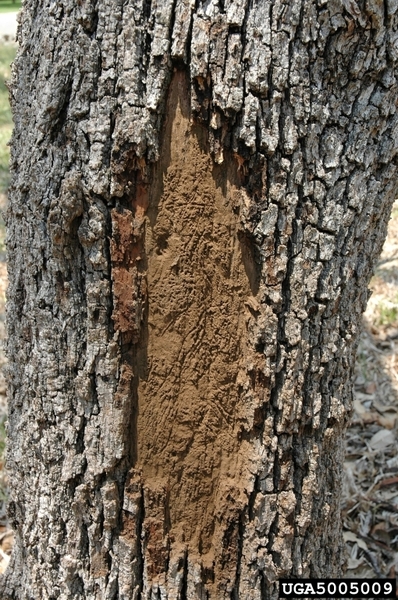
Figure 1. Stromata are mats that bear spores of Biscogniauxia, sloughing off bark. At first, they may appear reddish-brown or tan and powdery.
Ronald F. Billings, Texas A&M Forest Service, Bugwood.org

Figure 2. Over time, stromata may harden and turn black, resembling tar.
Robert L. Anderson, USDA Forest Service, Bugwood.org

Figure 3. Following release of spores, stromata eventually turn gray in color.
Robert Anderson, Bugwood.org
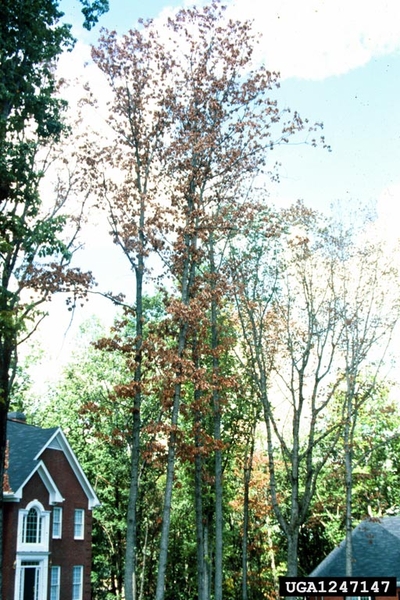
Figure 4. Leaf scorching or wilting is one symptom of Biscogniauxia canker. Other symptoms include branch dieback and canopy thinning.
Terry S. Price, Georgia Forestry Commission, Bugwood.org
Management
Since Biscgoniauxia canker occurs in stressed trees, maintaining tree vigor to prevent the disease is the only effective management tactic. As such, proper tree care is important. Providing adequate water during periods of drought and avoiding stress through factors like soil compaction, root damage, or herbicide injury may help prevent infection. As mentioned, Biscogniauxia is common in forests, so removing symptomatic trees is often not effective in preventing the disease in other trees. Still, one study suggested that prescribed fire may reduce the disease in forests. Researchers examined the incidence of Biscogniauxia across several fire intervals in upland forests of Oklahoma. They found that areas with frequent prescribed fire had the lowest incidence of Biscogniauxia canker (Freeman et al. 2019).
References
Bassett EN, Fenn P. 1984. Latent colonization and pathogenicity of Hypoxylon atropunctatum on oaks. Plant Disease. 68(4):317-319.
Blaedow RA, Heath B, Langston W, Lawing C, Moan J, Trickel R, Oten K. 2013. Forest health handbook. 3rd ed. North Carolina: North Carolina Forest Service. Available from:
Freeman AJ, Hammond WM, Dee JR, Cobb RC, Marek SM, Adams HD. 2019. The effect of prescribed fire on Biscogniauxia infection and δ13C in an upland oak-pine forest. Forest Ecology and Management. 451:117525. doi:10.1016/j.foreco.2019.117525
Tainter FH, Williams TM, Cody JB. 1983. Drought as a cause of oak decline and death on the South Carolina coast. Plant Disease. 67(2):195-197.
Texas A&M Forest Service. n.d. Forest health: Hypoxylon canker.
Vannini A, Paganini R, Anselmi N. 1996. Factors affecting discharge and germination of ascospores of Hypoxylon mediterraneum (De Not.) Mill. European Journal of Forest Pathology. 26(1):12-24.
Publication date: July 29, 2025
Reviewed/Revised: Sept. 30, 2025
N.C. Cooperative Extension prohibits discrimination and harassment regardless of age, color, disability, family and marital status, gender identity, national origin, political beliefs, race, religion, sex (including pregnancy), sexual orientation and veteran status.