
Problem
Herbicide injury caused from dichlobenil.
Symptoms
- Susceptible plants will not emerge if applied prior to weed emergence.
- Susceptible plants will display general decline if applied after weed emergence.
- In woody plants, dichlobenil may cause marginal chlorosis followed by necrosis.
- Susceptible plants may be girdled at soil line, followed by wilting of the entire plant and then it turns brown. This is usually not uniform across the field.
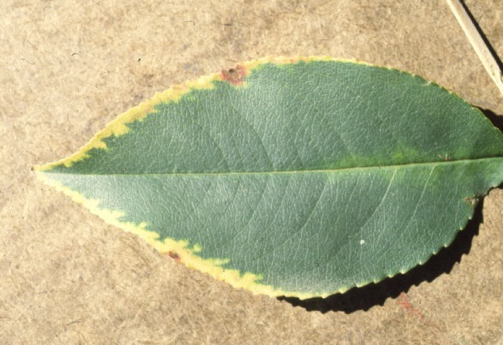
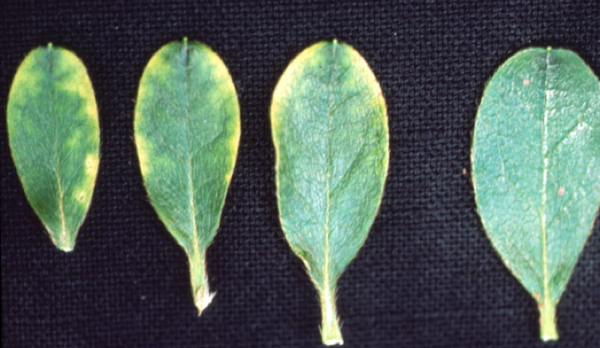
Casoron overdose injury symptoms on Kurume-type azalea (non-treated on the right).
J. Derr, Virginia Tech CC BY-NC-SA 4.0
Plant Entry and Symptom Expression
Dichlobenil inibits cellulose production in the growing points of roots and shoots. It works primarily on below-ground tissues but xylem transport to developing shoots may occur. This herbicide may be applied prior to or after weed emergence as it is absorbed through roots or young shoots. Sensitive woody plants can be girdled at the base, causing an overall decline in plant growth, leading to plant death in particularly sensitive species. Dichlobenil is volatile and may be absorbed by any growing tissue.
Similar Problems
Dichlobenil injury may be confused with symptoms from:
- Marginal chlorosis and necrosis caused by salt injury.
- Triazine herbicides may cause similar marginal chlorosis and necrosis.
- General plant decline due to root damage caused by voles, root rot, severe nutritional deficiency (especially magnesium deficiency).
Herbicide Mode of Action Category
Mode of Action Group 29
Useful Resources
North Carolina Agricultural Chemicals Manual
Southern Region Small Fruit Consortium
Southeastern US Vegetable Crop Handbook
Weed Management in Nurseries, Landscapes & Christmas Trees Information Portal
Herbicide Handbook, Weed Science Society of America
Applied Weed Science: Including the Ecology and Management of Invasive Plants (3rd Edition), Merrill Ross & Carol Lembi, pages 169, 181, 288-290
Publication date: Dec. 14, 2015
Reviewed/Revised: June 25, 2025
N.C. Cooperative Extension prohibits discrimination and harassment regardless of age, color, disability, family and marital status, gender identity, national origin, political beliefs, race, religion, sex (including pregnancy), sexual orientation and veteran status.