
Identification
- Species: Lycorma delicatula (Spotted Lanternfly) is an invasive sap-feeding planthopper from Asia.
- Appearance:
- Egg Masses: Laid in rows, covered with gray, putty-like substance that ages to a brown, flaky surface.
- Nymphs: Early instars are black with white spots; later instars develop red patches with black and white spots.
- Adults: ~1 inch long with gray wings with black spots, red hindwings, and a yellow-black banded abdomen.
- Damage: SLF feeds on sap using piercing-sucking mouthparts, causing wilting, oozing sap, reduced vigor, and sooty mold development from honeydew secretions.

Adult spotted lanternfly
Pennsylvania Department of Agriculture , Bugwood.org
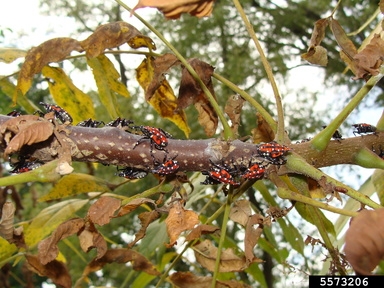
Spotted lanternfly nymphs
Eric R. Day, Virginia Polytechnic Institute and State University, Bugwood.org
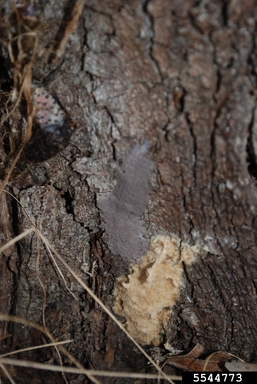
Spotted Lanterfly egg masses
Lawrence Barringer, Pennsylvania Department of Agriculture, Bugwood.org
Seasonal Biology & Life Cycle in North Carolina
- Egg Stage (Sept - Mar):
- Laid in fall on tree trunks, nursery containers, equipment, smooth surfaces.
- Overwinters as eggs.
- Hatching may begin as early as late March to early April.
- Nymph Stages (Apr - Jun):
- Four instars, each lasting ~2-3 weeks.
- Early instars feed on herbaceous plants and small woody stems; later instars move to trees.
- Found in dense clusters. Highly mobile and jump and crawl between hosts.
- Adult Stage (Jun - Nov):
- Adults are strong fliers but often walk or hop short distances.
- Mating starts mid to late summer.
- Egg-laying begins as early as early September and continues into November.
- Adults are most destructive due to large volume of feeding and egg-laying.
Preferred Host Plants in Nurseries
- Primary Host: Tree-of-heaven (Ailanthus altissima).
- Use for monitoring or as trap trees when treated with systemic insecticides.
- High-Risk Nursery Crops:
- Acer (Maple), Betula (Birch), Juglans (Walnut), Quercus (Oak), Salix (Willow), Prunus spp. (Cherry, peach, plum), Malus (Apple)
- Rhus, Populus, Styrax, Ulmus also reported
- Feeding Behavior:
- Prefers trunks and upper stems.
- Congregates in large groups.
- Excretes honeydew which encourages black sooty mold.
Monitoring & Mechanical Management
- Trapping:
- Use sticky bands wrapped around host tree trunks.
- Place traps in April before egg hatch.
- Visual Surveys:
- Inspect trees and plants, focus on trunks and nursery stock containers.
- Inspect newly arrived shipments or equipment from infested regions.
- Egg Mass Scraping:
- From October to March, inspect trees, nursery pots, pallets, vehicles, and buildings.
- Scrape and destroy egg masses using plastic cards or putty knives.
- Sanitation & Exclusion:
- Power-wash incoming shipments and equipment.
- Implement quarantine protocols for stock from SLF-infested counties.
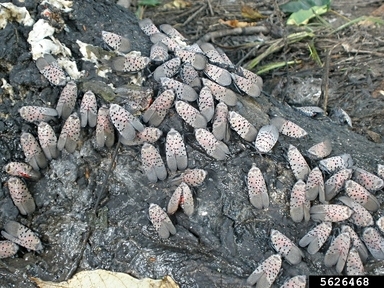
Adult spotted lanternfly aggregation
Ansel Oommen, Bugwood.org
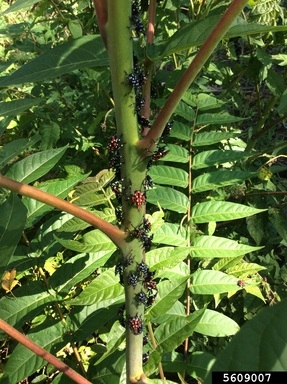
Spotted lanternfly aggregation on tree of heaven
Sara Lalk, Clemson University, Bugwood.org
Management Calendar for North Carolina
| Month | SLF Life Stage | Key Activities |
|---|---|---|
|
Jan – Mar |
Egg masses |
Scrape egg masses, inspect dormant nursery stock and hard surfaces |
|
Apr – May |
Egg hatch, 1st instars |
Deploy sticky bands, begin visual monitoring, apply insecticides if needed |
|
Jun – Jul |
2nd–4th instars |
Intensify monitoring, remove weeds, maintain trap trees, apply foliar sprays if needed |
|
Aug – Sep |
Adult emergence |
Survey adults, apply insecticides if needed |
|
Oct – Nov |
Egg laying |
Locate and treat egg masses, basal bark treatments on Ailanthus trap trees (if applicable) |
|
Dec |
Dormancy |
Plan for next season, clean and store tools and traps, training and record review |
Insecticides Labeled for SLF Use in Nurseries
|
Active Ingredient (example product) |
Application Method | Use Sites / Notes |
|---|---|---|
| Dinotefuran (e.g. Safari® 20 SG) | Foliar spray; soil/media drench; field drench | Container and in-ground ornamentals in nurseries; Section 2(ee) label for SLF use |
| Bifentrin (Talstar S Select, OnyxPro) | Foliar application | Ornamentals in greenhouses, nurseries (non-bearing fruit/nut trees); Section 2(ee) for SLF |
| Imidacloprid products (e.g. ImidaStar 2L T&O, Xytect, ArmorTech IMD 2SC, etc.) | Foliar spray; soil drench/injection (product-dependent) | Ornamentals and non-bearing fruit/nut trees; some require Section 2(ee) for SLF |
| Dinotefuran (e.g. Transtect, Zylam) | Basal bark spray (for Ailanthus only) | SLN (Section 24(c)) label for use on tree-of-heaven in SLF management |
| Soybean oil (50% solution) | Spot treatment on egg masses | Used by USDA SLF Program; suitable for treating egg masses on nursery stock and trees |
Implementation Notes
- Section 2(ee) / SLN Labels: These are special or supplemental labels permitting off-label but legal applications specifically for SLF.
- Application Methods:
- Foliar sprays are effective on nymphs and adults.
- Soil drenches/injections: longer protection for high-risk or trap trees.
- Host-Specific Strategy: Dinotefuran bark spray is approved only for tree-of-heaven (trap‑tree use) and should not be used broadly.
- Environmental Safety: Soybean oil offers a less-toxic option for egg mass control.
This fact sheet is designed for use in North Carolina nursery operations and includes life cycle, host plant risk, monitoring tools, calendar-based management, and registered insecticide options for SLF. Always follow label instructions and consult state guidance for updates.
Publication date: Aug. 8, 2025
N.C. Cooperative Extension prohibits discrimination and harassment regardless of age, color, disability, family and marital status, gender identity, national origin, political beliefs, race, religion, sex (including pregnancy), sexual orientation and veteran status.
NC Cooperative Extension prohíbe la discriminación por raza, color, nacionalidad, edad, sexo (incluyendo el embarazo), discapacidad, religión, orientación sexual, identidad de género, información genética, afiliación política, y estatus de veteran.
The use of brand names in this publication does not imply endorsement by NC State University or N.C. A&T State University of the products or services named nor discrimination against similar products or services not mentioned.
Recommendations for the use of agricultural chemicals are included in this publication as a convenience to the reader. The use of brand names and any mention or listing of commercial products or services in this publication does not imply endorsement by NC State University or N.C. A&T State University nor discrimination against similar products or services not mentioned. Individuals who use agricultural chemicals are responsible for ensuring that the intended use complies with current regulations and conforms to the product label. Be sure to obtain current information about usage regulations and examine a current product label before applying any chemical. For assistance, contact your local N.C. Cooperative Extension county center.
N.C. Cooperative Extension prohibits discrimination and harassment regardless of age, color, disability, family and marital status, gender identity, national origin, political beliefs, race, religion, sex (including pregnancy), sexual orientation and veteran status.