
Description and Biology
Leaf tiers are caterpillars that create refuges by webbing together terminal leaves (Figure 1) or by folding over a single leaf (Figure 2). All leaf tiers undergo egg, larva (or caterpillar), pupa, and adult (or moth) stages of development, and the leaf tying behavior only occurs while they are caterpillars. Leaf tiers can skeletonize leaves and chew holes in fruits and flower buds, typically leaving behind yellow or brown droppings, called frass (Figure 3). Three species that feed on highbush blueberries (Vaccinium corymbosum) in North Carolina are the oblique-banded leaf roller (Choristoneura rosaceana), blueberry leaf tier (Acleris curvalana), and gold striped leaf tier (Machimia tentoriferella). The caterpillars of these three species begin appearing between April and May in North Carolina, but each has unique overwintering strategies and larval development periods. Alternative hosts can include other cultivated and ornamental hardwoods such as cherry and apple.
Choristoneura rosaceana eggs are dull, greenish yellow, and laid in flattened, overlapping masses of up to 200 on leaves in the spring. Young caterpillars are dull green with a solid black head, while older caterpillars have a cinnamon-brown head, and are between ¾ – 1 inch long (Figure 4). After hatching, they first create a protective webbing and skeletonize lower leaf surfaces before moving to terminal developing leaves, tying them together to create a protective case for pupation. One to three generations can be expected each year in North Carolina, depending on the weather conditions. Adults will emerge between April and June, and older larvae will overwinter inside a silken cocoon.
Eggs of A. curvalana overwinter in dried leaf litter under blueberry plants and must experience a freeze to complete development and hatch. Young caterpillars have cream colored bodies and black heads. After hatching, A. curvalana caterpillars burrow into closed flower buds to feed and grow, typically leaving behind yellow frass. When nearing maturity, caterpillars will develop a more cinnamon-brown colored head (Figure 5) and shift to feeding on terminal leaf growth, as well as webbing leaves together to form shelters. In June, pupation will occur inside these shelters and adult moths emerge in late-June through July.
Machimia tentoriferella caterpillars are pale green with two faint whitish bands that follow the length of their bodies (Figure 6). They have a single generation per year, but not much is known about how these moths overwinter. Adults can be found in the mountains and piedmont region as late as December, suggesting that they may overwinter as either moths or eggs. After hatching, larvae will spin silken shelters on either side of a leaf to protect themselves while they feed. As they grow, M. tentoriferella caterpillars will leave their shelters at night to feed. In August or September, caterpillars begin to pupate inside a downward-folded leaf for around three weeks before emerging as moths in the fall.

Figure 1: Terminal leaves are often tied together and eaten by leaf tier caterpillars.
Photo by Bill Cline
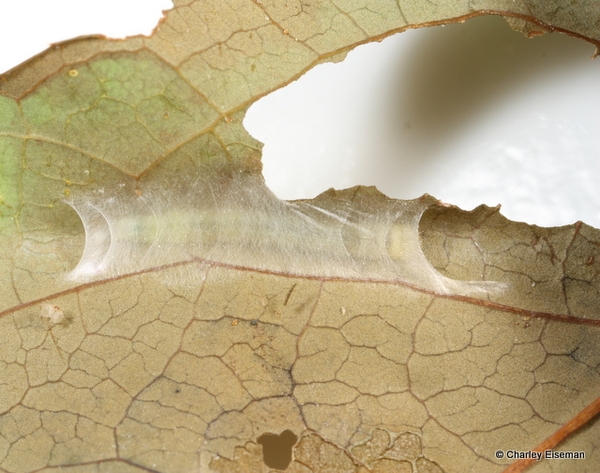
Figure 2: Machimia tentoriferella in a leaf fold protected by webbing.
Photo by Charley Eiseman
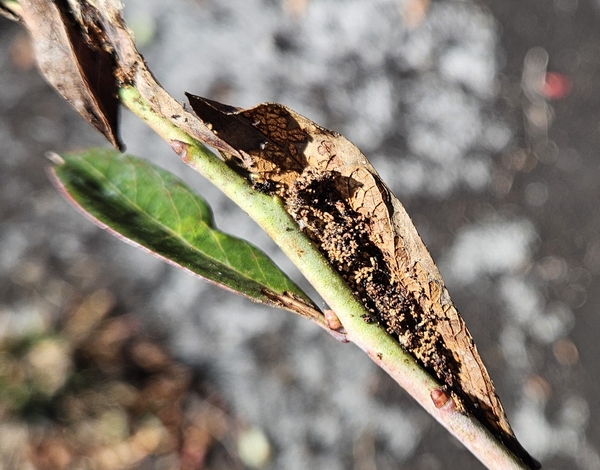
Figure 3: A blueberry leaf tied to its stem, filled with frass likely from a leaf tier caterpillar.
Photo by Bill Cline
Distribution
Leaf tiers are common in North Carolina; however, they rarely cause severe damage, and some species have been found only in certain counties. As the most widespread, C. rosaceana can be found from as far west as Swain County to as far east as Pamlico County. Machimia tentoriferella has been noted primarily in the mountains and piedmont regions, but has one recorded observation in Camden County. Acleris curvalana is the least observed and has only been recorded in Haywood, Madison, Buncombe, Yancey, Brunswick, and Carteret Counties.
Scouting and Management
Scouting for leaf tiers can begin as early as April. New spring leaf growth and terminal clusters should be examined for tightly rolled leaves and damage from feeding. Light colored eggs are laid in patches and rows. Pheromone traps can be used to monitor adult emergence and to determine when populations are at their peak, but only in situations where severe infestations are suspected. Removing their overwintering sites in the fall, including rolled leaves and leaf litter below plants during pruning operations, can help reduce emerging populations in the spring.
Sprays for leaf rollers are rarely necessary, and should only be used when there is a large number of larvae or egg masses early in the spring, or if excessive damage is noticed. The microbial insecticides Bacillus thuringiensis (or Bt) is effective against the larval stage of leafrollers, especially when they are newly hatched and less than ½ inch long. Spinosad is another widely available and effective insecticide that is labeled for use against leaf rollers in blueberries. Both of these products are available for conventional and organic growers. However, spinosad is harmful to bees and should not be used while plants are in bloom. See the Additional Resources section for further chemical recommendations.
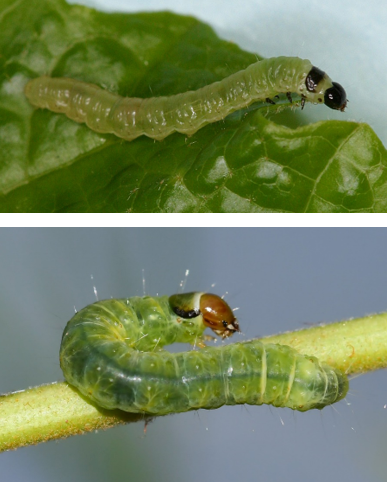
Figure 4: Early (top) and late (bottom) larvae of C. rosaceana, also known as the oblique-banded leafroller.
Photo by Todd M. Gilligan and Marc E. Epstein (top) and Royal Tyler (bottom)

Figure 5: Older larvae of A. curvalana, also known as the blueberry leaf tier. Early larvae look similar to early larvae of C. rosaceana.
Photo by Jocelyn, "osmeterium" on iNaturalist

Figure 6: Larvae of M. tentoriferella, also known as the gold striped leaf tier.
Photo by Jason M. Crockwell
Biological Control
Encouraging natural enemies of leaf rollers can help keep caterpillar populations at nondamaging levels. Generalist natural enemies, such as spiders, brown lacewing larvae (Hemerobiidae), assassin bugs (Reduviidae), and birds, consume leaf roller eggs and larvae. A number of wasps (Brachonidae and Ichneumonidae) and flies (Tachinidae) parasitize leaf rollers and tiers as well. Avoiding broad-spectrum insecticides that could knock down beneficials, such as these, may assist in managing leaf roller populations.
Additional Resources
Choristoneura rosaceana (Harris, 1841) - Oblique-banded Leafroller Moth
Acleris curvalana (Kearfott, 1907) - Blueberry Leaftier Moth
Machimia tentoriferella Clemens, 1860 - Gold-striped Leaftier Moth
Publication date: Jan. 4, 2026
N.C. Cooperative Extension prohibits discrimination and harassment regardless of age, color, disability, family and marital status, gender identity, national origin, political beliefs, race, religion, sex (including pregnancy), sexual orientation and veteran status.