
Introduction
Crape Myrtle Bark Scale (CMBS), Acanthococcus lagerstroemiae, is an exotic insect pest that feeds only on crape myrtles (Lagerstroemia spp.). CMBS infestations can damage the health and appearance of crape myrtles. CMBS has spread throughout the southeastern US including North Carolina where it has become a permanent pest to consider in nursery IPM.
Biology
Adult CMBS females are small, flat, and oval-shaped insects found on the bark of crape myrtles. They are in a group called felt scales. They have white or gray waxy covering and produce fluffy white egg cases that look like cotton swabs. Nymphs live on bark amongst the adults and are pink or orange with varying amounts of white wax. CMBS has at least two generations each year, likely more in warmer regions and in urban areas. In many parts of NC all life stages are found throughout the year.
CMBS feeds on the phloem sap of crape myrtles using their piercing-sucking mouthparts. As they feed, they excrete honeydew, which is a sugary liquid that promotes the growth of sooty mold, leading to blackened, unsightly foliage.
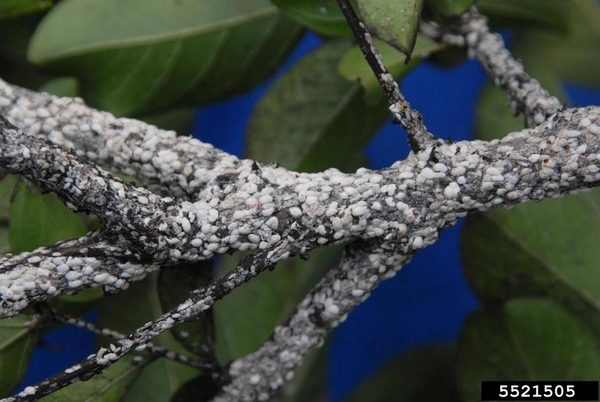
Crape myrtle bark scales.
Jim Robbins, Univ. of Ark. CES, Bugwood.org
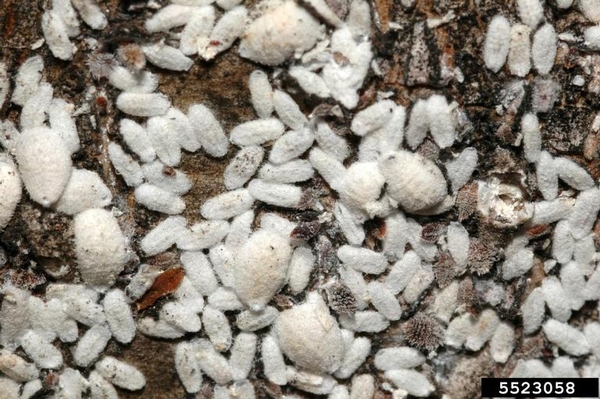
Crape myrtle bark scales.
Gary Brooks, Bayer CropScience, Bugwood.org
Damage
Heavy infestations can reduce growth and flowering of crape myrtle trees, resulting in weakened and unhealthy plants. The honeydew excreted by CMBS is a substrate for sooty mold growth. This black, powdery mold covers leaves, stems, and other surfaces.
Management
Inspect crape myrtle trees for signs of CMBS infestation, such as white to gray fluff or wax on branches and trunks.
Horticultural oils and insecticidal soaps can reduce CMBS abundance especially when crawlers (newly hatched nymphs) are present. This can be an effective tactic in fall and winter after leaves fall. Oil will smother all life stages and reduce densities on trees.
Systemic neonicotinoid insecticides can be applied to the soil or potting media to provide longer management. Neonicotinoids will also reduce Japanese beetle feeding and crape myrtle aphids. Neonicotinoid insecticides may contaminate flower parts that bees and other beneficial insects visit. Some insecticide labels prohibit application on flowering plants.
Natural predators, such as ladybugs and lacewing larvae, can help reduce CMBS populations. Pyrethroids and other contact insecticides can kill these beneficial insects and lead to scale insect and spider mite outbreaks.
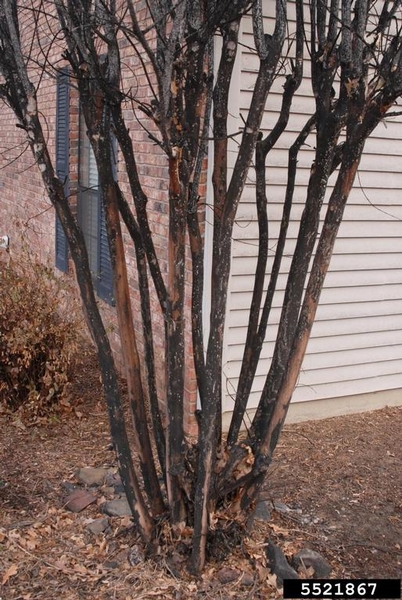
Crape myrtle bark scale and sooty mold.
Jim Robbins, Univ. of Ark. CES, Bugwood.org
Table of insecticide cclasses available for soft scale management and example products.
| Active Ingredient | Example Trade Names | IRAC Code |
| Acephate | Orthene, Lepitect | 1B |
| Bifenthrin | Menace GC, Onyx L, Talstar S | 3A |
| Imidacloprid | Marathon, Malice, MalleT | 4A |
| Thiamethoxam | Flagship 25WG | 4A |
| Dinotefuran | Safari 20 SG | 4A |
| Clothianidin | Sharda Clothianidin 50% WDG | 4A |
| Abamectin | various | 6 |
| Pyriproxyfen | Distance, Fulcrum | 7C |
| Buprofezin | Talus 70DF | 16 |
| Cyclaniliprole + Flonicamid | Pradia | 28 + 29 |
| Flonicamid | Aria | 29 |
| Neem oil | Triact 70, Trilogy | UN |
| Horticultural oil | Ultra Pure Oil, SuffOil-X | UN |
| Azadirachtin | Trilogy, Triact 70 | UN |
| Potassium salts of fatty acids | M-Pede | UN |
Publication date: Aug. 25, 2025
N.C. Cooperative Extension prohibits discrimination and harassment regardless of age, color, disability, family and marital status, gender identity, national origin, political beliefs, race, religion, sex (including pregnancy), sexual orientation and veteran status.
Recommendations for the use of agricultural chemicals are included in this publication as a convenience to the reader. The use of brand names and any mention or listing of commercial products or services in this publication does not imply endorsement by NC State University or N.C. A&T State University nor discrimination against similar products or services not mentioned. Individuals who use agricultural chemicals are responsible for ensuring that the intended use complies with current regulations and conforms to the product label. Be sure to obtain current information about usage regulations and examine a current product label before applying any chemical. For assistance, contact your local N.C. Cooperative Extension county center.
N.C. Cooperative Extension prohibits discrimination and harassment regardless of age, color, disability, family and marital status, gender identity, national origin, political beliefs, race, religion, sex (including pregnancy), sexual orientation and veteran status.