
Plan Before Planting
Many of the most important steps toward having a successful lawn are taken before any planting begins. Plan for easy maintenance and pleasing appearance. Turfgrass will not grow well in very shady spots or in poorly drained areas, and it will be hard to maintain on steep slopes.
Select the right turfgrass for the site. No one type of turfgrass is best suited to all situations. The turfgrass you choose to grow should be matched to the region and climate and suitable for the intended use and desired appearance. Some turfgrasses are more resistant to diseases than others.
If possible, plant the lawn during the season best suited to the variety selected. Employ proper planting density to establish a good stand, and water seeds to encourage emergence. After seedlings emerge, they will need to be watered, fertilized, and mowed at the proper time to ensure adequate early growth. These establishment practices can influence the growth and development of your lawn for many years to come.
Select the Right Turfgrass
Planting an improved, adapted grass is one of the best ways to avoid pest problems. Both cool-season and warm-season turfgrasses are grown in North Carolina, where environmental conditions vary greatly (Figure 1). The climate in the mountains is similar to that of the northeastern United States, where cool-season turfgrasses such as fescue and bluegrass are best adapted. The coastal plain has a climate suitable for warm-season grasses such as centipedegrass, zoysiagrass, or bermudagrass. The transition zone in the piedmont is often too cold in the winter for warm-season turfgrasses and too hot in the summer for cool-season turfgrasses to grow well. The microclimates of sites in the transition zone should be considered when selecting a turfgrass for a particular lawn. Warm-season turfgrasses are best adapted for lawns with sunny southwest exposures, whereas cool-season turfgrasses are best adapted for lawns with northern exposures. Evaluation of the climate or the exposure of the planting area will help you determine the best type of turfgrasses to grow to avoid severe disease problems in the future.
IPM Tip—Turfgrass Mixtures
Selecting adapted, disease-resistant cultivars is the best method for controlling disease.
Use a blend of several cultivars of cool-season turfgrasses to reduce damage from diseases. A blend of tall fescue cultivars or tall fescue mixed with Kentucky bluegrass will increase the resistance of the lawn as a whole to damage from common turfgrass diseases.
Warm-season turfgrasses are generally not mixed, although bermudagrass blends are available.
In addition to regional climate factors, the characteristics of each site and your goals for it will determine which types of turfgrass are appropriate. Choose an adapted turfgrass that best suits your preferences for color, density, and texture. Where heavy traffic is expected, use a tough, aggressive, wear-tolerant turfgrass. Consider the amount of time, effort, and money you are willing to put into maintenance. Turfgrasses are best able to fend off pests when they are healthy and not struggling to survive in stressful environmental conditions.
Cool-season turfgrasses grow best in the spring and fall and less actively in the summer. They stay reasonably green in the winter. Tall fescue, Kentucky bluegrass, fine fescue, and perennial ryegrass are common types of cool-season turfgrasses. Warm-season turfgrasses are slow to green up in the spring, grow well in the summer, and go dormant after the first heavy frost.
Table 1 contains information about the characteristics and requirements of various turfgrasses grown in North Carolina. Study the chart to help select the appropriate turfgrass for your region and the intended use of the lawn. Table 2 contains additional information on characteristics and requirements of specific warm-season turfgrasses.
|
Turfgrass |
Adaptation |
Appearance |
Preferred Planting season |
Rate of establishment a |
Maintenance |
||||||||||||||||
|---|---|---|---|---|---|---|---|---|---|---|---|---|---|---|---|---|---|---|---|---|---|
|
Shade |
Heat |
Cold |
Drought |
Wear |
Color |
Texture |
Cutting height (inches) |
Fertilizer 1,000 sq ft |
Mowing Frequency b |
||||||||||||
| Mountains |
Kentucky bluegrass |
G |
F |
VG |
G |
G |
med–dark |
medium |
fall |
moderate |
1.5–2.5 |
2.0–3.0 |
medium |
||||||||
|
Kentucky bluegrass/fine fescue c |
G |
F |
VG |
G |
F |
med–dark |
fine–med |
fall |
moderate |
1.5–2.5 |
2.0–3.0 |
medium |
|||||||||
|
Kentucky bluegrass/tall fescue c |
G |
G |
VG |
VG |
VG |
med–dark |
med–coarse |
fall |
fast |
2.5–3.5 |
2.0–3.0 |
high |
|||||||||
|
Kentucky bluegrass/tall fescue/fine fescue |
VG |
G |
VG |
VG |
VG |
med–dark |
med–coarse |
fall |
fast |
2.5–3.5 |
2.0–3.0 |
high |
|||||||||
|
Kentucky bluegrass/ |
G |
F |
VG |
G |
VG |
med–dark |
medium |
fall |
fast |
2.0–3.0 |
2.5–3.5 |
med–high |
|||||||||
|
Tall fescue c |
G |
G |
VG |
VG |
VG |
medium |
med–coarse |
fall |
fast |
2.5–3.5 |
2.5–3.5 |
high |
|||||||||
| Piedmont |
Bermudagrass (common) c |
VP |
VG |
VP |
E |
E |
medium |
medium |
spr/sum |
fast |
0.75–2.0 |
4.0–4.5 |
med–high |
||||||||
|
Bermudagrass (hybrid) |
VP |
VG |
P |
E |
E |
light–dark |
fine–med |
spr/sum |
fast |
0.75–2.0 |
3.0–6.0 |
high |
|||||||||
|
Bahiagrass c |
G |
G |
P |
E |
G |
med–dark |
coarse |
spr/sum |
moderate |
2.0–4.0 |
1.0 |
high |
|||||||||
|
Centipedegrass c |
G |
G |
P |
G |
P |
light |
coarse |
spr/sum |
slow |
1.0–2.0 |
1.0–2.0 |
low |
|||||||||
|
Kentucky bluegrass/tall fescue c |
G |
G |
VG |
VG |
VG |
med–dark |
med–coarse |
fall |
fast |
2.5–3.5 |
2.0–4.0 |
high |
|||||||||
|
Kentucky bluegrass/tall fescue/fine fescue |
VG |
G |
VG |
VG |
VG |
med–dark |
med–coarse |
fall |
fast |
2.5–3.5 |
2.0–4.0 |
high |
|||||||||
|
Tall fescue c |
G |
G |
VG |
VG |
VG |
medium |
med–coarse |
fall |
fast |
2.5–3.5 |
2.5–3.5 |
high |
|||||||||
|
St. Augustinegrass c |
VG |
VG |
P |
G |
P |
med–dark |
coarse |
spr/sum |
fast |
2.0–4.0 |
2.0–3.0 |
med–high |
|||||||||
|
Zoysiagrass c |
G |
VG |
F–G |
E |
G |
med–dark |
fine–med |
spr/sum |
very slow |
0.75–2.0 |
1.0–3.0 |
low–med |
|||||||||
| Coastal Plain |
Bermudagrass (common) c |
VP |
VG |
VP |
E |
E |
medium |
medium |
spr/sum |
fast |
0.75–2.0 |
3.0–4.5 |
med–high |
||||||||
|
Bermudagrass (hybrid) |
VP |
VG |
P |
E |
E |
light–dark |
fine |
spr/sum |
fast |
0.75–2.0 |
3.0–6.0 |
very high |
|||||||||
|
Bahiagrass c |
G |
G |
P |
E |
E |
med–dark |
coarse |
spr/sum |
moderate |
2.0–4.0 |
1.0 |
high |
|||||||||
|
Centipedegrass c |
G |
G |
P |
G |
P |
light |
coarse |
spr/sum |
slow |
1.0–2.0 |
1.0–2.0 |
low |
|||||||||
|
St. Augustinegrass c |
VG |
VG |
P |
G |
P |
med–dark |
coarse |
spr/sum |
fast |
2.0–4.0 |
2.0–4.0 |
med–high |
|||||||||
|
Tall fescue c |
G |
G |
VG |
VG |
VG |
medium |
med–coarse |
fall |
fast |
2.5–3.5 |
2.0–4.0 |
high |
|||||||||
|
Zoysiagrass c |
G |
VG |
F–G |
E |
G |
med–dark |
fine–med |
spr/sum |
very slow |
0.75–2.0 |
2.0–4.0 |
low–high |
|||||||||
Note: Some improved cultivars are better adapted and more pleasing in appearance than the comparison rating for a given turfgrass.
Key: E = excellent; VG = very good, G = good; F = fair; P = poor; VP = very poor ↲
a Establishment rate is dictated by planting dates, seedling and planting rate, intensity of culture, and environment. Sodding will result in fast establishment. ↲
b Mowing frequency is dictated by season, intensity of management, and use. ↲
c Can be seeded. ↲

Figure 1. Climatic regions in North Carolina.
Cool-Season Turfgrass Cultivars
The performance of numerous cultivars of cool-season turfgrasses, including tall fescue, Kentucky bluegrass, and fine fescue, have been tested in North Carolina. Due to the great number of suitable cultivars, lists of the better-performing cultivars can be found separate from this publication.
Note that companies often blend multiple cultivars together for sale in the retail market but use simple product names to enhance brand recognition, which is especially true with tall fescue. The combination of grasses is often recommended because there is no one turfgrass that will perform well under all conditions. When you are shopping for tall fescue seed, note that the name on the front of the bag may not represent or identify the cultivars that make up the product. To add to the confusion, the cultivars and the percentage of each cultivar within the bag of a specific product may change from year to year, but the product name often remains unchanged to maintain brand recognition. However, the bags are required to list the cultivars in the blend and the percentage of each cultivar by weight within the bag, so closely inspect the labels for this information. It may not be easy to find a bag that contains only cultivars from our recommended lists. We suggest choosing a product in which at least 50% of the contents consist of NC State's recommended cultivars. The higher the percentage, the greater the chances of obtaining a sustainable lawn.
Warm-Season Turfgrass Cultivars
Because most warm-season grasses are vegetatively propagated, the development cycle is considerably longer. As a result, introducing new warm-season cultivars takes more time than introducing cool-season cultivars. This extended development timeline helps explain why Tifway bermudagrass (commonly known as Tifway 419), released in 1960, and Meyer zoysiagrass, released in 1951, remain widely sold. There are newer cultivars with significantly improved traits (Table 2), but widespread adoption of these improved cultivars has lagged, accelerating only in recent years.
|
Turfgrass Species |
Cultivars |
Comments |
|---|---|---|
|
Bermudagrass |
Common-types (many are available) |
Can be seeded. |
|
Tifway 419 TifTuf Premier Pro Celebration TifSport TifGrand GN-1
|
Requires frequent mowing. Must be vegetatively planted. TifTuf is the most drought tolerant. |
|
|
Tahoma 31 Latitude 36 Northbridge |
Cold-tolerant. Better suited to western piedmont than other bermudagrass cultivars. |
|
|
Tifdwarf Sunday |
Not recommended for home lawn use because of intensive management requirements. |
|
|
Zoysiagrass |
Cavalier Emerald Geo Leisure Time Meyer (Amazoy) Zeon Zorro |
Emerald has fine texture. Meyer is the most cold-tolerant. |
|
Crowne El Toro Empire Icon Innovation Jamar Lobo Palisades |
Quick to establish from plugs. |
|
|
Compadre Zenith |
Generally purchased as sod, but can be seeded. Seed supply is generally limited. |
|
|
Centipedegrass |
Common TifBlair |
|
|
St. Augustinegrass |
Raleigh Sola |
Cold-tolerant throughout the piedmont. |
|
Common Palmetto Mercedes |
May not have sufficient cold tolerance. |
Note: Because the release and evaluation of turfgrass cultivars change rapidly, contact an Extension turfgrass specialist for the latest cultivar test results.
Plant at the Best Time
Table 3 provides planting times and rates. Cool-season turfgrasses are best seeded from mid-August to mid-October, depending on location. Seeding after these dates increases the likelihood of poor germination or seedling failure caused by cold temperatures. Spring seeding is less satisfactory because seedlings do not have time to become well established before hot weather begins.
If spring seeding is necessary, do it as early as possible to take advantage of cool weather and the absence of weeds. Remember, many weeds grow best during this time of year too. Seeding cool-season turfgrasses after March generally results in a need to reseed the following fall.
Annual ryegrass can be used as a temporary cover until fall. However, it is better to seed the desired cool-season grasses and renovate in the fall. This may require the assistance of a professional. Install cool-season turfgrass sod at any time during the cooler portions of the growing season when the ground is not frozen.
Warm-season turfgrasses may be seeded or planted vegetatively (by sod, sprigs, or plugs) from March through July. Planting dormant vegetative material (sod or plugs) provides a good chance of success. You can obtain vegetative planting material from a local sod producer. To reduce the chance of winter injury, plant before late summer so that the turfgrass can become well established before winter. Sod will not produce roots unless the soil temperature stays above 55ºF for several weeks.
|
Region |
Turfgrass |
Planting Datea |
Planting Rate/1,000 square feet |
|
|---|---|---|---|---|
|
Seedsb (lb) |
Sprigging Ratec (bushels) |
|||
|
Mountains |
Kentucky bluegrass |
Aug 15–Sep 1 |
1.5–2.0 |
|
|
Kentucky bluegrass/fine fescue |
Aug 15–Sep 1 |
1.5 + 1.5 |
N/A |
|
|
Kentucky bluegrass/tall fescue |
Aug 15–Sep 1 |
1.0 + 5.0 |
N/A |
|
|
Kentucky bluegrass/ tall fescue/fine fescue |
Aug 15–Sep 1 |
1.0 + 5.0 +1.0 |
N/A |
|
|
Kentucky bluegrass/ perennial ryegrass |
Aug 15–Sep 1 |
1.5 + 1.0 |
N/A |
|
|
Tall fescue |
Aug 15–Sep 1 |
6.0 |
N/A |
|
|
Piedmont |
Bermudagrass (common) |
Apr–July |
1.0–2.0 |
3.0–10 |
|
Bermudagrass (hybrid) |
Apr–July |
N/A |
3.0–10 |
|
|
Bahiagrass |
March–June |
5.0 |
N/A |
|
|
Centipedegrass |
March–July |
0.25–0.50 |
N/A |
|
|
St. Augustinegrass |
Apr–July |
N/A |
1.0 |
|
|
Kentucky bluegrass/tall fescue |
Sep 1–Sep 15 |
1.0 + 5.0 |
N/A |
|
|
Kentucky bluegrass/tall fescue/ fine fescue |
Aug 15–Sep 15 |
1.0 + 5.0 +1.0 |
N/A |
|
|
Tall fescue |
Sep 1–Oct 1 |
6.0 |
N/A |
|
|
Zoysiagrass* |
Apr–July |
1.0–2.0 |
3.0–10d |
|
|
Coastal Plain |
Bermudagrass (common) |
Apr–July |
1.0–2.0 |
3.0–10 |
|
Bermudagrass (hybrid) |
March–July |
N/A |
3.0–10 |
|
|
Bahiagrass |
March–June |
5.0 |
N/A |
|
|
Centipedegrass |
March–July |
0.25–0.50 |
N/A |
|
|
St. Augustinegrass |
Apr–July |
N/A |
1.0 |
|
|
Tall fescue |
Sep 15–Oct 15 |
6.0 |
N/A |
|
|
Zoysiagrass |
March–July |
1.0–2.0 |
3.0–10d |
|
N/A = not applicable ↲
a Optimum date of planting. Seeding beyond these dates increases the chance of failure. Sod consisting of cool-season turfgrasses can be installed at any time when the ground is not frozen. Warm-season turfgrasses can be installed as long as soil temperature exceeds 55ºF. ↲
b Pounds of uncoated seed per 1,000 square feet. If seeds are clay-coated, adjust seeding rates proportionately. If the amount of clay coating decreases the content of the bag by 50%, more seed will be need to be added to the seeding rate. For example, if the package contains 50% coated seed and the uncoated seeding rate is 6 pounds, you'll need to increase seeding rate to 12 pounds to compensate for the coated seed. ↲
c Bushels of sprigs per 1,000 square feet. (1 square yard of turf pulled apart is equivalent to 1 bushel of sprigs.) ↲
d Often plugged using 3 square yards of sod cut into 2- to 3-inch squares on 12- to 18-inch centers to plant 1,000 square feet. ↲
Prepare the Site
Another key to a successful organic lawn is careful preparation of the site. A healthy lawn needs a rooting environment favorable to soil organisms and turfgrass roots. In an organic lawn, weed control is best accomplished by following the steps listed below:
-
If topsoil at the original site is free of weeds, insist on saving it. If grading is needed, remove the topsoil (usually 4 to 8 inches) and stockpile it nearby. Topsoil imported from other areas will contain weed seeds. Covering topsoil with a dark plastic cover for several weeks will kill many weeds but may not kill all seeds.
-
Do not allow the builder to use the lawn site as a dumping ground. Paint, lumber, and concrete can be harmful to turfgrasses and other landscape plants.
-
Install tile drain in poorly drained areas. Get professional advice about the type of drain and installation.
-
Build protective wells to save trees if the final grade is to be appreciably higher than the present level.
-
Shape the underlying subsoil to the desired contour and redistribute topsoil uniformly above the subsoil. A 1% to 2% slope is needed for proper drainage away from buildings.
-
Water the area to enhance settling. Fill areas that settle unevenly with soil to avoid standing water. Insist that any topsoil added to the site be free of weeds.
For heavy clay soils or very sandy soils, mix 1 to 2 cubic yards of organic matter (compost, peat moss, or leaf mulch) per 1,000 square feet into the top 6 to 8 inches of soil. Clay soils are prone to compaction and require frequent aerification.
Soil acidity or nutrient levels that are too high or too low will limit plant growth and the action of beneficial soil microbes. On sites where trees have been growing for many years, the pH may be 4.0 or lower. Turfgrasses used in North Carolina grow best in soils with a pH near 6.5, except centipedegrass, which prefers a pH near 5.5. Note that a soil with a pH of 5.5 is 10 times more acidic than a soil with a pH of 6.5.
The pH of the soil determines the availability of soil nutrients to plants. Because lime and phosphorus move very slowly through the soil, these amendments should be incorporated to a depth of 6 to 8 inches before planting. Failure to adjust soil pH and phosphorus levels throughout the rooting zone prior to seeding can result in shallow rooting, poor drought tolerance, and inefficient uptake of nutrients. Overapplication of lime or nutrients can also inhibit plant growth, so it is important to apply the correct amount for your soil.
Even a well-adapted turfgrass can suffer from disease if the soil has not been adequately prepared. Most North Carolina soils have low pH and low phosphorus levels, especially if the area was wooded just before the lawn was planted. Soil tests should be taken at the site early enough to discover how much lime and phosphorus should be incorporated before planting. The depth of incorporation of lime and phosphorus determines the depth of rooting of the turfgrass. A deep, healthy root system results in a healthy plant that can better tolerate environmental stresses, including pests.
Test the soil before applying lime or fertilizer. The only way to determine whether the acidity (pH) and nutrient levels are adequate for the turfgrass you plan to grow is to have a soil test analyzed by a reputable soil-testing laboratory. Local N.C. Cooperative Extension centers have sampling boxes and submission forms for mailing samples to the North Carolina Department of Agriculture & Consumer Services (NCDA&CS) Soil Testing Laboratory. It may take several weeks (or longer in late winter and early spring) to receive results of a soil test, so plan ahead. The soil test will indicate the proper amount of lime and nutrients required per 1,000 square feet for the type of turfgrass you wish to grow. General recommendations are provided in Table 4.
How to Prepare a Soil Sample
For new lawns, sample 10 to 12 locations to a depth of approximately 4 inches (the depth you expect your tiller to reach). Remove a uniform slice with a shovel from each location or use a soil-sampling tube. Combine these samples in a clean plastic bucket and mix thoroughly. About 1 cup of soil from the combined sample is needed for analysis. For a site with uniform soils, only one combined sample may be needed. If the soil varies greatly in color or texture, additional combined samples should be taken from each distinct soil area.
For established lawns, the recommended sampling depth is 3 inches. This shallower sampling depth will detect problems in the rooting zone more accurately than a deeper sample.
Rake the site to establish a smooth, level final grade. Soil particles should be no larger than marble size, and pea-gravel size is even better. Hand-raking is the best way to level the soil and work out hills and hollows. Allow time for rain or watering to settle the soil, then roll lightly with a lawn roller to firm the soil before seeding. Before seeding, hand-rake again to break up the crusty surface. Protect water quality by sweeping any fertilizer off paved surfaces and back onto the turf area.
IPM Tip—Limit Nitrogen (N)
To decrease susceptibility of lawn grasses to pests and environmental stress, avoid applying more than 0.5 pounds of nitrogen per 1,000 square feet to cool-season turfgrasses in June, July, and August. Likewise, avoid high-nitrogen fertilization of warm-season turfgrasses in the fall or winter.
Planting Methods
Lawns can be established with seed or vegetative material. Buying poor-quality plants or seed often results in less-than-satisfactory performance by the turfgrass and pest problems. Selection is especially important when establishing a lawn. Read the information on the seed label carefully, and make sure you purchase seed with no noxious weed seed and low levels of other crop seed. One way to be sure you have seed or planting material that is true to type, free of noxious weed seed, and contains low levels of other crop seed is to purchase certified seed or sod. “Certified” indicates that the seed or plants have met certain standards to ensure high quality and low levels of contaminants.
Seeding is usually the most economical method of establishing turfgrasses. Both rotary and drop spreaders work well (see Appendix B for operating and calibration instructions). Apply half of the seed in one direction and the other half moving at right angles to the first pass. Lightly cover the seed by hand-raking or dragging with a section of chain link fence. Roll the soil lightly to firm the surface and provide good seed-to-soil contact.
|
Timing |
Product |
Amount |
Comments |
|---|---|---|---|
|
During site preparation |
Lime |
Follow soil test recommendations. |
Apply uniformly with a rotary or drop spreader. Apply half of the fertilizer in one direction and the second half at right angles to the first pass. Incorporate lime and nutrients into the top 6 to 8 inches of the soil using a rototiller. |
|
Phosphorus (P2O5) |
|||
|
Potassium (K2O) |
|||
|
Nitrogen (N) |
1.0 lb N/1,000 sq ft. |
Soil tests do not routinely analyze for soil N. |
|
|
Surface application at time of planting |
Starter-type fertilizer (ratio of 1-2-2) |
0.5 lb N/1,000 sq ft. |
Apply to the soil surface at the time of seeding. |
|
Follow-up application (when new seedlings are between 1 and 2 inches tall, about 3 weeks after they emerge) |
Complete fertilizer (N-P-K) (ratio of 3-1-2 or 4-1-2) |
0.5 to 1.0 lb N/1,000 sq ft. These rates are equivalent to 10 lb of 5-10-10 or 10-10-10. |
Organic sources such as composted manures can be safely used, but will usually supply higher levels of P and K per unit of N. |
|
For faster spread of vegetatively planted warm-season turfgrasses, add 0.5 to 1.0 pound of nitrogen per 1,000 square feet every three to four weeks during the growing season until grass covers the soil completely. |
|||
Notes: Organic fertilizers with a guaranteed analysis will have three numbers on the label. These numbers represent the percentage content of nitrogen (N), phosphate (phosphorus as P2O5), and potash (potassium as K2O) contained in the fertilizer, in that order. Thus, a 50-pound bag of composted manure with an analysis of 4-4-2 would contain 2 pounds of N (50 0.04 = 2.0), 2 pounds of P2O5, and 1 pound of K2O. In this example, 50 pounds of the composted manure should be applied to each 1,000 square feet of area to be treated.
Mulch the surface with weed-free straw, hay, or commercial mulch if erosion may be an issue or to help conserve moisture. Use one bale per 1,000 square feet for warm-season turfgrasses and one to two bales for cool-season turfgrasses. Once mulch is in place, stabilize it by rolling or watering. Excelsior netting can be used if the site is very windy. If applied evenly and lightly, these materials need not be removed.
Vegetative planting is necessary for turfgrasses for which seed is not available. When this method is used, keep the fresh plant material moist until planting. Protect it from direct sun. Once it is installed, keep it moist until the turfgrass is adequately established. Fertilize with 0.5 to 1 pound of nitrogen per 1,000 square feet every one to three weeks for fastest spread. Table 3 provides times and rates for planting vegetative turfgrasses. Several methods of vegetative planting useful in lawn areas are described below.
Sprigging is the uniform distribution of sprigs (cut stems) over an area. After sprigs are thrown or dropped onto the surface, press them into the top 0.5 to 1 inch of soil by hand or using straight coulters. Large areas planted with bermudagrass or zoysiagrass sprigs require a minimum of 3 to 5 bushels of sprigs per 1,000 square feet. For faster cover, up to 10 bushels per 1,000 square feet can be planted. St. Augustinegrass is seldom established through sprigging because the stems are too sensitive.
Plugging is space-planting individual pieces of sod that are 2x2-inch squares or larger. Depending on desired coverage rate and the species of turfgrass, these may be planted on centers of 6 inches to 10 feet. Plugging is an excellent way to introduce a better-adapted turfgrass into an existing lawn in an effort to replace the existing turfgrass by crowding it out. Zoysiagrass, St. Augustinegrass, and centipedegrass are often planted by plugging.
Sodding uses strips of turfgrass from one site to establish an "instant" lawn on another site. To prevent drought- or heat-induced decay of plant material, install sod as soon as possible after it has been harvested. Install sod within 24 hours of delivery. Plan to unstack and unroll the sod if it cannot be laid within 48 hours. During installation, keep stacks of sod in the shade to lessen the chance of heat buildup. Soil should be moist (but not overly wet) before laying sod. Irrigate the soil several days before delivery to settle the topsoil and provide necessary moisture. Start sodding from a straight edge (driveway or sidewalk) and butt strips together, staggering the joints in a brick-style pattern. Avoid stretching sod. Use a knife or sharp spade to trim to fit irregularly shaped areas. Lay sod lengthwise across the face of slopes and stake the pieces to prevent slippage. After the sod has been placed, press the sod with a roller to ensure good sod-to-soil contact, then begin watering.
IPM Tip—Planting and Seeding Rates
Proper seeding and planting rates will help to control disease damage. With tall fescue, for example, a high seeding rate (10 or more pounds of uncoated seed per 1,000 square feet) will usually result in rapid greening of the lawn in the fall but poor survival the following summer. Many small seedlings do not develop deep root systems and are more susceptible to drought stress and diseases such as brown patch.
Although lower seeding rates (4 to 6 pounds of uncoated seed per 1,000 square feet) results in slower greening of the lawn in the fall, plants will be better developed and more likely to survive disease and drought stresses the following summer.
Watering
To prevent seeds, seedlings, and new turfgrass from drying out and to prevent soil from eroding, keep the top 0.5 inches of the soil moist. Water lightly 2 to 3 times a day for 15 to 20 days. After the third mowing, water to a depth of 6 to 8 inches about once a week or when needed.
Bluegrass takes 7 to 14 days longer to germinate than other cool-season turfgrasses. As the seedlings grow and root, water less often but for longer periods. For mixtures containing bluegrass, do not make the mistake of decreasing water as soon as the seedlings appear. Kentucky bluegrass may take as long as three weeks to germinate, so continue watering until the bluegrass seedlings emerge.
Mowing
The frequency of mowing should be governed by the amount of growth, which is dependent on temperature, fertility, moisture conditions, season, and the natural growth rate of the turfgrass. Table 1 includes the suggested cutting heights for different species. In home lawns, we suggest not removing more than one-third of the plant material with each mowing.
-
Use a mower with a sharp blade.
-
Begin mowing as soon as the turfgrass is 50% taller than the desired height. (Measure from the base of the plant at the soil surface.) For example, mow tall fescue back to 3 inches when it reaches 4.5 inches tall.
-
Mow only when the soil and plants are dry to reduce the risk of spreading disease and injuring the turf.
-
Allow clippings to remain on the lawn. They can reduce the need for fertilizer by 20% to 30%.
Fertilizing
-
Fertilize the new seedlings about three weeks after they emerge using a complete fertilizer (N-P-K) that provides about 1 pound of N per 1,000 square feet. A fertilizer with a 3-1-2 or 4-1-2 analysis is preferable but can be substituted with another complete analysis fertilizer. Organic sources such as composted manures can be used safely but will usually supply higher levels of P and K per unit of N. (See Table 6 for information on available organic fertilizer products.)
-
Apply fertilizer uniformly (Figure 2) with a rotary or drop spreader.
-
For faster spread of vegetatively planted warm-season turfgrasses, add 0.5 to 1 pound of N per 1,000 square feet every four to six weeks during the growing season until turfgrass covers the soil completely.
-
To decrease susceptibility of lawn grasses to pests and environmental stress, do not apply more than 0.5 pounds of N to cool-season turfgrasses in June, July, and August or to warm-season turfgrasses in late fall or winter.
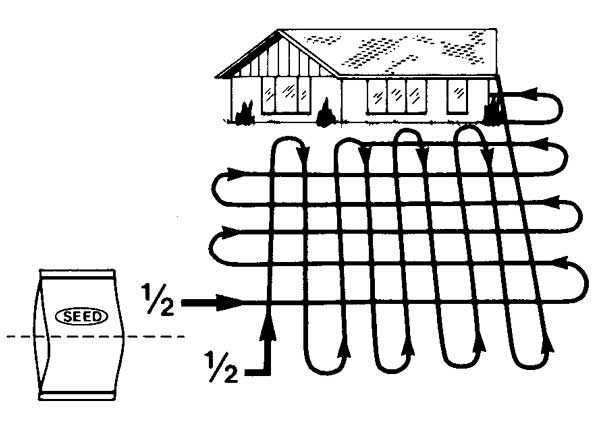
Figure 2. To ensure uniform coverage when applying fertilizer or lime, apply half while moving back and forth in one direction and the other half while moving at a right angle to the first pass.
Pests in New Lawns
Weeds
Broadleaf weeds are common in new plantings. However, many weeds will be controlled by taking proper care of the topsoil before seeding, by maintaining optimum growing conditions for the turfgrass species, and by mowing at the proper height after establishing the lawn. Weed control in sodded lawns is best done through inspection of the sod before laying it. Sod should be installed with no gaps between edges to reduce the opportunity for light to reach the soil surface and encourage weed growth. Complete coverage and quick establishment of sod generally prevent weeds from becoming established. In organic lawns, hand-pulling is the preferred method of weed removal.
Diseases
Seedling diseases are best controlled by establishing the turfgrasses properly and not mulching too heavily. Turfgrass diseases often appear after periods of prolonged wetness, regardless of fertilization strategies. In organic lawns, where chemical fungicides are not used, good management is the best way to avoid or minimize disease. Using compost and organic fertilizer has also been shown to minimize certain turfgrass diseases.
-
Select a disease-resistant turfgrass adapted to your region.
-
Do not overwater, overfertilize, or underfertilize.
-
Avoid shaded planting sites.
-
Improve drainage.
-
Increase airflow by removing low-hanging tree branches.
-
Mow at the highest recommended height using a sharp blade.
-
Mow when the turfgrass is dry.
-
Remove large clumps of clippings or spread them evenly in a thin layer.
If disease becomes established, remediating its effects without using chemical fungicides is challenging. Sometimes, the turfgrass will recover from the disease and regain a healthy appearance. If the turfgrass does not survive, renovation of the area will be necessary.
Insects
Insects are less of a problem in new lawns because bare soil or soil covered by sparse vegetation usually does not provide adequate food sources to support insect populations. Ants and fall armyworms, however, are notable exceptions. Fire ants can be transported in sod to newly established areas. Asian needle ants are less likely to move in infested plant material but can be transferred to new areas in moist media such as mulch and potting soil. Some nuisance ant species build nests and forage in bare soil areas. In early to mid-summer, fall armyworm damage can be more severe in newly sprigged, sodded, or seeded areas. Damage from fall armyworms is compounded if the turf has been mechanically disturbed (for example, from harvesting or aerating) in new lawns or newly renovated areas.
Publication date: Feb. 2, 2026
AG-562
Other Publications in Organic Lawn Care: A Guide to Organic Lawn Maintenance and Pest Management for North Carolina
Recommendations for the use of agricultural chemicals are included in this publication as a convenience to the reader. The use of brand names and any mention or listing of commercial products or services in this publication does not imply endorsement by NC State University or N.C. A&T State University nor discrimination against similar products or services not mentioned. Individuals who use agricultural chemicals are responsible for ensuring that the intended use complies with current regulations and conforms to the product label. Be sure to obtain current information about usage regulations and examine a current product label before applying any chemical. For assistance, contact your local N.C. Cooperative Extension county center.
N.C. Cooperative Extension prohibits discrimination and harassment regardless of age, color, disability, family and marital status, gender identity, national origin, political beliefs, race, religion, sex (including pregnancy), sexual orientation and veteran status.