
How To Store Drawn Comb When Not in Use
Drawn comb is a very expensive commodity for bees. It takes 8 pounds of honey to produce 1 pound of wax. Thus, wax is very valuable to the beekeeper as well. Instead of having the bees use this much energy every year to build new comb, it is wise to save drawn comb to use again next year. This allows the bees to put more effort into storing the nectar and producing a larger honey crop instead of having to make new wax.
Even so, wax used for many seasons will eventually need to be replaced. When bees first make wax it is a pretty white color. After a season or two, especially wax in the brood nest, the color begins to turn brown and after several years it is almost black. Wax has been studied extensively in connection with pesticide residues in the hive, and it is well known that wax can act as a reservoir for many harmful compounds. Although the details are not well known, it has been shown that this may negatively influence queen quality and overall health of the colony. For this reason, it is suggested that older, dark frames be culled and replaced with new foundation in the spring.
At the end of the season when populations begin to decrease, extra boxes often need to be removed and put into storage. If not stored properly, wax comb may be damaged resulting in it not being in good enough condition for the bees to reuse. One of the main culprits of stored-comb deterioration is wax moths. The greater wax moth (Galleria mellonella) or the lesser wax moth (Achroia grisella) may lay eggs on open comb, then the larva will feed on the wax as its main diet. In serious outbreaks, the larvae may even damage the woodenware by chewing into the wood to pupate. In nature, these moths act as decomposers and play a vital role in cleaning up old nest sites, but beekeepers are continuously fighting against these pests. If stored properly, wax moths can have minimal effects so that comb will remain in good condition and placed back on the bees next season when populations begin to increase.
One common method to prevent wax moth infestation is by using a product called Paramoth, which is in the form of crystals. When placed on stored equipment, it acts as a deterrent for wax moths. Paramoth is not to be confused with generic moth balls. The two products are similar but have different active ingredients. Common moth balls use naptholene as the active ingredient, which may be quite harmful to honey bees. The active ingredient in Paramoth is pardichlorbenzene (PDB), which is not harmful to honey bees when used properly. This is only to be used in equipment that has been removed from active colonies, so do not place them inside of occupied hives.
Boxes of empty drawn comb may be stacked up on top of each other, using a solid bottom as a base with a lid on top. A scoop of the PDB crystals is placed above the top bars, usually on a piece of paper to prevent them from falling between the frames. It is helpful to add an empty super before adding the lid, as this extra space allows for sublimation. The product works by sublimation and the gas, being heavier than air, will permeate through the complete stack of frames. Read the label for complete instructions.
The crystals will evaporate over time and will need to be replaced periodically as long as the boxes are in storage. A common issue is to place the PDB on the stack of stored equipment and then forget to go back. When this happens, the beekeeper may retrieve the frames, only to find them full of wax worms and wax moths. Frames stored using PDB will need to be removed from the treatment and left to air out for 24 hours prior to placing frames on a colony of bees.
If there are only a few frames that need to be saved, freezing is an option. This will kill anything that is currently living in the comb and any eggs that may be present. If the weather gets cold enough in your area, it is possible to leave the boxes outside over the winter but be careful of mice since they enjoy spending the winter in beehives since they are warm and dry. They will chew on the wax combs and make it unusable for the bees next season.
Exposing the combs to light is another method beekeepers often use to keep moths out. Hanging the frames on a string or wire is one method or placing the frames in a box and stand the box on end so sunlight can go between the frames, which will also deter wax moths.
Another option to preserve drawn comb is to use Bacillus thuringiensis (BT), a biological control product that affects only Lepidopterans, the order of insects that includes the wax moth. When ingested, BT damages the digestive system of the insect and therefore is unable to grow to maturity. This product is a liquid concentrate that is to be mixed with water and then sprayed onto each frame of drawn comb. This product, once dry, will protect the comb from wax worms. This is a more time-consuming process up front, but once the frames are dried, they may be stored without any further treatments until they are needed. As always, read and follow the instructions on the label.
If the proper precautions are taken when storing combs, the beekeeper should be able to start the spring with nice frames of drawn comb to provide as the colonies grow. Instead of having to make new combs, the bees will be able to start storing nectar and raising brood early which will lead to a larger, stronger colony and hopefully a bigger honey crop.
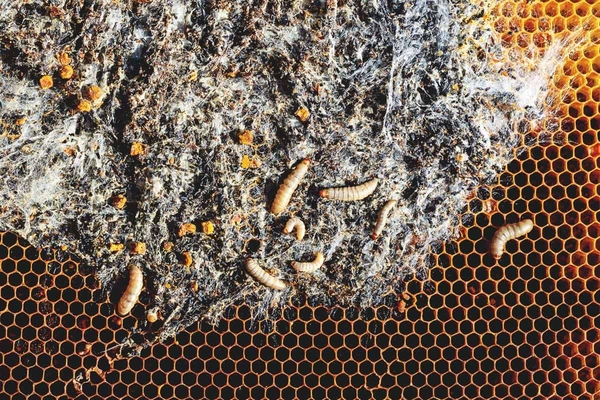
Honey bee frame showing damage caused by wax worms
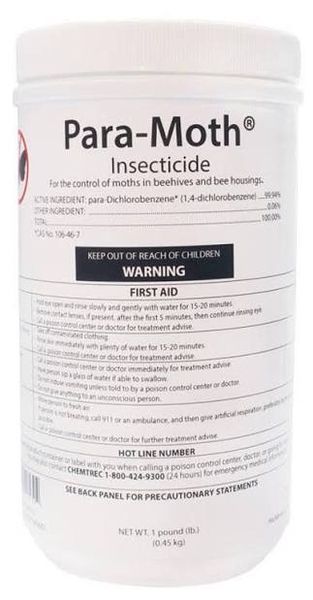
Paramoth Crystals to control wax moths in stored equipment.
Publication date: July 2, 2026
Recommendations for the use of agricultural chemicals are included in this publication as a convenience to the reader. The use of brand names and any mention or listing of commercial products or services in this publication does not imply endorsement by NC State University or N.C. A&T State University nor discrimination against similar products or services not mentioned. Individuals who use agricultural chemicals are responsible for ensuring that the intended use complies with current regulations and conforms to the product label. Be sure to obtain current information about usage regulations and examine a current product label before applying any chemical. For assistance, contact your local N.C. Cooperative Extension county center.
N.C. Cooperative Extension prohibits discrimination and harassment regardless of age, color, disability, family and marital status, gender identity, national origin, political beliefs, race, religion, sex (including pregnancy), sexual orientation and veteran status.