
Biology
Soft scales (Hemiptera: Coccidae) are small (<0.125 in long) and highly specialized insects. The females are wingless and sessile, and the males have only a single pair of wings. Adult males look like gnats, lack mouthparts, and do not feed. Their life cycle involves first-instar nymphs with fully developed legs and antennae, and are fairly active. These are known as "crawlers," which colonize new healthy plants and are the stage most vulnerable to insecticide applications since they lack waxy covers. When soft scale females molt into adults after various nymphal instars, they become sessile, meaning they will feed with their piercing-sucking mouthparts in the same spot for their entire life span. Females secrete a waxy or scalelike covering that protects their bodies and their long egg sacs filled with eggs (Triplehorn and Johnson, 2005). Coccids are a large group of insects with more than 105 North American species, including many important ornamental and agricultural pests.
A few species of soft scales feed on blueberries and related crops (Vaccinium, also including cranberries). These include Pulvinaria ericicola and Pulvinaria floccifera. P. floccifera, also known as the cottony scale or the cottony Camellia scale. These scale insect species are occasional pests of blueberries in North Carolina and have been encountered before in NC blueberries through samples sent to the NC State Plant Disease and Insect Clinic in 2021 (Cline, 2022). Females of P. floccifera are 3 mm (0.125-inch) in diameter scales, often found on the underside of leaves. Their cottony waxy covering is characteristic of adult females. Oblong and large cottony white egg masses emerge from beneath adult females and are often twice the length of the adult scale. There is one generation per year and overwinters as immatures on the twigs of the plants. Nymphs molt into adults in early spring, and adult females are highly visible in late April when they produce white egg sacs. Once the eggs are laid, the female dies, and egg sacs will remain, containing up to 1,000 eggs. Upon egg hatch, crawlers will move to the leaves and feed with piercing-sucking mouthparts. The white egg sacs are probably the most noticeable stage of this insect.
The terrapin scale, Mesolecanium nigrofasciatum, is an occasional pest of tree fruits and shrubs throughout much of the southern and eastern United States. Like other scale insects, this species remains immobile (sessile) throughout most of its life cycle and secretes a rigid, hemispherical covering over its body. This protective covering (called a derm) is brown or reddish-brown and distinctively marked with radiating black bands resembling the shell of a turtle. The derm increases in size as the insect grows, eventually reaching a diameter of 3 to 4 mm (about 1/8 inch). There is only one generation of the terrapin scale per year. Mated females overwinter on host plant stems (usually from the previous season’s growth) and bear live young over a period of 4 to 6 weeks in early summer. Crawlers migrate to the leaves where they settle along the mid-rib and veins (usually on the underside) and begin to secrete a derm. Development continues on the leaves for six to eight weeks. In late summer, females migrate back to the stems and undergo a period of rapid growth and sexual development. Males remain on the leaves until they become sexually mature, then migrate to the stems, mate with females, and die within a few days. Females continue to feed and develop on the stems until forced into dormancy by cold weather.
Scouting and Management
Cottony scales can be easily seen in the plants when adult females produce egg sacks in late spring. However, overwintering nymphal stages are the most vulnerable and ideally the ones that should be targeted with insecticides. Terrapin scale populations can be detected at any time of the year, but they are most conspicuous in late summer when sooty mold coats the foliage, or in autumn after the leaves have fallen. Young scale crawlers and females can also be found earlier in the summer by examining the undersides of leaves.
Since scale insects feed by removing sap from a plant, foliage with scale infestations may turn yellowish or pale in color, which can reduce vigor, decrease yield, and even shorten the lifespan of infested bushes. Heavy infestations also produce large quantities of honeydew. This sugary waste product often coats the foliage, fostering growth of a sooty mold that blocks light and reduces the plant’s photosynthetic efficiency.
Cultural practices during the dormant season can kill overwintering pests and limit the spread of disease. Annual and selective pruning of old and diseased wood can suppress populations of scale insects and blueberry bud mites, while clearing the ground cover in surrounding woods and field margins destroys overwintering plum curculio and the eggs of sharpnosed leafhoppers. Careful pruning can also help control light or scattered infestations of scale insects.
Sanitation protocols are essential to prevent the spread of crawlers and the infestation of healthy fields. Crawlers can be moved by wind, farming equipment, and field workers. Farming equipment, such as mechanical pruners and harvesters, should be thoroughly cleaned before moving to new fields, and workers should inspect their clothing before entering a new field.
It is nearly impossible to control the cottony and terrapin scales with insecticide treatments applied during the growing season because the scale covering is impervious to most materials. The best results are obtained when applications are timed to coincide with the active period of the crawlers (late winter or early spring) or when dormant oil sprays are applied. Dormant oil sprays are commonly used on blueberries in North Carolina during October and November. Ensure temperatures are not below 50°F and not above 65°F when applying dormant oils. This is usually for low to moderate infestations. For high infestations (multiple areas with plants covered in scales), systemic insecticides will be needed in addition to oil sprays. Systemic insecticides are better applied after harvest or before bud break. Follow product labels, which may instruct you not to spray certain plant species or mix oil with specific other products. For example, do not mix oil with chlorothalonil, sulfur, or certain other fungicides. Also, avoid applying oil within 3 weeks of an application of sulfur-containing compounds, such as wettable sulfur.
Systemic insecticides that could help mitigate scale insect infestations include Movento, Sivanto Prime, Admire Pro, Assail, and Knack. Application of these systemic insecticides has proven effective in late July or August, after the end of harvest and machine pruning in July. Management of scales can be also offered when mitigating other insect pests. For example, Assail and Admire Pro sprays applied against Japanese beetle infestations at the end of summer or early fall may also provide protection against scale insects. Similarly, Movento sprays used before bud break in early spring can also provide protection against blueberry gall midge and scales.
See the Southeast Regional Blueberry Integrated Management Guide and the North Carolina Agricultural Chemicals Manual for specific management information.
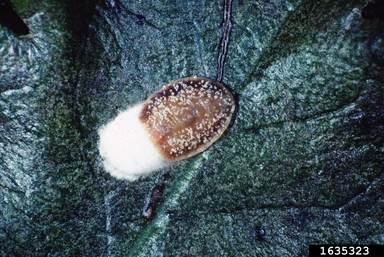
Cottony Camellia scale, Pulvinaria floccifera adult female
John .A. Davidson, Univ. Md, College Pk, Bugwood.org
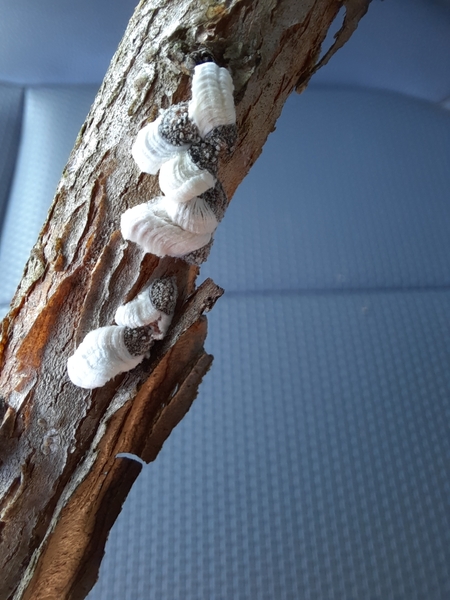
Multiple Pulvinaria floccifera adult females in a blueberry branch.
Bill Cline
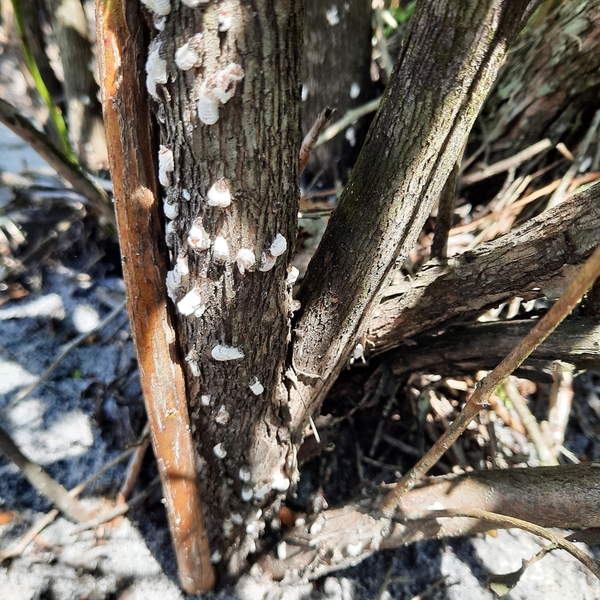
Stems of a blueberry plant covered with multiple P. floccifera adult females.
Bill Cline
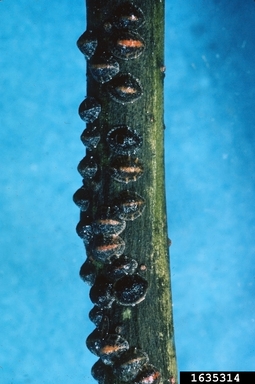
Terrapin scale (Mesolecanium nigrofasciatum)
John .A. Davidson, Univ. Md, College Pk, Bugwood.org
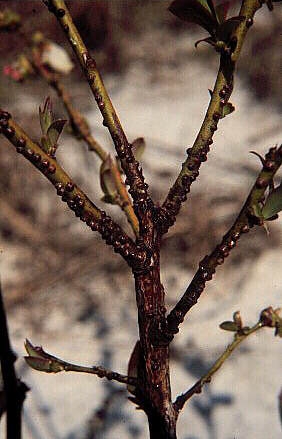
Blueberry stem infested with terrapin scale (Mesolecanium nigrofasciatum) during early spring (before crawler emergence).
John Meyer.
Biological Control
A tiny wasp parasite, Coccophagus lycimnia, has been reported to be associated with P. floccifera (Johnson and Lyon, 1991). Additionally, Coccophagus japonicus and Coccophagus yoshidae have been reported as parasitoids as well (Tachikawa, 1956). However, parasites are not noted to provide adequate population regulation for this soft scale scale.
Numerous parasites and predators have been reported attacking the terrapin scale (Williams and Kosztarab 1972). The most abundant parasites are tiny chalcid wasps in the genera Aphycus and Coccophagus that attack female scales following the stemward migration. A ladybeetle, Hyperaspis binotata, is their most common predator. In some cases, these natural enemies exert significant restraint on the growth of scale populations, but hyperparasites are also abundant and the level of control tends to be variable from year to year.

Coccophagus lycimnia adult female with the obvious bright yellow spot on scutellum (top row) emerged from the green scale Coccus viridis (Coccidae: Hemiptera).
Modified from Al-Shami and Qureshi, 2024. Salman Al-Shami UF/IFAS
Additional Resources
Camellia (Camellia)-Cottony camellia scale
Pulvinaria floccifera (formerly Pulvinaria camelicola; soft scale)
Publication date: Aug. 8, 2025
N.C. Cooperative Extension prohibits discrimination and harassment regardless of age, color, disability, family and marital status, gender identity, national origin, political beliefs, race, religion, sex (including pregnancy), sexual orientation and veteran status.