
Biology
Various species of grasshoppers including the differential grasshopper, Melanoplus differentialis (Thomas) and southern red-legged grasshopper Melanoplus femurrubrum (De Geer) can feed on tobacco. Southern red-legged grashoppers are ¾ to 1 inch long, with a greenish-gray to olive-green or reddish-brown with a yellowish underside. Their last pair of legs are red with black spines. The differential grasshopper is 1½ to 2-inches long with a shiny, brownish-yellow color and black V-shaped marks on their last pair of legs (Figure 1). Immatures (nymphs) are similar but lack fully developed wings (Figure 2).
Grasshoppers damage tobacco by chewing ragged holes in the leaves (Figure 3). Most species prefer other plants but will eat tobacco if their food supply is inadequate. They often migrate into tobacco fields from hay fields, pastures, and old fields, especially when populations are high during droughts and following hay mowing or other habitat modifications. You can notice immature and adults grasshoppers resting on the leaves of tobacco or flying around when large populations are present. Also, they leave behing elongated frass in the leaves (Figure 4).

Figure 1. Adult grasshopper resting on a tobacco leaf.
Photo by Lorena Lopez

Figure 2. Immature grasshopper on tobacco and grashopper injury.
Photo by R.J. Reynolds Tobacco Company , R.J. Reynolds Tobacco Company, Bugwood.org

Figure 3. Extensive grasshopper damage on tobacco leaf.
Photo by Lorena Lopez
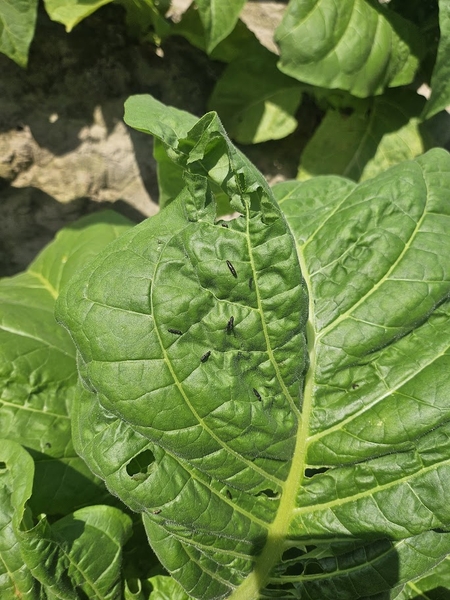
Figure 4. Frass left behing but grasshoppers on tobacco leaf.
Photo by Lorena Lopez
Thresholds and Management
Grasshopper can show up as early as four weeks after transplant until final harvest. To reduce grasshoppers and cricket invasions, keep borders clean amd avoid haying grasshopper-infested grass strips near tobacco fields. In general, weed control and haying should be avoided immediately before and for 4 weeks after transplant. No exact thresholds have been established for grasshoppers, but as a rule, treat when anticipated damage is equal to or greater than that caused by a 10-20% budworm infestation (threshold suggestion not based on research). Ten grasshoppers per 50 scouted plants is another threshold used in Virginia tobacco. Grasshopper infestations rarely go beyond the suggested thresholod and most do not require insecticide applications.
Grasshoppers are susceptible to broad spectrum insecticides. Orthene® (acephate) and Acenthrin® (acephate+bifenthrin, do not apply bifenthrin after laybay) are labeled for grasshoppers in tobacco but the active ingredient acephate is related to leaf residse concerns and some buyers may encourage growers not to use it late in the season. Warrior II® is also labeled against grasshoppers in tobacco but be aware for the long pre-harvest interval of 40 days.
Insecticides labeled for budworms and hornworms, such as Steward®, Coragen®, and Exirel® have 7-14 pre-harvest intervals and can offer suppression activity against grashoppers when applied during Lepidopteran infestations (these product labeles include grasshoppers in other field crops like soybeans but not specified for tobacco). However, these insecticide are also related to leaf residue concerns when applied late in the season. Make sure to discuss late applications of these insecticides with buyers.
See the Flue-Cured Tobacco Guide or the North Carolina Agricultural Chemicals Manual for registered materials, rates, and applications recommendations.
Publication date: July 1, 2025
N.C. Cooperative Extension prohibits discrimination and harassment regardless of age, color, disability, family and marital status, gender identity, national origin, political beliefs, race, religion, sex (including pregnancy), sexual orientation and veteran status.