
Challenge of Decreased Reproductive Efficiency in Beef Cattle and Its Economic Impact
Decreased reproductive efficiency is a persistent challenge in beef cattle reproduction, limiting herd productivity, increasing input costs, and reducing overall profitability. Poor breeding outcomes, cows getting bred too late into the breeding season, poor estrus detection, and delayed or inaccurate pregnancy detection are among the primary contributors to decreased efficiency. In addition, many producers may lack confidence or training in the use of advanced reproductive technologies, such as estrous synchronization and artificial insemination (AI), which hinders widespread adoption of these practices. These gaps in efficiency not only impact animal health and reproductive success, but also constrain producers’ ability to make data-driven decisions that optimize herd performance. In the broader context of the U.S. cattle industry, improving reproductive efficiency is essential for enhancing economic sustainability and ensuring effective use of natural and labor resources.
Implementing Research-Based Extension Programs to Address Reproductive Challenges
To address the previously described challenges, Extension programs are increasingly emphasizing the importance of research-based training for producers and agricultural professionals. NC State Extension developed Reproductive Management Schools (Repro Schools) to deliver hands-on, science-driven education to cattle producers and Extension agents across North Carolina. From 2024 to 2025, these workshops were delivered to participants from 17 counties and included both classroom-style lectures and experiential learning opportunities using reproductive tracts and live animals. The educational program was focused on five major areas: selection and mating decisions, breeding season management, estrous synchronization and AI protocols, pregnancy diagnosis via rectal palpation, and pregnancy diagnosis via blood-based tests (tail bleeding). This structure aimed to improve participants’ technical knowledge, increase their confidence in applying new skills, and ultimately lead to more efficient reproductive practices on their farms.
Evaluating the Educational, Technical, and Economic Impacts of Repro Schools
This study evaluates the effectiveness of Repro Schools in improving participants’ knowledge, confidence, and perceptions of economic benefit related to reproductive management. Five primary research questions guided this evaluation:
-
Did participants report increased knowledge and confidence in key reproductive practices following the training?
-
How useful and applicable did participants find the content and delivery of the program?
-
What was the reported level of confidence in specific technical skills, including selection and mating decisions, breeding season management, estrous synchronization, and pregnancy diagnoses via rectal palpation and blood testing (tail bleeding)?
-
Did hands-on learning contribute differently than lecture content to reported gains?
-
How much return on investment did participants estimate they might gain from applying these skills to their operations?
By addressing these questions, this study sought to assess the educational impact of Repro Schools, provide evidence to support the impact of hands-on, research-based Extension programming, and provide insight into the delivery of future educational efforts within the beef cattle industry.
Survey-Based Analysis and Statistical Evaluation of Training Effectiveness
The 58 participants completed post-training surveys using a 5-point Likert scale to evaluate content quality, delivery, and usefulness. Many also provided retrospective pre- and post-assessments, allowing for a within-subject comparison of perceived gains in knowledge, confidence, and decision-making ability. Statistical analysis was conducted using generalized linear mixed models with the GLIMMIX procedure of SAS to analyze the response data from pre- and post-training evaluations. The model included the fixed effects of question (evaluated topic), time (before and after workshop), and their interaction, along with the random effect of the participants. In the post hoc analysis, probabilities and odds ratios were calculated and used to make comparisons. The statistical significance was stated at α = 0.05. Beyond quantifying learning outcomes, this evaluation contributed to the broader field of Extension education by highlighting how applied in-person programs can translate academic research into meaningful on-farm improvements. As the cattle industry continues to evolve, programs like Repro Schools offer a critical link between real-world implementation, promoting more informed, confident, and economically sustainable decision-making among beef producers.
Results and Importance
Participants consistently rated the Repro Schools positively. Figure 1A shows that 98.3% of the participants felt the content was better than expected, grading the workshop as 4 and 5, while Figure 1B indicates that 100% of participants rated the presentation style and delivery as strong. Figure 1C demonstrates that the amount of information presented was generally considered appropriate. Collectively, these findings highlight that the program structure and delivery were well received by participants.
The workshops improved the participants' knowledge, their confidence in using the skills and information gained, and their interest in the subjects. As shown in Figure 2A, 91.4% of participants reported notable increases in knowledge to a 4 or 5 score after the workshop, while Figure 2B indicates greater interest in reproductive management subjects by 94.8% of the participants. Of special significance, Figure 2C illustrates that participants’ confidence in applying reproductive skills also increased, which is crucial to improving reproductive efficiency in cattle operations.
Participants also recognized the potential financial value of the workshop. Figure 3 shows that most participants projected that a positive economic benefit would result from the information gained, with many estimating improvements of several thousand dollars per operation. The greatest percentage of participants (34%) chose $2,001 to $5,000 return on investment for applying the information and skills gained in the workshop; this perception underscores the practical relevance of the training to on-farm decision-making. Knowledge and confidence gains were especially evident in technical reproductive practices. Finally, it is notable that 100% of participants who selected $0 return on investment reported not owning or working on a farm.
The participants' perceived knowledge pre- and post-workshop was assessed across five main areas, including selection and mating decisions (Figure 4A), breeding season management (Figure 4B), estrous synchronization and AI (Figure 5A), pregnancy diagnosis by rectal palpation (Figure 5B), and tail bleeding for pregnancy diagnosis by blood-based test (Figure 5C). The bar graphs in Figure 4 and Figure 5 represent the percentage of participants per score (1 to 5), where red indicates the pre-workshop knowledge and gray indicates the post-workshop knowledge, while the scatter-plot dots represent each participant's knowledge score, varying from their perceived pre-workshop rating to the post-workshop rating.
Broadly, the bar graphs depict a greater improvement in the participants' perceived gain of knowledge, exhibited by a greater percentage of lower scores (for example, 1 and 2) during the pre-workshop evaluation (red bars) and a greater percentage of higher scores (for example, 4 and 5) during the post-workshop evaluation (gray bars). In addition, individual self-assessment can be observed via the scatter plots at the right halves of Figure 4 and Figure 5, where pre- and post-workshop evaluations are indicated per participant. Interestingly, improvements were different across topics per participant, although all participants self-reported improvements across all topics. Figure 4A demonstrates that participants were 17.85 times more likely to report higher knowledge in selection and mating decisions after the workshop (p < 0.0001), with the probability of a low rating decreasing from 37.88% pre-training to 3.3% post-training. Similarly, Figure 4B shows that participants were 30.79 times more likely to report higher confidence in breeding season management tools after the workshop (p < 0.0001), with the probability of low ratings decreasing from 43.47% to 2.43%. In summary, participants showed substantial gains in their confidence with advanced reproductive technologies.
Figure 5A demonstrates that participants were 25.71 times more likely to report higher knowledge in estrous synchronization and AI after the workshop (p < 0.0001), and the probability of a low rating decreased from 50% to 3.74%. Figure 5B illustrates that confidence in pregnancy detection via rectal palpation increased, with participants 48.38 times more likely to report higher ratings after the workshop (p < 0.0001), with the probability of a low rating decreasing from 87.39% to 12.53%. Figure 5C depicts changes in the gain of knowledge of participants in tail bleeding to conduct a blood-based pregnancy diagnosis, where there was a 183 times chance of a higher score after the workshop (p < 0.0001); this skill represented the greatest improvement among all participants. In addition, the probability of a low rating decreased from 71.37% to 1.34% after the workshop.

Figure 1. Participants' ratings of the workshop, where scores vary from not optimal (1) to extremely optimal (5). Panel A applies to the content of the workshop, Panel B applies to presentation delivery and style, and Panel C applies to the amount of information provided.
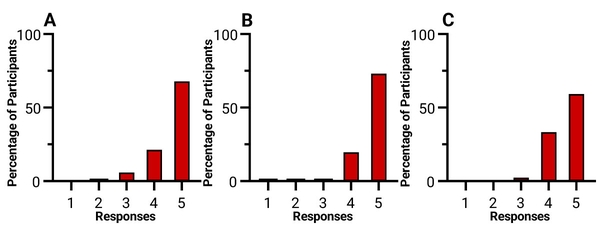
Figure 2. Participants' ratings of how the workshop benefited them, where scores vary from no change (1) to greatly improved (5). Panel A applies to knowledge improvement, Panel B applies to interest in the subjects, and Panel C applies to confidence in using skills and information gained.
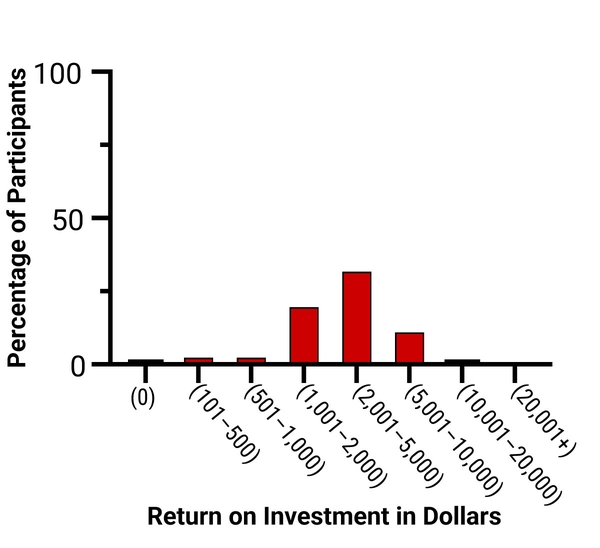
Figure 3. Participants' ratings of the perceived return on investment of applying gained information and skills to their operation or at their work. 100% of participants who selected $0 reported not owning or working on a farm.
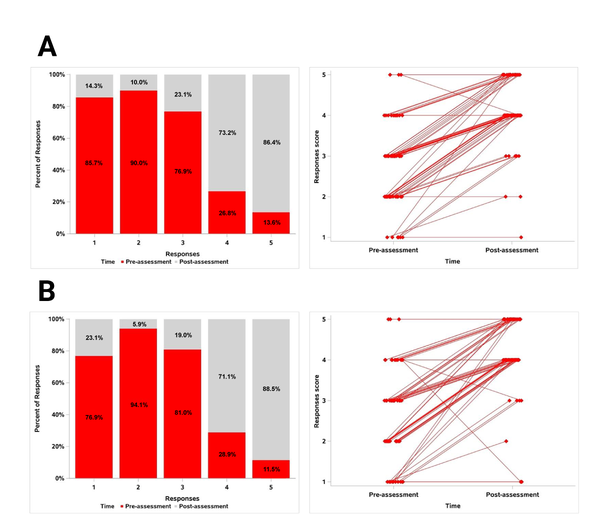
Figure 4. Participants' perceived pre- and post-workshop knowledge, where scores range from very low (1) to very high (5) in topics related to selection and mating decisions (Panel A) and breeding season management (Panel B).
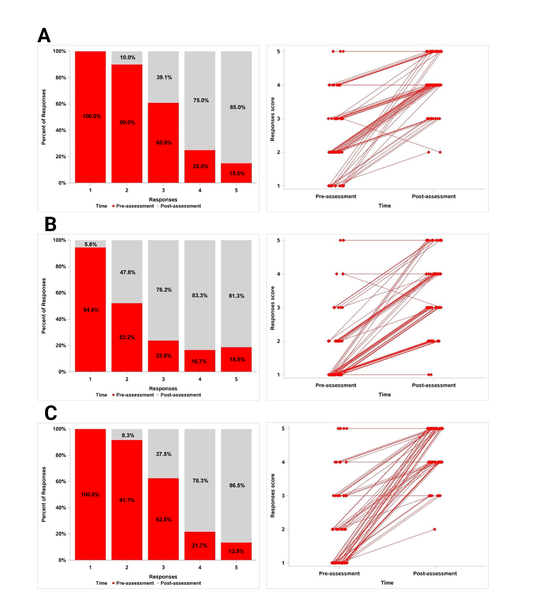
Figure 5. Participants' perceived pre- and post-workshop knowledge, where scores range from very low (1) to very high (5) in topics related to estrous synchronization and artificial insemination (Panel A), pregnancy diagnosis by rectal palpation (Panel B), and tail bleeding for pregnancy diagnosis by blood-based test (Panel C).
Implications
Our evaluation results clearly demonstrate that Repro Schools are highly effective in improving participants' knowledge about, confidence in, and application of reproductive management practices. Across all measured areas, participants reported significant gains, and these were strongly supported by statistical analyses highlighting the substantial impact of hands-on experiential training. Participants also valued the program’s content, delivery, and practical applications, as indicated by the majority rating the workshop content "better than expected," the presentation style "effective," and the amount of information "appropriate." These positive perceptions, combined with self-reported increases in knowledge, interest, and confidence, suggest that the program was both engaging and educationally effective.
Return on investment was another important outcome, as 82.75% of the participants projected that the training would give them a financial advantage, with several expecting gains of several thousand dollars per operation (100% of participants who did not project a return on investment stated that they did not have cattle yet or did not work on a farm). This outcome underscores the practical relevance of the program and suggests that knowledge and confidence gains may translate into real-world improvements in reproductive efficiency and herd profitability. Overall, our findings highlight the importance of applied hands-on Extension programs for translating research into practice. By combining lectures with experiential learning, Repro Schools provide producers with the skills and confidence needed to learn advanced reproductive technologies. Future work should examine long-term adoption of these skills, as well as herd-level outcomes such as improved conception rates, calving distribution, and realized economic returns. Nonetheless, the current evaluation demonstrates that Repro Schools are a valuable tool for enhancing both technical knowledge and economic decision-making in beef cattle operations.
Future Reproduction Schools
For information on future Repro Schools or to bring one to your county, contact your local Extension livestock agent. In addition, subscribe to the NC State Extension Beef Portal to receive research-based information and learn about upcoming events.
Acknowledgments
This project was funded in part by the North Carolina Cattlemen’s Association. This work is supported by the Research and Extension Experiences for Undergraduates Program, Project Award No. 2021-673037-34642, from the U.S. Department of Agriculture’s National Institute of Food and Agriculture.
Thank you to all the participants, collaborating universities, Extension offices, and research stations for their contributions in making this project possible. We also thank all the livestock Extension agents who partnered with us to provide the workshops.
Publication date: Nov. 25, 2025
AG-998
N.C. Cooperative Extension prohibits discrimination and harassment regardless of age, color, disability, family and marital status, gender identity, national origin, political beliefs, race, religion, sex (including pregnancy), sexual orientation and veteran status.