
Weed management in container nurseries is highly dependent on the use of preemergence herbicides, yet there are sensitive crops for which preemergence herbicide use is to be avoided. In those situations, growers have relied upon sanitation and hand weeding. However, there are other options for controlling weeds without using chemicals. Various mulches, including fabric or organic disks, plastic pot-toppers, and organic mulches, have been investigated for weed control in containers. Disk mulches have been made out of organic materials (plant fibers, human hair) or synthetic materials (plastics, felted materials, and geotextiles). Although fairly effective preventing weed seedling emergence, weeds can emerge around the edges of the disks or through the slit necessary for getting the disk around the stem of the nursery plant. Some of the lighter disks have been prone to being blown out of containers.
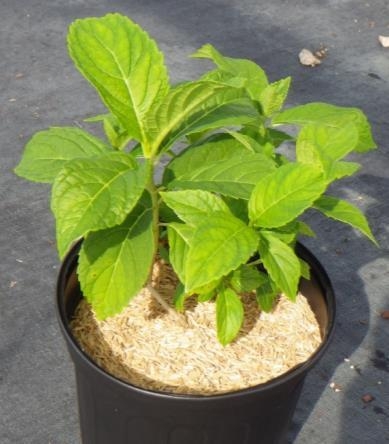
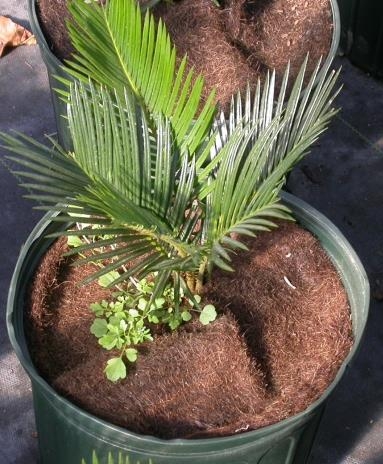
Weed seedlings do not emerge through the disk mulches, but may emerge around the edges or in the slits.
Photo by: J. Neal
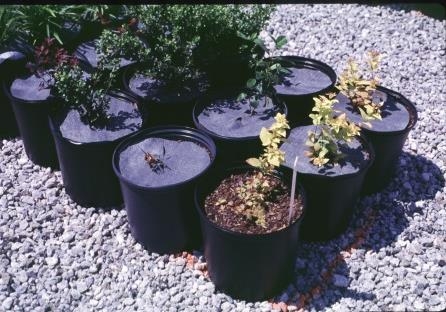
Fabric disks can blow off.
Photo by: J. Neal
Pine bark nuggets, wood chips, par boiled rice hulls and other organic mulch materials can be placed on the container substrate surface to prevent or reduce germination of many weed species by excluding light, reducing the moisture level at the substrate surface, and providing a physical barrier. Typically, these mulch materials will need to be applied at depths of at least 1 inch in order to be effective. Coarse mulch materials are usually more effective than fine-particle materials. Organic mulches must be applied at sufficient depths to be effective. Our research indicates at least a 1-inch layer is needed to provide control of weed seeds germinating below the mulch layer. Thinner layers may control weed seeds landing on top of the mulch. One organic mulch receiving significant interest is parboiled rice hulls. This mulch is effective but, being lightweight, is subject to blowing off. Also, in one recent installation, we have seen birds scratching the mulch out of pots.
How much mulch does it take to get the 1 to 1.5 inch layer? It requires a surprisingly large volume of mulch to achieve the 1 to 1.5 inch layer. We found little difference in the volume of shredded hardwood mulch or rice hulls required to achieve 1 to 1.5 in depths in pots. Below is a table showing the volume (cups) of mulch for several common container sizes.
|
Depth |
Trade gallon (3 L) |
Full gallon (4 L) |
2 Gallon (2G) |
3 Gallon (3G) |
|---|---|---|---|---|
|
1" |
1 ½ cups |
2 cups |
3 cups |
5 cups |
|
1.5" |
2 cups |
3 cups |
4 ½ cups |
7 ½ cups |
Mulches are more expensive than herbicides but the actual material costs are generally less than $0.20 per pot – significantly less expensive than relying exclusively on hand weeding. Below are estimated mulch costs. The following are estimates from retail pricing of material costs only. Bulk purchasing could reduce the material cost. This does NOT include mulch application costs.
| 3L | 4L | 2G | 3G | |
|---|---|---|---|---|
| 1" | $0.02 | $0.03 | $0.04 | $0.07 |
| 1.5" | $0.03 | $0.04 | $0.06 | $0.10 |
| 3L | 4L | 2G | 3G | |
|---|---|---|---|---|
| 1" | $0.04 | $0.05 | $0.08 | $0.13 |
| 1.5" | $0.05 | $0.08 | $0.12 | $0.20 |
One other drawback for mulches is the labor costs for mulch application. Methods to mechanize the application may improve the cost-returns on the use of mulches. In European nurseries, it is not uncommon to see a mechanized mulch applicator on a potting line.
When using mulches for weed control, several cultural practices may need to be adjusted.
- Potting practices will need to be adjusted to leave enough “head space” for the 1 to 1.5 inch layer of mulch.
- Mulches help retain moisture in the containers, thus irrigation frequency will need to be adjusted. Having mulched crops in the same irrigation zone with other crops may result in excess irrigation on some and inadequate irrigation on others.
- Top-dressed fertilizer may be less effective when placed atop mulches. Incorporated slow release fertilizer or dibbled fertilizer will be more effective when mulches are used.
- It should be noted that mulches are less effective in container nursery crops that suffer from frequent blow-overs, as mulches will be spilled from the container(s) in such cases. Research has been conducted on “tackifiers” to hold the mulch in place but no commercial system is in widespread use at the time this article was written.
- The crown of small liners may be covered by the mulch, resulting in poor growth of herbaceous species.
Mulches can be effective alternatives to preemergence herbicides in many cropping situations, particularly in herbicide-sensitive crops. Many materials are available and they generally work similarly. But, like all other weed control options, mulches will not be 100% effective. When weeds do emerge in the mulched pots, remove the weeds when young to minimize mulch disturbance. And, mulches should be considered just one piece of an integrated weed management plan for the nursery.
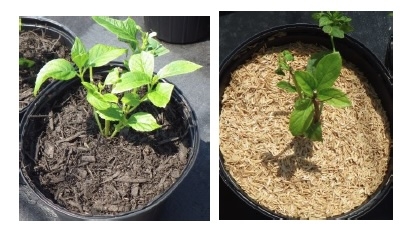
Wood chips, rice hulls and other organic materials have been used as mulches in containers.
Photos by J. Neal
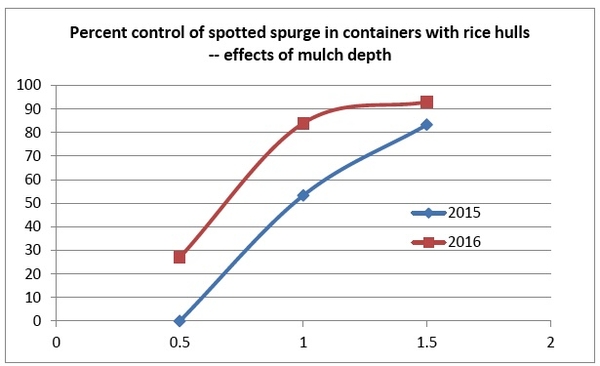
Figure 1. Effects of rice hull mulch depth on spotted spurge control in 2015 and 2016 research conducted at NC State University.
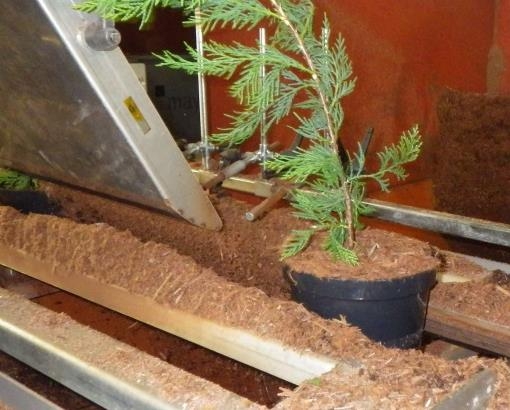
A mulch applicator in a commercial nursery potting line at a European Nursery. Mechanization such as this could reduce the cost of mulch applications.
Photo by: J. Neal
Publication date: Aug. 22, 2016
Reviewed/Revised: June 17, 2026
N.C. Cooperative Extension prohibits discrimination and harassment regardless of age, color, disability, family and marital status, gender identity, national origin, political beliefs, race, religion, sex (including pregnancy), sexual orientation and veteran status.