
Biology
The corn earworm (Helicoverpa zea), also known as the cotton bollworm, soybean podworm, or tomato fruitworm, is the caterpillar of a noctuid moth that occasionally feeds on strawberry fruit in North Carolina. It also feeds on a wide variety of cultivated crops and weeds. Corn earworms have the same basic egg, larva, pupa, and adult life stages as other moths. Female moths lay eggs singly on suitable host plants. The larvae (caterpillars) feed on some of the leaves, but mostly on the developing fruit. Once mature, the larvae tunnel into the soil where they pupate. Corn earworm larvae have light-colored heads and a rough texture due to the presence of microspines along their bodies. They come in a wide variety of colors, including yellow, green, and light red, and usually have lateral stripes along their sides. Mature caterpillars can grow to be around 1.75 inches long. Caterpillars that mature in the spring and summer emerge as moths the year they were born. Caterpillars that mature in the fall overwinter as pupae in the soil and emerge as adults in the following spring. Adult corn earworm moths hold their mottled, light-brown wings in a triangular position. Their wingspan is approximately 1 to 1.5 inches wide. The moths are mostly active at night, but occasionally fly during the day.

Corn earworm larvae showing one of their characteristic color patterns
Erin Eure
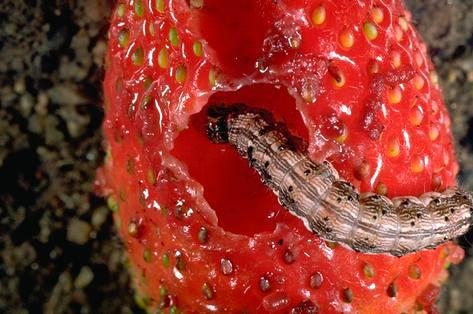
Corn earworm larvae feeding on strawberries.
UC IPM
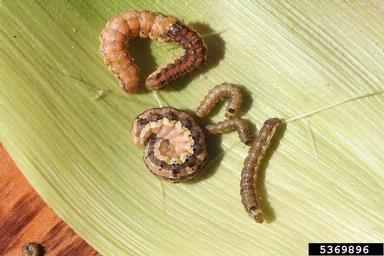
Although different colors, these are all corn earworms.
Whitney Cranshaw, Colorado State University, Bugwood.org
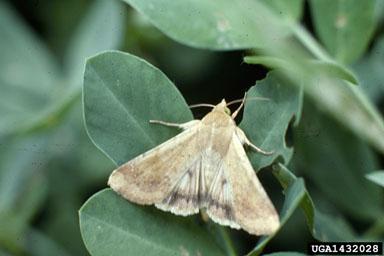
Each of the corn earworm moth's hind wings has a central dark spot and a dark band around the bottom.
Steve L. Brown, University of Georgia, Bugwood.org
Damage
Damaging population outbreaks in strawberries are most likely to occur during periods of warmer-than-usual temperatures, such as warm, and dry springs. In strawberries, caterpillars can feed on flower buds and open flowers, but mostly feed on developing or ripe fruit. Caterpillars cause the most damage by chewing large holes into the fruit. Also, larvae can be found feeding inside the fruit once it is picked during pick-your-own (PYO) activities, which greatly affects PYO systems.
In areas where corn earworms have been a problem in the past, pheromone traps can be used to sample for moth activity. But these monitoring methods are rarely used or needed for strawberries, since this pest is uncommon in NC berry crops.
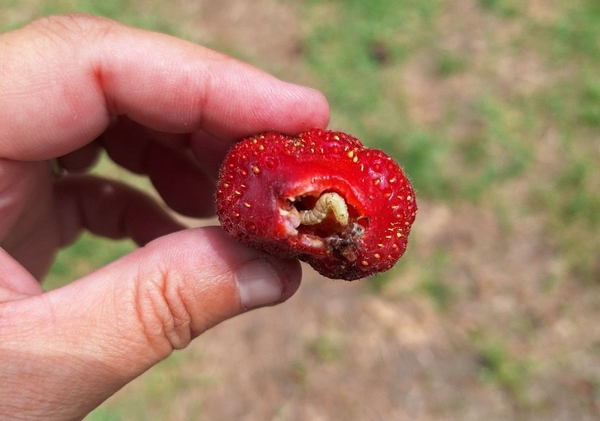
Grown corn earworm larva inside a strawberry.
Taylor Black
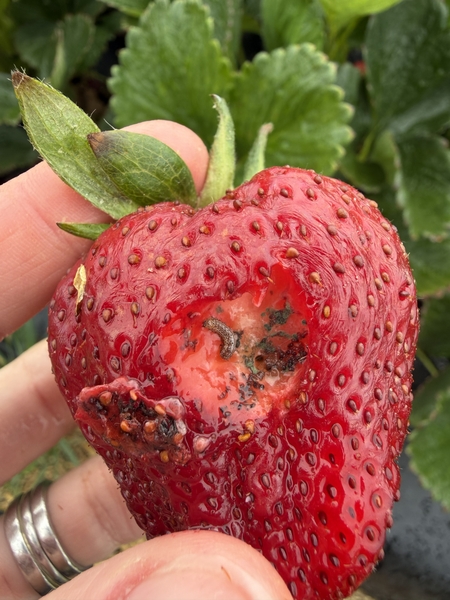
Early instar of an corn earworm larva feeding on a strawberry.
Erin Eure
Management Options
Cultural
Soil preparation and fumigation practices common in North Carolina strawberry production destroy most overwintering pupae in the strawberry field. However, moths can migrate in from adjacent fields. Good mowing and weed-control practices can reduce the availability of food sources for larvae.
Conventional Insecticides
Conventional insecticides are available for corn earworm control in strawberries. Because the earworms feed directly on the fruit, contact insecticides are not likely to control them. Systemic insecticides that move through plant tissue, such as Coragen (chlorantraniliprole), or insecticide products with translaminar activity that move within the leaf tissue where they are applied, such as Harvanta (cyclaniliprole), are the best options for remedying these outbreaks. Two insecticide applications, scheduled 1-2 weeks apart, should be sufficient to mitigate infestation.
Some formulations of Bt-based insecticides are approved to control corn earworms in organically grown strawberries. If used, it must be timed to egg hatch to be effective. Refer to the North Carolina Agricultural Chemicals Manual for materials recommended for use against corn earworms in North Carolina and the Southern Region Small Fruit Consortium Strawberry IPM Guide for regional recommendations. For other states, check with your local extension agent.
Organic Insecticides
Some formulations of Bt-based insecticides are approved for control of corn earworms in organically-grown strawberries. Refer to the North Carolina Agricultural Chemicals Manual for materials recommended for use against corn earworms in North Carolina and the Southern Region Small Fruit Consortium Strawberry IPM Guide for regional recommendations.
More Information
North Carolina Agricultural Chemicals Manual
Strawberry IPM Guide - Southern Region Small Fruit Consortium
Corn Earworm in Soybeans - North Carolina Soybean Insect Pests
Publication date: June 23, 2014
Reviewed/Revised: May 3, 2026
N.C. Cooperative Extension prohibits discrimination and harassment regardless of age, color, disability, family and marital status, gender identity, national origin, political beliefs, race, religion, sex (including pregnancy), sexual orientation and veteran status.