
Increasing the Adoption of Artificial Insemination in North Carolina
Reproductive efficiency is a major aspect of livestock production systems due to its direct impact on profitability and sustainability. Artificial insemination (AI) offers a proven, cost-effective method to improve genetic progress and herd productivity. Despite its benefits, however, the widespread adoption of AI is limited in the United States. In 2017, only 8.7% of small operations, 17.7% of medium operations, and 29.4% of large operations adopted AI, with 11.6% of operations already using it (Binelli et al. 2021).
Using AI sires rather than natural service bulls provides a greater economic return. By choosing the best AI sire to fit your operations, you will decrease the maintenance cost and labor of housing a natural service bull while also increasing the genetic pool. In dairy herds, daughters of AI sires are proven to produce significantly more milk than heifers sired by natural service bulls, with heifers sired by AI often producing almost 900 kilograms of extra milk per lactation, bringing in more profit (Mohammed 2018). Using AI can increase profit by $105 to $175 per cow per year for a dairy (Mohammed 2018). In beef herds, AI can reduce the transmission of infectious genital diseases (sexually transmitted diseases) and lessen the stress of natural service on the animals and producers (Patel et al. 2017). In addition, AI allows producers to shorten the calving season within a specific range. Producers are also able to concentrate labor on specific days during the calving season by knowing which day the most help will be needed.
Finally, in beef herds, producers can also expect to wean heavier calves by introducing superior genetics.
One of the primary barriers to incorporating AI into beef and dairy herds is the lack of educational resources and hands-on training. To address these deficits, NC State Extension and North Carolina Cooperative Extension organized an artificial insemination training school in partnership with genetic companies and the Department of Animal Science at the University of Mount Olive. The resulting workshops combined technical instruction and applied learning to increase producers' confidence in the use of AI and reproductive management strategies such as estrous detection and estrous synchronization. Such strategies are perceived as complex, but in reality, they offer producers the ability to easily control and enhance the timing and success of breeding.
Increasing confidence in AI techniques within local agricultural communities is essential. The objective of the workshop was to give producers, Extension agents, and students training in AI, expand their knowledge, and enhance reproductive efficiency within their operations.
Workshop Structure and Data Analysis
The Artificial Insemination School was conducted over two days, totaling 16 hours. Eight Artificial Insemination Schools were conducted from fall of 2023 to spring of 2025. Each day contained four hours of classroom teaching and four hours of hands-on training. Topics included bovine reproductive anatomy and physiology, estrous detection, estrous synchronization protocols, sire selection and mating decisions, semen handling and thawing, AI technique and equipment use, and rectal palpation. The 82 participants included 43 producers, 33 university students, and 6 Extension agents, representing 18 counties and 5 North Carolina universities. Among the producers, 84.44% were beef producers, 5.17% were dairy producers, and 10.34% were mixed.
Evaluation data were collected using a Likert scale to measure self-assessed knowledge before and after training. The data were analyzed with the GLIMMIX procedure of SAS as ordinal responses using a generalized linear mixed model to determine statistical significance in knowledge gain across topics. The model included the fixed effects of question (evaluated topic), time (before and after workshop), and their interaction, along with the random effect of the participants. In the post hoc analysis, probabilities and odds ratios were calculated and used to make comparisons. The statistical significance was stated at α = 0.05.
Survey, Results, and Importance
On the last day of the workshop, participants were given a self-assessment evaluation containing three main sections.
- Section 1: Participants were asked to rate their satisfaction level with the content of the workshop, workshop structure, instructors, facilities, and overall quality of the training provided.
- Section 2: Participants were asked to rate their perceived knowledge pre- and post-workshop in five main areas: cattle reproductive anatomy and physiology, AI technique, AI equipment and semen handling, heat detection, and estrous synchronization protocols.
- Section 3: Participants were asked to rate their intention to adopt techniques they learned. In addition, they were asked to state whether they were already adopting any of the techniques.
The self-assessment evaluation was conducted to assess the perceived knowledge gained after the workshop as well as the effectiveness of the training. Based on responses, we concluded that there was a high satisfaction rate with the workshop, a significant knowledge gain across all topics, and a high rate of intention by the participants to apply or consider applying the skills they learned to their operations.
The satisfaction section's overall score demonstrated high satisfaction rates, with the majority of participants feeling very satisfied with the presentation, training, and information being given to them (Figure 1). When rating the relevance of the information to their operation's needs, 82.9% of participants selected 4 (very satisfied) and 17% selected 3 (satisfied). The instructor’s presentation quality was also highly rated, with 92.7% of participants reporting that they were very satisfied and 7.3% reporting that they were satisfied. The participants reported the greatest satisfaction with the overall quality of the training workshop, with 96.3% selecting 4 (very satisfied) and 3.7% selecting 3 (satisfied). In summary, the responses confirmed the effectiveness of the workshop in creating a relevant, comfortable learning environment for producers, students, and Extension agents and the accomplishment of our mission to give them a positive outlook on AI. Finally, the survey generated feedback on potential areas for improvement of the workshop.
The participants' perceived pre- and post-workshop knowledge was assessed across five main areas in Section 2. In Figure 2 and Figure 3, the bar graphs represent the percentage of participants per score (1 to 5), where red is the pre-workshop knowledge and purple is the post-workshop knowledge, while the scatter-plot dots represent each participant's knowledge score, varying from their perceived pre-workshop rating to the post-workshop rating. Broadly, the bar graphs depict a greater improvement in participants' perceived gain of knowledge, which can be observed by a greater percentage of lower scores (for example, 1 and 2) during the pre-workshop evaluation (red bars) and a greater percentage of higher scores (for example, 4 and 5) during the post-workshop evaluation (purple bars). In addition, individual self-assessment can be observed on the right half of the figures, where pre- and post-workshop evaluations can be observed per participant. Interestingly, improvements were different across topics per participant, although all participants self-reported improvements across all topics. In Figure 2, the greatest improvement is indicated on Panel B, where the estimated odds of participants reporting lower knowledge before the workshop were 186 times greater than the estimated odds of them reporting lower knowledge after the workshop. In contrast, participants reported the least improvement in knowledge of cattle reproductive anatomy and physiology in Figure 2, where the estimated odds of lower knowledge before the workshop were 30 times greater than the estimated odds of lower knowledge after the workshop. The latter response suggests that participants with no previous biological background may still find the amount of information and nomenclature somewhat daunting.
Similarly, Figure 3 focuses on heat detection (Panel A) and estrous synchronization protocols (Panel B). Like the other topics, many participants showed a lower knowledge score before the workshop and a higher knowledge score after the workshop, as depicted by the increase in the purple color and decrease in the red color as the score increases in the bar graphs. Across all five topics, heat detection and estrous synchronization protocols ranked as a medium-scale improvement, where participants' estimated odds of knowledge were 41 times lower before the workshop and 55 times greater after the workshop. Altogether, Figure 2 and Figure 3 indicate greater perceived knowledge across each topic after the workshop, demonstrating that although AI can seem very complicated, after two days of intensive training, producers, students, and Extension agents can understand the topics, grasp the process behind AI, and master the tools needed to implement it. It is noteworthy that the majority of participants had no previous experience with AI.
The last question in the survey assessed the intent of participants to incorporate what they learned into their operations or routine (Figure 4). The response options were no (1), maybe (2), yes (3), and already doing this (4), where numbers represent the number of participants out of the total number of participants (82). When asked whether they would incorporate artificial insemination, 50.7% of participants selected yes (3) and 23.2% selected maybe (2). For incorporating estrous synchronization protocols, 52.4% selected yes (3) and 22% selected maybe (2). The highest level of intent was reported for developing a reproductive management program for their farm, with 61% selecting yes (3). Finally, about 20% of the participants reported they were already incorporating each of these techniques in their operation or routine. Across all data, 74% of participants showed interest in the adoption of AI, and 84% of participants showed interest in the adoption of a reproductive management program, which accomplishes the workshop's goal of encouraging producers to incorporate assisted reproductive technologies that can increase return on investment and maximize reproductive efficiency.
Overall, these results demonstrate the workshops' effectiveness in increasing the confidence and knowledge in AI among participants necessary to increase the adoption of AI throughout North Carolina operations, whether small or large, to help reduce labor and cost while increasing yield, productivity, and profitability.
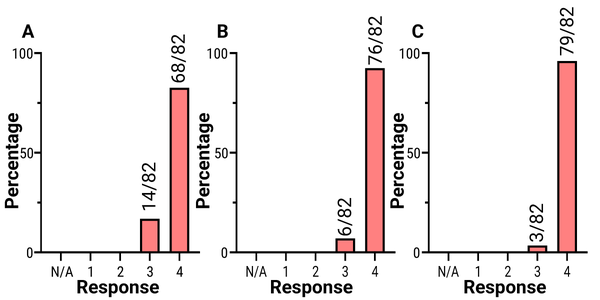
Figure 1. Participant satisfaction level, where options range from not satisfied (1) to very satisfied (4). Panel A applies to the relevance of the information provided; Panel B applies to the presentation quality of the instructors; Panel C applies to the overall quality of the training. A total of 82 participant answers were recorded.
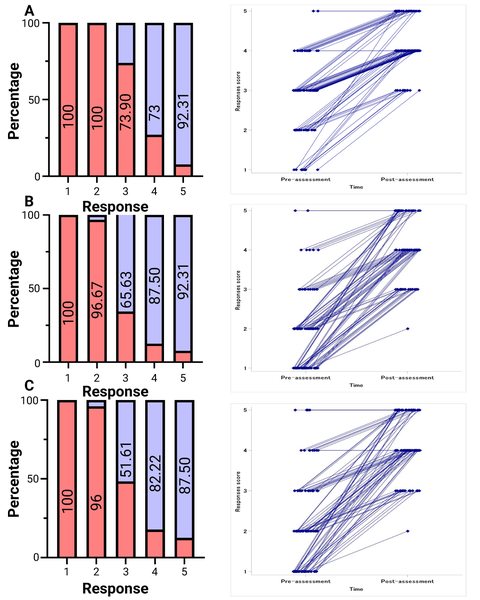
Figure 2. Participants' perceived pre- and post-workshop knowledge, where options range from very low (1) to very high (5) in topics related to cattle reproductive anatomy and physiology (Panel A), artificial insemination technique (Panel B), and AI equipment and semen handling (Panel C).
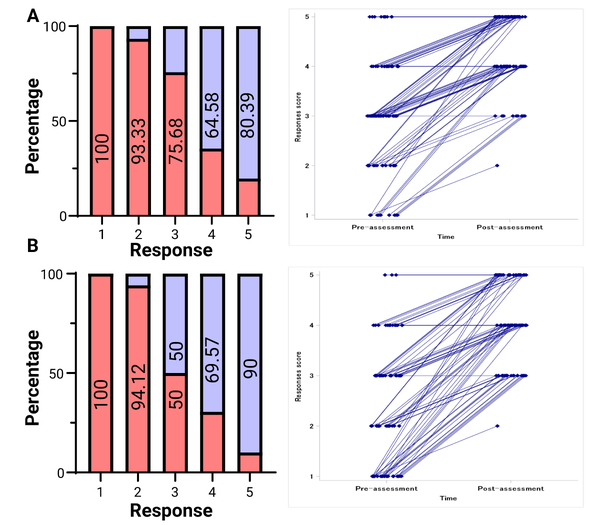
Figure 3. Participants' perceived pre- and post-workshop knowledge, where options range from very low (1) to very high (5) in topics related to heat detection (Panel A) and estrous synchronization protocols (Panel B).
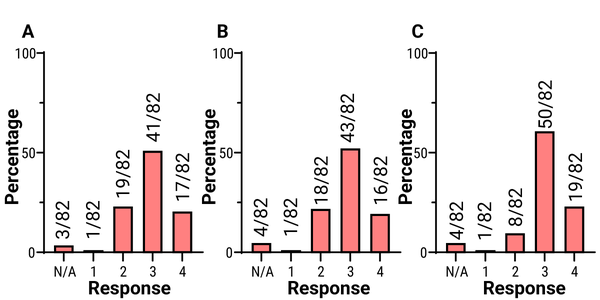
Figure 4. Participants' intention to adopt techniques learned during the workshop, including AI (Panel A), estrous synchronization protocols (Panel B), and developing a reproductive management program (Panel C).
Future Artificial Insemination Schools
For information on future artificial insemination schools, contact your local Extension livestock agent. In addition, subscribe to the NC State Extension Beef Portal to receive research-based information and learn about upcoming events.
Acknowledgments
This project was funded in part by the North Carolina Cattlemen’s Association. This work is supported by the Research and Extension Experiences for Undergraduates Program, Project Award No. 2021-673037-34642, from the U.S. Department of Agriculture’s National Institute of Food and Agriculture.
Thank you to all the participants, collaborating universities, genetic companies, Extension offices, and research stations for their contributions in making this project succeed.
References
Binelli, M., A. Gonella, and J. Bittar. 2021. Analysis of the USDA’s 2017 Cow-Calf Management Practices Results: Part 2—Breeding Practices/Reproductive Technologies. Ask IFAS — Powered by EDIS. ↲
Mohammed, A. 2018. “Artificial Insemination and its Economical Significancy in Dairy Cattle: Review.” International Journal of Research Studies in Microbiology and Biotechnology 4 (1): 30–43. 10.20431/2454-9428.0401005. ↲
Patel, G. K., N. Haque, M. Madhavatar, et al. 2017. “Artificial Insemination: A Tool to Improve Livestock Productivity.” Journal of Pharmacognosy and Phytochemistry SP1: 307–313. ↲
Publication date: Dec. 1, 2025
AG-999
N.C. Cooperative Extension prohibits discrimination and harassment regardless of age, color, disability, family and marital status, gender identity, national origin, political beliefs, race, religion, sex (including pregnancy), sexual orientation and veteran status.