
Sanitation is an under-recognized and under-utilized component of nursery weed management plans and programs. Nursery sanitation is a commitment to weed prevention and management throughout the nursery and throughout the production cycle. This begins with weed-free substrates, storing pots and flats where they will not be contaminated, producing weed-free (or as nearly weed-free as possible) liners, and preventing the introduction and spread of weeds in the production systems. One of the first steps in developing a sanitation plan is to assess the sources of weed seeds in the nursery. While some sources will be obvious, determining the source(s) of weed seeds may not be as simple as it sounds. Depending upon conditions in each nursery, potential sources may include potting substrates, weeds growing in areas near production space, liners, hedgerows (and nearby fields), roadways, and the pots themselves.
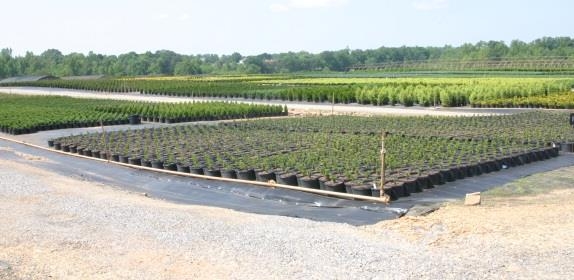
Substrates as a Source
Potting substrates such as pine bark, peat moss and perlite are generally free of weed seeds. However, when such materials are stockpiled, either at the nursery or the substrate supplier’s facility, many weeds can be introduced. The presence of weeds in or adjacent to substrate piles will provide the opportunity for weed seed introduction via wind (groundsel, horseweed, dogfennel), physical dispersal (such as the bittercress or oxalis), and encroachment by rhizomatous and stoloniferous weeds (like bermudagrass or mugwort).
Potting substrates need to be stored and mixed in areas that reduce the potential for weed seed contamination. The preferred storage area is a concrete slab. Never use recycled substrates in propagation
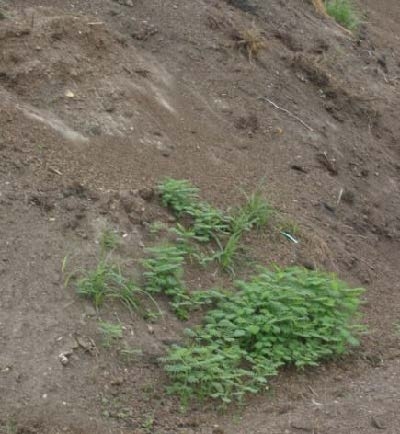
Keep substrate piles weed free. Recycled substrate, is often contaminated with many weed seeds.
Photo: J. Neal
Use New Or Clean Containers
Recycling pots and flats can introduce weeds. Whitwell1 has demonstrated that by simply washing pots and flats with high-pressure water, bittercress infestations were reduced sevenfold. Similarly, weeds should be controlled around pot storage areas to prevent the introduction of weeds into new and cleaned pots and flats.
1Personal communication: T. Whitwell, Dep. of Hort., Clemson Univ., Clemson SC
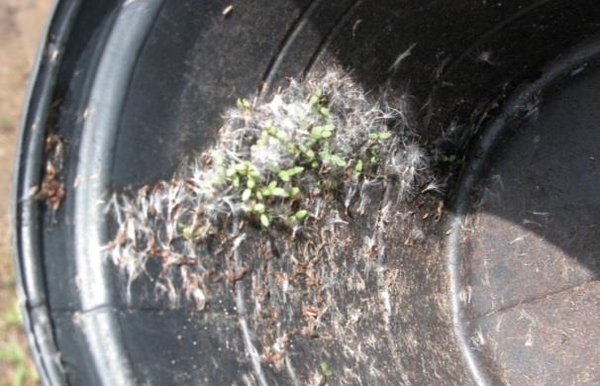
Use new or clean containers.
Storage
Store pots and flats in weed free areas, preferably on concrete or other hard surfaces. Nurseries in some regions have started steam-sterilizing flats and pots before re-use. The practice has become common in tobacco seedling production and forest nursery seedling production. Guidelines for steam sterilizing tobacco trays suggest maintaining a temperature of 176 F for at least 30 minutes for disease control. Seeds of some weeds may require longer times or higher temperatures but, to date, exact temperatures to kill seeds of most common nursery weeds have not been documented. The US Forest Service has recently reported a protocol for steam sterilization of pots and flats for disease control, but these procedures will also control most weed seeds.
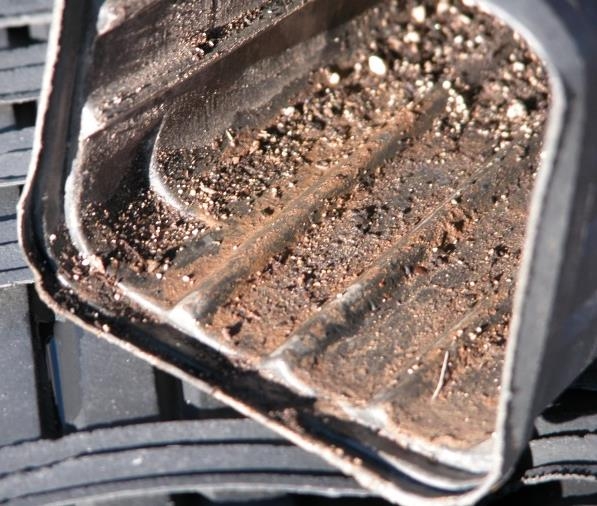
The pots and flats themselves can be sources of weed seeds, especially re-used containers. Shown here is a pot from a stack of pots intended for re-use. Groundsel seeds accumulated in the pot following a heavy rain event.
Photo: J. Neal
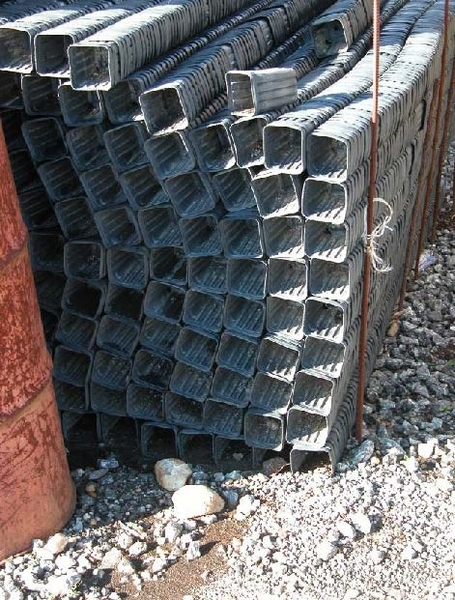
Pots stored on the ground, as shown here, are subject to washing soil and weed seeds into the pots. Store pots off of the ground to prevent weed seed contamination.
Photos: J. Neal
Dispersal
Many nursery weeds have effective means of dispersal. Bittercress, oxalis, mulberryweed, and spurges have mechanisms to disperse their seeds for several feet from the parent plant. Seeds of many other common nursery weeds (like groundsel, horseweed, willowherb, and dogfennel) are spread by wind. And other weeds are spread by splashing water, including pearlwort, liverwort and eclipta. Therefore, it is imperative that the areas around the nursery, especially propagation or liner production facilities, be kept weed-free.
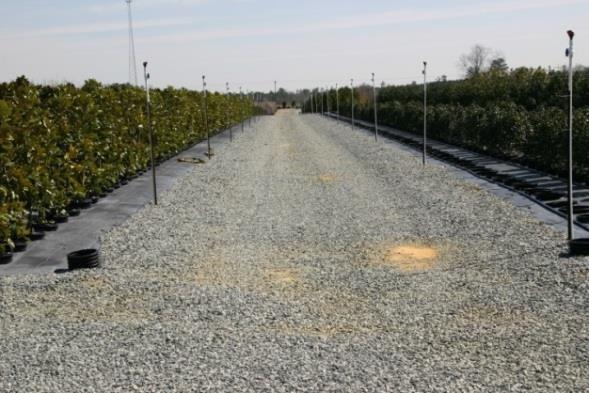
Gravel or ground cloth are often used to provide clean and relatively weed-free production areas. Each has advantages and disadvantages. Gravel provides good drainage but spilled substrate can “fill” the gravel, resulting in greater potential for weed growth. Compared to gravel, ground cloth can be more easily cleaned between crops, but spilled substrate on ground cloth can likewise provide an environment for weed growth.
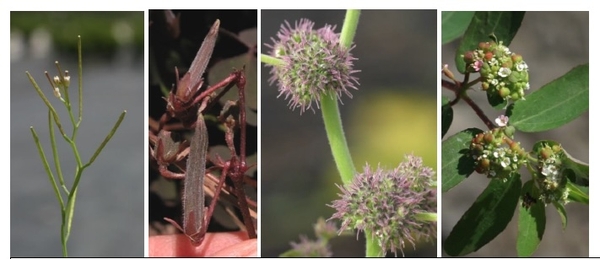
Bittercress, oxalis, mulberryweed and spurges (left to right) all have mechanisms for seed self-dispersal. Bittercress and oxalis can “shoot” seeds over 6 feet; mulberryweed, about 4 feet; and spurge from 2 to 6 feet (depending on the species).
Photos: J. Neal
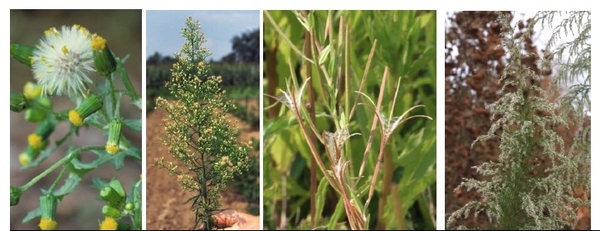
Groundsel, horseweed, willowherb and dogfennel (left to right) produce wind dispersed seeds. Control such weeds around the nursery to prevent contamination of substrate piles and crops.
Photos: J. Neal
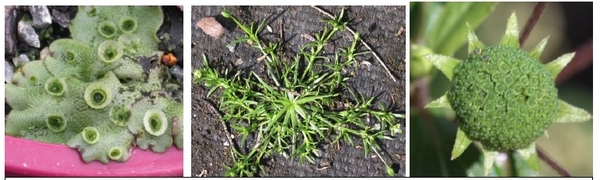
Many weeds are water dispersed. Liverwort (left) and pearlwort (center) form “cups” designed to splash plantlets or seeds when water droplets (from rain or irrigation) hit the cups. Eclipta (right) seeds will float and move with surface water.
Photos: J. Neal
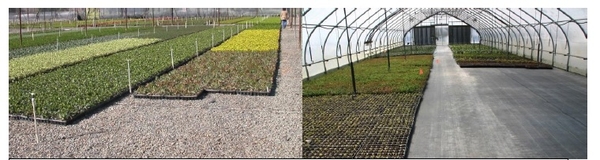
Keep propagation areas weed free to prevent infesting the crops.
Photo: J. Neal
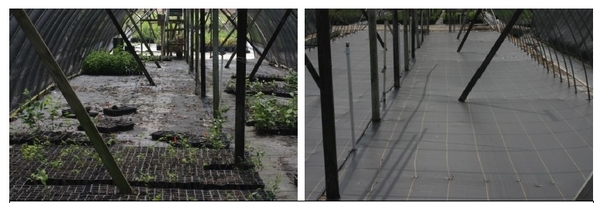
Ground cloth should be cleaned before each new crop is placed in the area.
Photos: J. Neal
Using Herbicides for Sanitation
Treating roadways, gravel production pads and other “non-crop” areas with residual herbicides will prevent most weeds. Of the many herbicides labeled for use in nursery crops, prodiamine (Barricade), flumioxazin (Sureguard) or indaziflam (Marengo) are the most commonly used herbicides for residual weed control in gravel. Preemergence herbicides typically provide 10 to 12 weeks of residual weed control, but there is some evidence that indaziflam may have longer persistence.
Which should you use? That depends on the predominant weeds in your nursery. All three control spurge (Chamaesyce spp.). Flumioxazin controls most broadleaf weeds but indaziflam is more effective on eclipta (Eclipta prostrata). If sedges (Cyperus) or marsh parsley (Cyclospermum leptophyllum) are dominant weeds, consider using dimethenamid-p (Tower) either alone or with flumioxazin. Marengo and Sureguard may also be applied to the gravel or ground under benches, around the foundation of covered structures. For more information on weed control in covered structures see Horticulture Information Leaflet: Weed Control in Greenhouses and Covered Structures.
Consider crop safety as well. In areas where tender herbaceous crops are produced it is advisable to utilize prodiamine +/- isoxaben (Gallery) as a sanitation treatment, avoiding other herbicides which have a higher potential to injure tender plants from accidental exposure (by splashing, drift, or movement in surface water). To avoid the movement of spray drift into greenhouses or other covered structures, make sure exhaust fans are off and vents are closed before spraying herbicides near greenhouses. NEVER USE soil sterilant-type herbicides, such as those containing imazapyr (Arsenal, Sahara, others), sulfometuron (Oust) or prometon (Pramitol), in or around nurseries. The risk of crop injury is too great.
If treating gravel production areas before crops are placed on the site, consider whether or not you intend to use the same active ingredient in the crop. Each herbicide has specific limits on the total amount of herbicide that can be applied to a site at one time or within a growing season. For example: if you apply Sureguard to the gravel for residual control before placing pots on the site, then you should not use Broadstar (granular formulation of the same active ingredient) as the first treatment. You may use Broadstar later in the season but for the first application one should rotate to a different active ingredient. Also keep in mind the herbicide applied to the gravel bed will count toward the yearly maximum allowed per acre per year.
Emerged weeds in roadways and other “non-crop” areas may be controlled with several postemergence herbicides including glyphosate (many trade names), glufosinate (Finale), diquat (Reward) and pelargonic acid (Scythe). These non-selective herbicides are also labeled for controlling weeds under benches and along the foundations of enclosed structures, but care must be taken to prevent spray drift onto the crop. Emerged weeds should be controlled before they have a chance to shed seed. Therefore, postemergence weed control should be a regular and on-going practice. Glyphosate resistant weeds are becoming more common. In particular, wind-dispersed weeds such as horseweed (Conyza canadensis) have spread to container nurseries. If you have treated horseweed with glyphosate and plants have re-grown following treatment, you may have resistant horseweed. Switch to glufosinate or other means to control glyphosate resistant horseweed.
A few tips for getting better weed control with postemergence herbicides:
- Use spray dye marker when applying postemergence herbicides. This ensures the applicator can see which weeds have been sprayed and which have not. It also alerts other workers to avoid these places after treatment.
- Check irrigation cycles. Many postemergence herbicides require several hours to absorb into the leaves before rain or irrigation. Different formulations of glyphosate will have different “rain-fast” intervals ranging from 1.5 to 6 hours.
- Don’t waste herbicide. When using glyphosate you don’t need to “soak it”. A light spray at a 2 to 3% solution will work just as well. Remember, all herbicide that washes off the foliage of the weed is wasted. Contact herbicides, like diquat and pelargonic acid, do require a higher spray volume for good coverage and optimum efficacy.
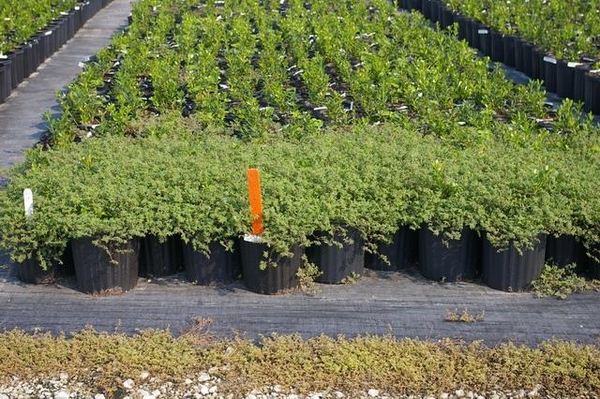
Pots near the edges are often infested by weed seeds dispersed from weeds growing on the edges of the roadways. In this example the spurge on the roadway infested the closest pots.
Photo: J. Neal
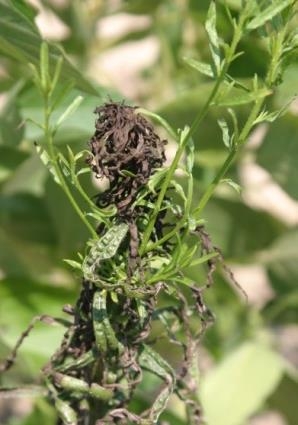
Glyphosate resistant horseweed will initially show symptoms of injury, but will re-sprout and continue to grow.
Photo by J. Neal
Start With Clean Liners
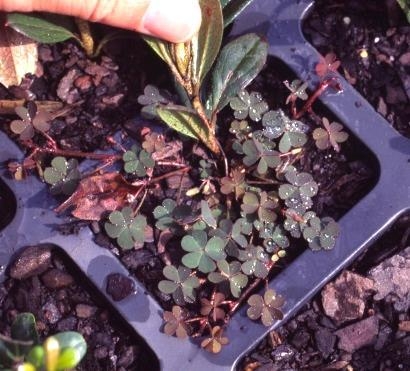
Weedy liners are perhaps the most problematic source of weeds in the nursery. Once established in a liner, weeds like oxalis can be nearly impossible to remove. Even if you pull the weeds from liners before potting, the seeds left behind will lead to weedy crops. Inspect liners before potting. If you have problems with weedy liners sources, look for other sources. If you are propagating your own liners, maintain clean liner production areas.
Prevent Weeds From Spreading
Removing weeds before they spread and reproduce can reduce future weed populations and reduce overall weed control costs. When hand weeding, remove the weeds from the site. Do not leave the debris in the production area. Some nurseries even bag weeds to prevent spread. Remember, many weeds have the ability to self-disperse their seeds – even after they have been pulled.
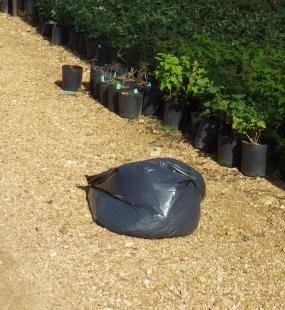
Bagging weeds prevents seeds from dispersing
Hand Weed Frequently
Removing weeds from nursery blocks before they can go to seed will decrease overall weed populations and decrease labor costs.
Get Rid of Old Stock
Old, “carry-over” stock is a common source of weeds. This weedy stock is an important source of weed seeds for new crops. If you must carry over older stock, don’t neglect the weed control. It’s a lot easier to keep pots clean than to clean-up weedy plants.
The entire weed management program will be more effective when you place an emphasis on nursery sanitation – in and around the crops.
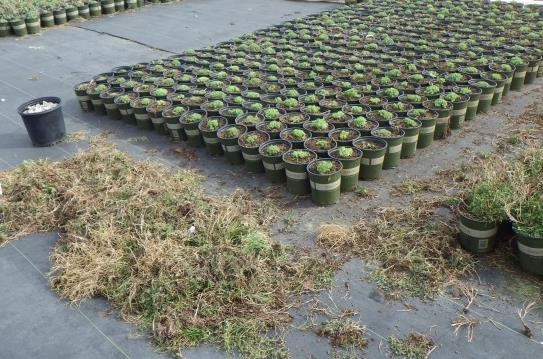
Remove weeds before they go to seed. These pots will have high populations of weeds because the weeds removed had already produced seeds.
Publication date: Aug. 22, 2016
Reviewed/Revised: June 17, 2026
Recommendations for the use of agricultural chemicals are included in this publication as a convenience to the reader. The use of brand names and any mention or listing of commercial products or services in this publication does not imply endorsement by NC State University or N.C. A&T State University nor discrimination against similar products or services not mentioned. Individuals who use agricultural chemicals are responsible for ensuring that the intended use complies with current regulations and conforms to the product label. Be sure to obtain current information about usage regulations and examine a current product label before applying any chemical. For assistance, contact your local N.C. Cooperative Extension county center.
N.C. Cooperative Extension prohibits discrimination and harassment regardless of age, color, disability, family and marital status, gender identity, national origin, political beliefs, race, religion, sex (including pregnancy), sexual orientation and veteran status.