
Biology
Two species of hornworms may be present on tobacco plants, the tobacco hornworm (Manduca sexta) and the tomato hornworm (Manduca quinquiemaculata). These species are biologically similar but easily distinguished from one another, both as larvae and as adults. Hornworm eggs are round, pale green, and laid on the upper surface of tobacco leaves (Figure 1). Newly hatched larvae are small, appear blueish to pale green with a black horn, and may be on upper surfaces of leaves. Larval tobacco hornworms have seven diagonal stripes on each side and a red posterior horn, while larval tomato hornworms have eight chevrons on each side and a bluish black horn (Figure 2). Tobacco hornworm moths have six orange spots on their abdomen, and tomato hornworm moths have five spots. Larvae feed on several solenaceous crop species, including tobacco and tomato, as their names suggest. Hornworms progress through 5 to 6 larval instars, with the majority of feeding occurring at fifth or sixth instar. The pupae of both species are dark brown and have a handle-like tongue case on the exterior. Hornworms overwinter as pupae in the soil. Adults begin to emerge in early June, and most of the damage occurs in July and later (Figure 3 and Figure 4). Two to three hornworm generations occur in North Carolina, depending upon temperature.
Here is a video that describes the lifecycle of these two species and illustrates key characteristics to tell these two species apart.
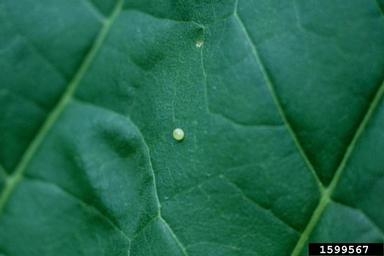
Figure 1. Hornworm egg.
John C. French Sr., Retired, Universities:Auburn, GA, Clemson and U of MO, Bugwood.org

Figure 2. Tobacco hornworm (above) and tomato hornworm (below). The tomato hornworm is smaller because it is younger. It can grow to be the size of the tobacco hornworm. Note the differences in their “horns”.
Clyde Sorenson

Figure 3. Tomato hornworm moth.
Clyde Sorenson
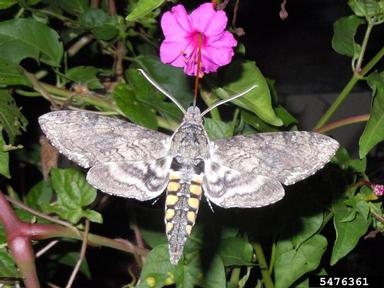
Figure 4. Tobacco hornworm moth.
Nancy Hinkle, University of Georgia, Bugwood.org
Scouting for Hornworms
It is necessary to know the density of insects and their damage (per plant or per acre) to determine if and when insecticide treatments are necessary. Tobacco and tomato hornworms are managed in the same way. Hornworm populations may occasionally develop prior to topping (as early as 4 weeks after transplant), but they are most common post topping in North Carolina. Eggs are often found in the upper part of leaves and within the upper 2/3 of plants. Hornworm larvae feed within the upper 2/3 of plants, and are often found on the underside of the leaves.
Hornworms can cause substantial damage to a plant, which is often clearly noticeable. Feeding holes caused by larvae are smooth on the edges and can be very large. Hornworm “frass” or droppings are distinctively barrel-shaped and also indicative of an infestation (Figure 5 and Figure 6). Frass can be found around the stalk or in the upper part of leaves and can help to find nearby feeding larvae. Remember, however, that hornworm thresholds are based on insect counts, not on frass or damage observations.
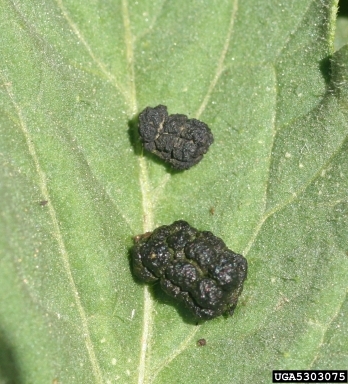
Figure 5. Hornworm barrel-shaped frass.
Whitney Cranshaw, Colorado State University, Bugwood.org
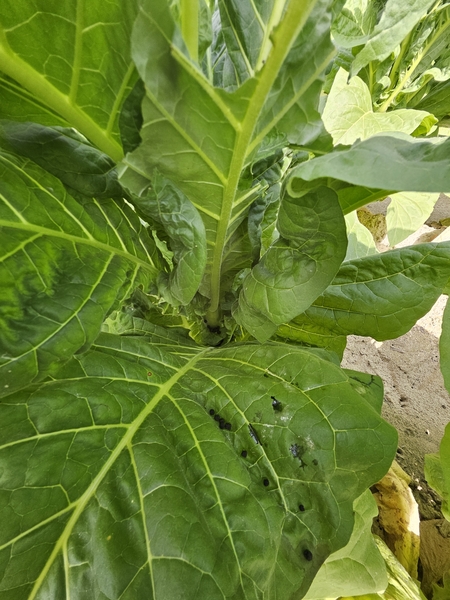
Figure 6. Hornworm frass on a tobacco plant.
Lorena Lopez
Thresholds and Management
Insects should only be treated when their densities exceed recommended economic thresholds. This practice ultimately saves money, protects workers and the environment, and has the potential to reduce pesticide residues by avoiding unnecessary applications. Treating only when insects reach thresholds is also a key component of integrated pest management (IPM) practices required as part of tobacco GAP programs.
Multiple hornworms may be present on a single plant. As these caterpillars can eat a lot of tobacco in a short period of time, once scouting has revealed populations above threshold, growers should take quick action to prevent defoliation. Hornworms are voracious feeders; two hornworm larvae are capable of completely defoliating a tobacco plant, and moderate populations in a field can result in significant damage.
Treatment is justified (threshold) when one or more hornworms larger than 1 inch and without parasite white cocoons are found per 10 plants checked (same as 10% infestation). Since larvae with parasite cocoons eat much less (approximately 1/5 as much as a healthy, non-parasitized larva), they should be counted as 1/5 of a caterpillar, meaning five worms with cocoons equal one healthy worm. Avoid removing parasitized hornworms as the adults emerging from the cocoons will continue to play an important role in reducing feeding on other hornworms in the field.
Insecticides such as chlorantraniliprole and cyantraniliprole have shown excellent and good activity against hornworms; however, these products are related to residue concerns by some tobacco buyers. Make sure to discuss any insecticide residue concerns with buyers before considering applications with these products late in the season. Other insecticides like spinosad (especially against young larvae), and indoxacarb have also shown excellent efficacy against hornworms and are not related to leaf residues when applied as foliar applications late in the season.
See the Flue-Cured Tobacco Guide or the North Carolina Agricultural Chemicals Manual for registered materials, rates, and application recommendations.
Biological Control
Many native biological control agents feed on hornworms in North Carolina, and these predators and parasites play an active role in reducing the damage hornworms cause. The most obvious hornworm parasitoids are the braconid wasp Cotesia congregata. These wasps lay their eggs inside of first to third instar hornworm larvae. As the caterpillars mature, so do the wasp larvae. The wasp larvae then emerge from the fourth or fifth instar hornworm and pupate in white cocoons on their backs (Figure 7). A parasitized hornworm eats roughly 1/5 that of a non-parasitized worm. Many species of wasps (Polistes spp.) use hornworms and other caterpillars as food for their larvae. Growers and scouts who are fortunate enough to see parasitized hornworms should keep in mind that visibly parasitized hornworms feed slowly and die before completing development.
Stilt bug adults and nymphs (Jalysus spinosus) are a species of true bugs that feed on both tobacco budworm and hornworm eggs (Figure 8). These are often found in summer within the top 2/3 of the plants searching for lepidopteran eggs (Figure 9). Tachinid fly parasitiods (Winthemia spp. and Archytas marmoratus) also attack hornworms, killing them in the pupal stage. These flys can also lay eggs near the head of advanced larval instars when they are close to pupate (Figure 10).
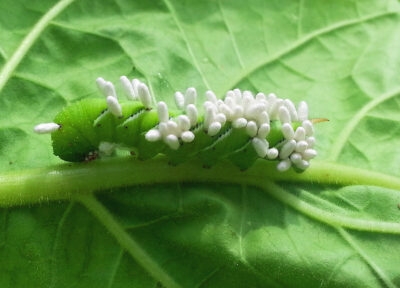
Figure 7. Parasitized hornworm by braconid wasp. Although the white bodies look like “eggs”, they are actually wasp cocoons.
Demetri Tsiolkas

Figure 8. Stilt bug (Jalysus spp.).
Susan Ellis, Bugwood.org
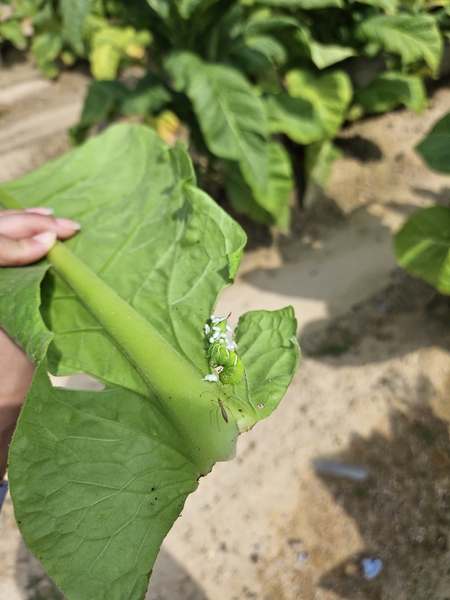
Figure 9. Stilt bug near a parasitized hornworm.
Lorena Lopez

Figure 10. Tachinid fly stalking a hornworm larva.
Lorena Lopez
Publication date: Aug. 5, 2025
N.C. Cooperative Extension prohibits discrimination and harassment regardless of age, color, disability, family and marital status, gender identity, national origin, political beliefs, race, religion, sex (including pregnancy), sexual orientation and veteran status.