
General Information
Downy mildew is a disease caused by fungal-like organisms that can affect a wide variety of popular bedding plants. While this fact sheet will focus primarily on common bedding plants, downy mildews affect many other commercially important crops.
Pathogen
The downy mildew pathogens that infect bedding plants are a range of mostly host specific species found in the genera Basidiophora, Hyaloperonospora, Peronospora, and Plasmopara. These organisms closely resemble fungi but, among other differences, have distinct cell wall compositions and modes of reproduction, which classifies them in a different taxonomical kingdom than fungi and are most closely related to brown algae. Downy mildew pathogens are obligate parasites, meaning they require a host plant to reproduce and cannot be cultivated in the laboratory.
Host Plants
A wide range of bedding plants are susceptible to downy mildew, including Impatiens, China aster, snapdragon, Coleus, spider flower, Lisianthus, Gerbera daisy, primrose, common sage, red salvia, Texas sage, Viola/pansy, Verbena, sweet alyssum, and garden stock. In North Carolina, Coleus downy mildew is the most common based on records in the NC State Plant Disease and Insect Clinic.
Most downy mildew pathogens are host specific. For example, Plasmopara obducens only infects impatiens and Peronospora antirrhini only infects snapdragons. Certain other downy mildew pathogens have a broad host range. For example, Hyaloperonospora parasitica, which infects both sweet alyssum and stock, infects many other crops in the Brassicaceae family.
Favorable Environmental Conditions for the Disease
The optimum environmental conditions for downy mildew is specific to each downy mildew pathogen. However, in general, disease is favored by cool temperatures and high humidity conditions (60 to 80°F and humidity greater than 85%). Under these conditions, the infection can progress rapidly.
Symptoms and Signs
Symptoms of downy mildew vary based on the host plant. Often the first symptom is chlorotic (yellowing or losing green pigment) or necrotic spots on leaves, but the severity and pattern can vary by host plant. For example, infected leaves of Coleus will exhibit larger necrotic areas (Figure 1), whereas the chlorotic spots on infected autumn sage leaves are typically smaller, patchier and more dispersed (Figure 2). Water-soaking or a greasy appearance also may be observed depending on the conditions or the host (Figure 3).
Downy mildew pathogens produce sporangia (spores) on the underside of leaves only and can help in diagnosing the disease (Figure 4, Figure 5). Sporulation can appear as patches of white, purplish, or gray fuzz. Other symptoms include leaf distortion and stunting, especially when the plant is infected at a young age. As the disease progresses, leaves may fall off and eventually the plant may die. However, the infection may also remain localized, depending on plant species, age, and health, as well as environmental conditions.
There are many other abiotic and biotic problems that can look like downy mildew, so it is important to contact your local extension agent and/or submit samples to the NC State Plant Disease and Insect Clinic for assistance.
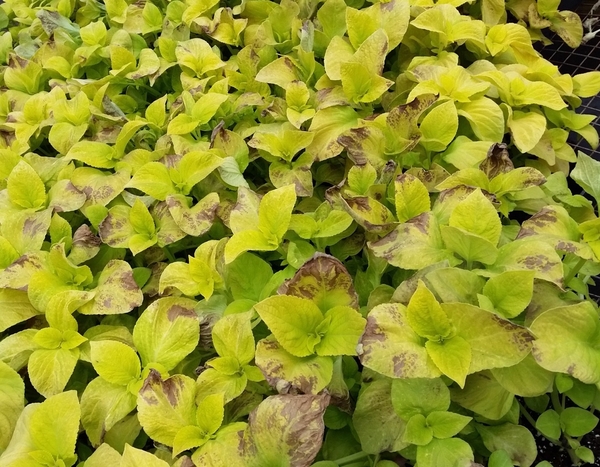
Figure 1. Downy mildew on Coleus.
Inga Meadows
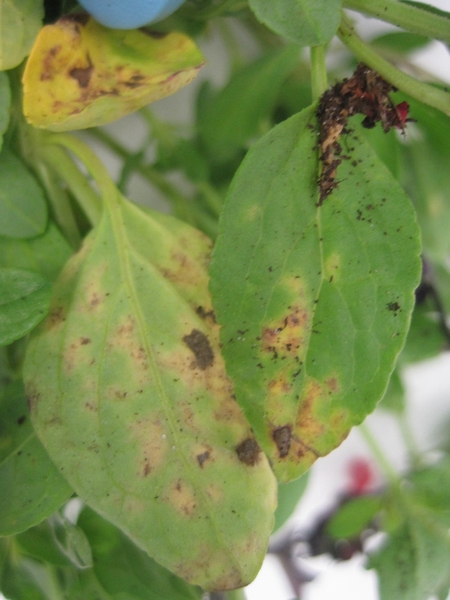
Figure 2. Downy mildew on autumn sage
NC State Plant Disease and Insect Clinic
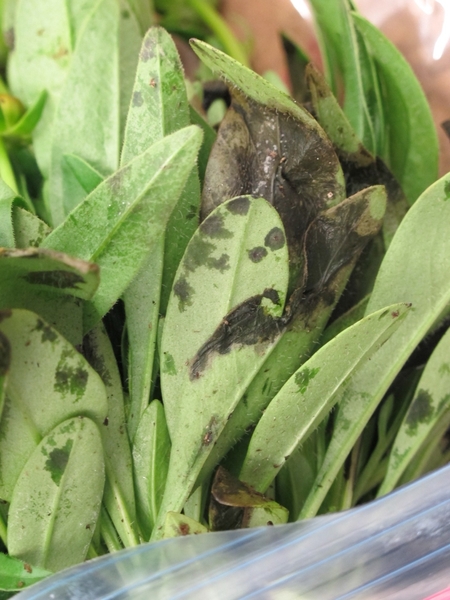
Figure 3. Water-soaking symptoms on leaves of tickseed with downy mildew.
NC State Plant Disease and Insect Clinic
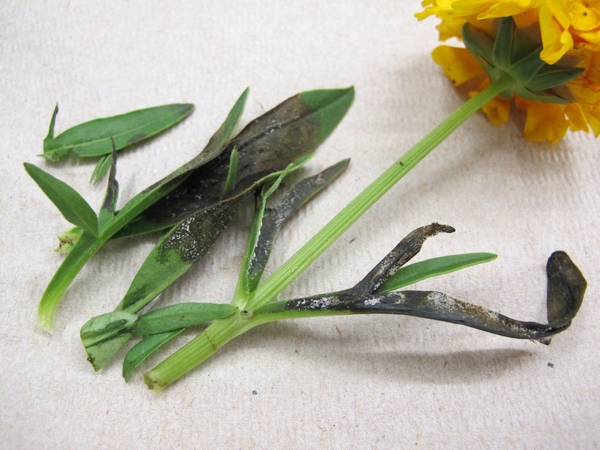
Figure 4. Sporulation (white fuzz appearance) on leaves of tickseed infected with a downy mildew pathogen.
NC State Plant Disease and Insect Clinic
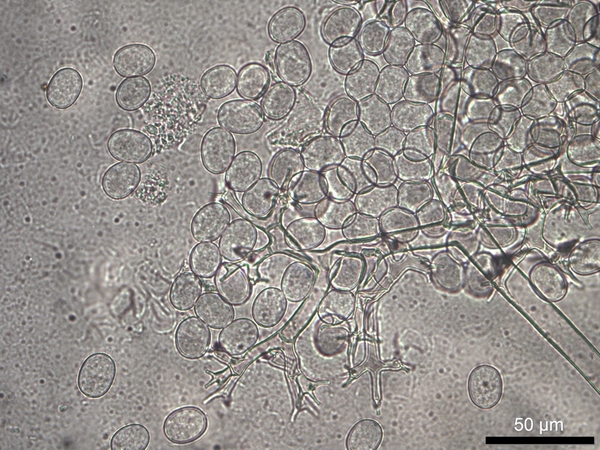
Figure 5. Sporangia and sporangiophore (structure that bears sporangia) of the downy mildew pathogen that affects tickseed (Plasmopara halsteadii).
NC State Plant Disease and Insect Clinic
Disease Cycle
Sporangia are the asexual spores of the downy mildew pathogen that infect plants. Sporangia can be spread by air currents (long distance) or water splash (short distance). The sporangia germinate directly and enter the plant through stomata (respiratory pore on the undersides of leaves). The pathogen can grow throughout the leaf tissue and produce sporangia through stomata creating masses of sporangia on the undersides of the leaves. These sporangia are then dispersed to neighboring plants and the cycle continues. Some members of the downy mildew pathogens may form sexual, survival structures (oospores) that can remain in the soil and plant debris through the winter. In the spring, or when conditions are conducive, the oospores germinate into sporangia which then can initiate a disease outbreak.
General Disease Management
The downy mildew pathogens tend to be aggressive and, thus, there are few effective cultural practices to reduce disease.
- Select plants resistant to downy mildew. This is the most effective way to reduce disease. There are some commercially available varieties of bedding plants known to be resistant or less susceptible to downy mildew (e.g., some varieties of Coleus and pansy) or select plants that do not get downy mildew, such as New Guinea impatiens.
- Minimize humidity. If planting in a greenhouse, try to maintain humidity below 85%. If planting outdoors, improve air circulation by widening plant spacing, thinning, staking, and pruning plants. Use a drip irrigation instead of an overhead watering system, if possible. These practices may reduce the severity of disease, but will not eliminate it.
- Remove infected plant material to reduce disease in subsequent years. Removing infected plant material is only effective for the downy mildew pathogens that form the survival structure (oospores). Discard infected material in the trash rather than compost since the pathogen can remain in the soil and plant matter through the winter. It is important to inspect new plant material for symptoms to avoid introducing the pathogen to a new area.
- Remove weeds in surrounding areas. Nearby weeds may be hosts for the pathogen, but this varies by pathogen.
Disease Control for Homeowners
Homeowners should focus on taking preventative measures against downy mildew by following the recommendations above. There are no effective fungicides to manage downy mildew for homeowners.
Disease Control for Conventional Growers
In addition to the recommendations above, fungicides can be used to control downy mildew. The following table lists commercially available fungicides known to mitigate downy mildew (Bremia lactuae, Peronospora spp., Plasmopora viburni) on floriculture crops in greenhouses. For more information on the efficacy of the products, see table 10-11B in the NC Agricultural Chemicals Manual. Before applying any of these chemicals, consult the product label and take necessary precautions. Also, be sure to rotate fungicides in different FRAC groups to prevent the pathogen from developing resistance to the chemical.
|
Pesticides and Formulation |
FRAC |
Rate of Formulation |
Schedule and Remarks |
|---|---|---|---|
|
azoxystrobin (Heritage WG) (Heritage SC)
|
11 |
2 to 4 oz/100 gal 3.8 to 7.7 fl oz/100 gal
|
Apply every 7 to 21 days during periods of active plant growth and prior to dormancy or severe infection. Use lower use rates for herbaceous seedlings. Do not make more than 3 sequential applications before alternating with a fungicide of a different mode of action. |
|
azoxystrobin + benzovindiflupyr (Mural WG)
|
11 + 7 |
4 to 7 oz/100 gal |
Apply every 7 to 14 days. |
|
chlorothalonil + thiophanate-methyl (various)
|
M05 + 1 |
(See label) |
Minimum re-treat interval is 7 days. Do not apply to green or variegated pittosporum or schefflera more than once. Apply only when foliage and flowers are dry or nearly dry |
|
copper (various) |
M01 |
(See label) |
Begin at first sign of disease and repeat at 7 to 14-day intervals. Do not tank mix copper formulations with Aliette. Avoid contact with metal surfaces. Discoloration of blooms may occur on certain plant varieties – check label. Phytotoxicity may occur; test a small number of plants first before treating an entire crop. Check label ratesfor crops in dormancy.
|
|
cyazofamid (Segway O) |
21 |
2.1 to 3.5 fl oz/100 gal |
14 to 21-day intervals using another registered fungicide with a different mode of action. Apply sufficient volume to wet all foliage until runoff (normally 50 to 100 gallons per acre). Check label for when to use an adjuvant or surfactant
|
|
dimethomorph (Stature SC) |
40 |
6.12 to 12.25 oz/100 gal |
Apply at first sign of disease. Apply to obtain complete coverage of flowers, foliage, and stems. Repeat at 10 to 14-day intervals throughout the production cycle.
|
|
dimethomorph + ametoctradin (Orvego)
|
40 + 45 |
11 to 14 fl oz/100 gal |
Apply on 10 to 14-day intervals using another registered fungicide with a different mode of action. Apply sufficient volume to wet all foliage until runoff (normally 50 to 100 gallons per acre). |
|
fenamidone (Fenstop) |
11 |
7 to 14 fl oz/100 gal |
Apply as a foliar spray until wet. Repeat as necessary on a 28-day schedule. Do not apply more than 2 applications per crop per season. |
|
fluoxastrobin (Disarm G) (Disarm 480SC) |
11 |
18 oz/cu yd (soil mix) 1 to 4 fl oz/100 gal |
Apply as a surface application or incorporate into soil mixture. It may take 1 to 3 weeks for the product to translocate through the plant and provide sufficient protection. Apply every 7 to 21 days. |
|
fluoxastrobin + myclobutanil (Disarm M)
|
11 + 40 |
6 to 11 fl oz/100 gal |
Apply on a 7 to 21-day schedule. Season limits apply. |
|
fluopicolide (Adorn F) |
43 |
1 to 4 fl oz/100 gal |
No more than 2 applications per cropping cycle. Do not apply sequentially; rotate with a fungicide with a different mode of action. Reapply on a 14 to 28-day schedule. |
|
fluxapyroxad + pyraclostrobin (Orkestra Intrinsic) |
7 + 11 |
8 to 10 fl oz/100 gal |
Apply preventatively on a 7 to 14-day interval. Check label for specific species of downy mildew as rates may differ. |
|
fosetyl-Al (Aliette 80WDG) |
P07 |
1.25 to 4 lb/100 gal |
Aliette: Do not exceed 400 gallons of spray solution per acre. Do not exceed 1 application every 14 days. Check label for compatibility with copper and other compounds. Aliette is not compatible with the flowable form of Daconil 2787. Do not mix Aliette with any sticker, extender, or wetting agent.
|
|
mancozeb (various) |
M03 |
(See label) |
Begin at first sign of disease. Repeat at 7 to 10-day intervals. Most effective when applied prior to infection. Not for use on marigold. |
|
mandipropamid (Micora) |
40 |
4 to 8 fl oz/100 gal |
This product can also be used on vegetables sold to the retail market in GH with permanent flooring. Apply prior to disease development. Repeat sprays at 7 to 14-day intervals. Make no more than 2 sequential applications, then rotate to another fungicide with a different MOA. |
|
mefenoxam (Subdue Maxx) (Subdue GR) |
4 |
0.5 to 1 fl oz/100 gal See label |
Make only 1 application of Subdue MAXX before switching to a fungicide with a different mode of action. Apply Subdue Maxx as a foliar spray or soil drench treatment. Apply Subdue GR as a soil surface or soil/planting media incorporation treatment – see label for rates. |
|
phosphorous acid, mono- and di-potassium salts of (various) |
33 |
(See label) |
Apply prior to disease development. Do not apply to plants that are heat or moisture stressed or dormant. Spray to thoroughly wet all foliage. Avoid application when conditions favor prolonged periods of leaf wetness (>4 hours). Follow labels for repeat application limits and other application method rates. |
|
oxathiapiprolin (Segovis) |
49 |
0.6 to 3.2 fl oz/100 gal |
Begin foliage applications prior to disease development and continue on 7 to 14-day interval when conditions are conducive for disease development. Do not apply more than 2 consecutive applications before switching to another non-Group U-15 fungicide. |
|
polyoxin D zinc salt (Affirm WDG) |
19 |
0.25 to 0.5 lb/100 gal |
Apply as a foliar spray every 7 to 10 days. Apply prior to disease development and when conditions are conducive for disease. |
|
potassium bicarbonate (MilStop) |
N/A |
1.25 to 5 lb/100 gal |
Uniform and complete coverage of foliage is essential for best results. See label for special instructions regarding poinsettia, pansy, and impatiens. |
|
potassium phosphite (Confine Extra, Rampart) |
N/A |
1 to 2 qt/100 gal |
Repeat at 2 to 4-week intervals. Do not apply as a foliar spray to plants treated with copper at less than 20-day intervals. |
|
pyraclostrobin (Insignia) (Insignia SC Intrinsic) |
11 |
4 to 8 oz/100 gal 3 to 6.1 fl oz/100 gal
|
Apply prior to onset of disease and repeat every 7 to 14 days. Do not expose flowering impatiens or flowering petunias to Insignia. |
|
pyraclostrobin + boscalid (Pageant Intrinsic) |
11 + 7 |
12 to 18 oz/100 gal |
Apply prior to disease development. Repeat at 7 to 10-day intervals. Make no more than 2 sequential applications. Do not expose petunia or impatiens in flower or wintercreeper or nine bark to spray or drift as injury may occur. |
|
thiophanate-methyl + mancozeb (Zyban WSB) |
1 + M03 |
24 oz/100 gal |
Apply at first sign of disease and repeat at 7-day intervals. |
|
trifloxystrobin (Compass 50WDG) |
11 |
1 to 2 oz/100 gal |
Apply as a foliar spray before disease is detected or when conditions are favorable for disease. Repeat at 7 to 14-day intervals until threat of disease is over.
|
Resources
The 2025 North Carolina Agricultural Chemicals Manual provides information on the selection, application, and safe use of chemicals.
The NC State University Extension Plant Pathology Website provides information on crop disease Management.
The Southeastern US Pest Control Guide for Nursery Crops and Landscape Plantings provides information regarding control products used in nursery crops, greenhouse crops, and ornamental landscapes.
The NC State University Plant Disease and Insect Clinic (PDIC) provides diagnostics and control recommendations.
Sources
Backerman, J. (2022). Diseases of Landscape Plants, Downy Mildew. Purdue University Extension.
Chase, A.R., Daughtrey, M.L, Cloyd, R. A. (2018). Compendium of Bedding Plant Diseases and Pests. APS Press. College of Agriculture and Life Sciences, North Carolina State University. (2024). 2024 North Carolina Agricultural Chemicals Manual. NC State Extension.
Dicklow, M.B., Madeiras, A. (2018). Downy Mildews of Ornamental Plants. UMass Extension Greenhouse Crops and Floriculture Program.
Hausbeck, M., Harlan, B., Lopez, R. (2020). Don’t let downy mildew on impatiens surprise you. Michigan State University Extension.
Pollard, A. (2023). Addressing Downy Mildew and Powdery Mildew in the Home Garden. PennState Extension.
Rossman, A.Y., Palm, M.E. (2006). Why are Phytophthora and other Oomycota not True Fungi?. Plant Health Instructor APS.
Publication date: Oct. 7, 2025
Reviewed/Revised: Jan. 7, 2026
N.C. Cooperative Extension prohibits discrimination and harassment regardless of age, color, disability, family and marital status, gender identity, national origin, political beliefs, race, religion, sex (including pregnancy), sexual orientation and veteran status.
Recommendations for the use of agricultural chemicals are included in this publication as a convenience to the reader. The use of brand names and any mention or listing of commercial products or services in this publication does not imply endorsement by NC State University or N.C. A&T State University nor discrimination against similar products or services not mentioned. Individuals who use agricultural chemicals are responsible for ensuring that the intended use complies with current regulations and conforms to the product label. Be sure to obtain current information about usage regulations and examine a current product label before applying any chemical. For assistance, contact your local N.C. Cooperative Extension county center.
N.C. Cooperative Extension prohibits discrimination and harassment regardless of age, color, disability, family and marital status, gender identity, national origin, political beliefs, race, religion, sex (including pregnancy), sexual orientation and veteran status.