
Introduction
Since 2021, researchers have evaluated sesame as a viable alternative crop for North Carolina. Through a collaboration between NC State, the NCDA&CS, and N.C. Cooperative Extension, we have developed production recommendations tailored specifically to our state’s growing conditions. This guide is designed to provide the foundational knowledge necessary for farmers interested in adding sesame to their crop rotation. Please note that while this guide is robust, it is not exhaustive. Our objective is to share essential production knowledge derived from local trial data and farmer experiences.
Description
Sesame (Sesamum indicum L.) is a warm season, annual broadleaf crop that likely originated in sub-Saharan Africa but was domesticated in India. It is the only agronomic crop from the family Pedaliaceae and shares no relation to any of our commonly grown agronomic crops. Sesame plants can grow between 2’ to 8’ in height depending on genetics, fertility, water availability, row spacing, and plant populations. Plants start flowering as early as 30 days after planting and continue flowering until ~75-80 days after planting. Growth is indeterminate: sesame will continue to produce new flowers at the apical meristem as capsules and seeds from older flowers begin to mature (Figure 1).
Flowers only bloom for one day, after which they fall to the ground. New farmers may be alarmed at the number of blooms that litter the ground, but this is completely normal. Each flower can become a capsule containing ~50-70 sesame seeds. In nature, sesame capsules shatter once seed are mature. Many varieties grown in developing countries still shatter and thus require manual harvest. Fortunately, breeders developed non-dehiscent or shatter resistant lines, which allowed for mechanical harvest. It is important to note that these lines are not truly shatter resistant: capsules will open slightly at the top along the seams, which poses a risk for seed damage and/or loss if not harvested in a timely fashion.
Sesame seeds produced in NC are white/tan, though black seeded varieties exist. Seeds are very high in oil (~50%) and can be used for baking/confectionary, pressed for oil, or ground into a paste (tahini).
Texas, Oklahoma, and parts of Kansas have been the major sesame producing regions in the US. Sesame’s impressive drought tolerance is one of the major factors that has allowed this crop to do well in this arid production region.
Sesame has proven to be highly deer resistant. In the five years that we have worked with this crop we have never seen any deer damage. These observations were confirmed by producers in Texas and Oklahoma. Numerous farmers across North Carolina stated that sesame was the only crop they could produce in certain fields that are regularly browsed to death by deer.
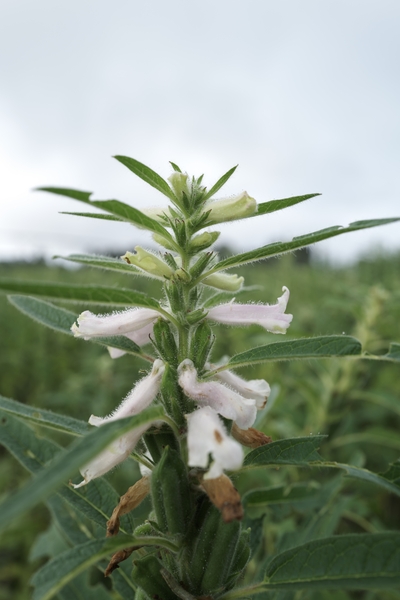
Figure 1. Sesame is indeterminate and will contain maturing capsules, recently opened blooms, and developing flower buds along the same stem.
Site Selection
Soil type does not appear to be a limiting factor for sesame production: we have produced excellent crops from the heavy Cecil red clay soils in Piedmont to the course, deep sandy soils in the Sandhills. Soil pH should be similar to traditional row crops (5.5 – 7), though research in optimal pH is lacking.
Care should be taken to select fields that do not have a history of holding water as sesame is not tolerant of waterlogging and will quickly die in saturated conditions (Figure 2).
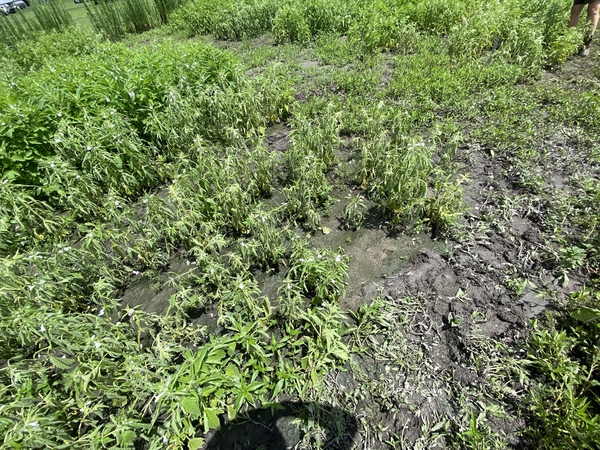
Figure 2. Sesame showing severe stress in waterlogged soils.
Variety Selection
Currently, Sesaco and Equinom are the two major seed breeders in the US. We have conducted variety trials in 2021-2022 and 2024. Varieties come and go so it is important to discuss what varieties are available with the seed dealer and/or contractor.
Field Preparation and Planting
Sesame should be planted once soils reach ~70 ºF, which is usually around the middle of May. We do not recommend planting sesame any later than the first week of July. Sesame requires ~100 days to reach full seed maturity and an additional 7-14 days to dry down completely for harvest. Timely planting is critical to optimize yields.
Fields should be weed free and as clean as possible at planting. Sesame is not a competitive crop with weeds and we are limited in labeled herbicide options. A pre-plant burndown application of Glyphosate or Gramoxone can be used along with shallow tillage. Sesame can be no-till planted, but care should be taken to minimize prior crop residue that may impede proper seed placement and emergence.
Planting is the most challenging aspect of sesame production. Though small, sesame seeds need to be planted deep to ensure proper placement in moist soil. The seed needs three days of moisture to germinate. If the soil dries during those three days the seed dies. Consequently, we recommend setting planter depth to 0.25” below the line of defined moisture. Final planting depth can range from 0.5”-1” depending on available moisture, soil type, and temperature. Sesame seeds are sensitive to compaction. Release as much of the closing wheel down pressure as possible. The goal is to simply cover the seed trench with loose soil. It is also critical to never plant if rain is in the forecast over the ensuing 5 days. We have seen the down pressure caused by rain be severe enough to inhibit emergence even in soils that do not form a crust.
Sesame can be planted flat or on beds. Beds require more labor but provide several benefits. Knocking the top off the bed prior to planting allows for planting directly into a layer of moist, friable soil, and can lead to uniform emergence. Bedded soils tend to warm up faster than flat ground, which could lead to an earlier planting date. Beds also shed water in heavy rain and reduce the risk of loss due to wet feet.
Row Spacing and Plant Populations:
Sesame shows a high degree of phenotypic plasticity: it will grow tall and slender if planted in narrow rows versus short and branched in wider rows. We found that yields did not differ when grown on 7.5” (drilled), 15”, and 30” row spacing. We advise against using a grain drill to plant sesame. Drills often lack precise depth control, and the resulting narrow rows restrict airflow, prevent in-season cultivation, and encourage rank growth susceptible to lodging.
Most traditional planters can be used to plant sesame except for a Kinze brush type meter. Milo and sugar beet plates can be used. For more information on planter type, plates, and settings, see Appendix I in Sesaco’s production guide. We have also used a sesame-specific metering disk from Thunderstruck® Ag Equipment with good results. Do not completely fill the seed hoppers as the seed weight can be enough to crush the delicate seed or cause clogging. One pound of sesame contains approximately 150,000 seeds, which fits in the palm of your hand, so a little goes a long way.
Currently we recommend seeding at a rate of 1 lb/ac or 150,000 seed/ac. Earlier recommendations, and those for Texas and Oklahoma, were significantly higher but we found that these high rates led to crowded, rank growth that was susceptible to lodging later in the season (Figure 3).
When checking for proper seed depth, make sure that seed are metering at the appropriate rate. The table below provides the number of seed per linear row foot to achieve 150,000 seed/ac.
Table 1. Seed per linear foot for different row spacing to achieve 150,000 seed/ac. |
|
|
Row spacing (in) |
Seed/linear foot |
|
15 |
4.3 |
|
22 |
6.3 |
|
30 |
8.6 |
|
36 |
10.0 |
|
40 |
11.5 |
Seeds should emerge within 3 – 5 days under optimal soil moisture and temperature. Skips can occur, but the general rule of thumb is that if there’s no more than 2’ between plants the stand is enough to produce a good crop. If stands are thinner than this, growers should be prepared to replant. As mentioned earlier, sesame is highly plastic and can fill in open spaces with branched growth.
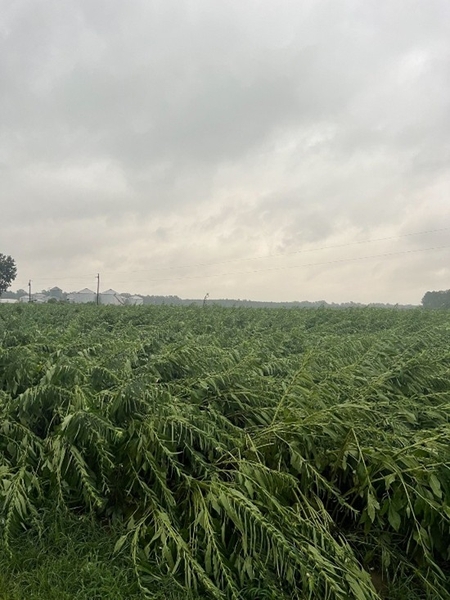
Figure 3. Lodged sesame following a severe storm. High plant populations led to overly tall, weak stems.
Nutrient Management:
Sesame fertility requirements are low, likely due to the deep root system’s ability to tap into nutrient pools many of our common field crops cannot reach. Nitrogen rate trials in 6 locations over two years did not show a consistent nitrogen response in the crop. Our current recommendation is to apply no more than 50 lb N/ac. Higher rates of nitrogen may cause more harm than good as it can promote lush, leafy, and tall growth that is more prone to disease and lodging. Preliminary work evaluated nitrogen fertilizer split-applied at planting and at canopy closure. Recent research has evaluated fertilizer timing and there may be a slight increase in yield and improved plant architecture when fertilizer application is delayed until the onset of flowering. We have not evaluated other macro- or micronutrient needs; however, in 2025 we saw numerous instances of poor capsule production on otherwise healthy plants. These fields all had low potassium soil test reports, and none was applied prior to planting. While these are not conclusive observations, we recommend applying a balanced amount of fertilizer (e.g. 50 lb N – 50 lb P – 50 lb K).
Weed Management:
Weed management can be the biggest challenge to producing a successful sesame crop. Sesame’s growth rate is very slow during the first 25 days. During this time the crop is putting down a deep tap root, but little growth is occurring above ground. Consequently, sesame does not compete well against most warm season weeds. Compounding the issue further is the fact that few herbicides have sesame on the label. As mentioned earlier, Glyphosate or Glufosinate can be used as a burndown prior to planting. Ethalfluralin (Sonalan HFP) is currently the only pre-emergent herbicide labeled for use in sesame. However, current recommendations for use include planting 45 days after Sonalan application to minimize crop damage. We have seen good results with S-metolachlor (Dual Magnum), however damage can occur in course/sandy soils after rain. Dual Magnum is not currently registered for use in sesame, but ongoing work by the IR-4 program may lead to registration. Sethoxydim (Poast) and clethodim (Select Max) are labeled post-emergence grass herbicides that are effective. These herbicides should be applied prior to flowering as they can damage flowers and ultimately reduce yield.
Sesame responds well to tillage. Soil can be thrown on the stems, like tobacco, with no ill effects. Many growers state that sesame growth seems to perk up following tillage.
Disease and Insect Management
Foliar diseases can appear later in the season. Fortunately, there are multiple fungicides that can be applied including Propiconazole (Tilt), Azoxystrobin (Quadris), and Pyraclostrobin (Headline). We recommend two applications of Azoxystrobin or Pyraclostrobin starting at flowering to manage Alternaria leaf spot. In 2024 we saw a lot of Cercospera leaf spot around the state, which can be managed with Tilt so growers should be ready to apply both products. If left untreated, these diseases can cause damage to the capsules resulting in premature capsule opening and reduction in yield and seed quality.
Common insect pests in sesame include aphids, stinkbugs, and corn earworms. There are no established economic thresholds for these pests in sesame. Growers should scout fields for pest pressure and damage. Aphid damage usually occurs at the apical meristem where aphids and their black sap can be seen. Extreme amounts of aphid sap can cause issues when harvesting. Corn earworms will burrow into the maturing capsules causing seed damage (Figure 4). Labeled products include Chlorantraniliprole (Vantacor), Zeta-Cypermethrin (Mustang Maxx), and Sulfoxaflor (Transform).
Sesame has been shown to be resistant to multiple root-knot nematode species including Southern and Guava root-knot nematodes. Current research is investigating the impacts of sesame when planted in rotation with susceptible crops in fields with root-knot nematode pressure. We are especially interested in determining if sesame can reduce root-knot nematode pressure and provide a positive carryover effect on the subsequent susceptible crop.
Carefully read and follow the labeled application rate and timing for all pesticides used in sesame.
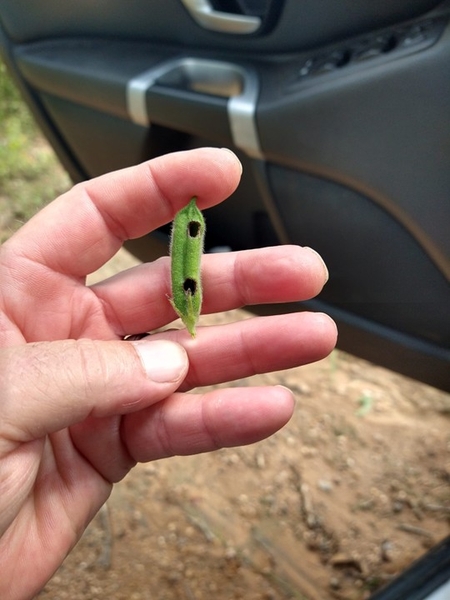
Figure 4. Corn earworm entry and exit holes on a damaged sesame capsule.
Harvest:
Even though sesame is indeterminate, the crop will eventually stop flowering towards the end of the season. During this time leaves will start to yellow as nutrients are remobilized and moved to the developing seeds. Fields should start to take on a lime green/yellow color – this is perfectly natural and desired. A dark green field late in the season is an indicator of over-fertilization and can result in delayed harvest. Sesame also starts to defoliate as it nears the end of the season. It is important to regularly check for mature seeds by cracking open a capsule and looking for a distinct black layer (PHOTO), similar to corn. Immature sesame seeds are milky white in color and change to a buff tan color at maturity. Again, because sesame is indeterminate, the lower capsules will mature before upper capsules. The goal is to have mature seeds at the top of the plant; however, this is not always possible. If plants have mature seeds up until the top 4” of the plant, a harvest aid can be applied to dry down the plant prior to cutting. Glyphosate or Saflufenacil (Sharpen®) are labeled for use as a desiccant/harvest aid in sesame. The time required for these products to work depends on weather conditions (warmer = faster), which can range from 1 – 3 weeks. Some farmers have waited until the first frost to kill the crop. We do not recommend this practice as the first frost is not consistent and can result in seed loss due to overly mature capsules at the time of cutting. The plants should be completely brittle with no visible green or flex in the stems. Seeds should be 7% moisture at the time of cutting. Higher moisture content can cause issues in storage and may lead to rejection at the receiving point. Being timely with harvest is imperative to reduce loss and quality degradation. If stems are dry and seed moisture is acceptable, you should cut the crop as soon as possible. Leaving sesame in the field longer can result in seed loss from opened capsules. Additionally, plant material becomes increasingly brittle over time, which will be pulverized in the combine and impossible to separate from the clean seed, leading to dockage.
Combine settings:
Though the seeds are small, sesame can be successfully harvested with common conventional platform headers (augur or drapers). Most combine header loss occurs at the header, so care should be taken to ensure that the header speed is set to the ground speed. Specific combine settings can be found in Appendix 2 in the Sesaco Production guide. We recommend using a handheld grain moisture meter to ensure proper combine settings. Sesame test weight should be 45 lbs: values below this indicate too much foreign matter, values higher than this (48 – 50 lb) may be too clean, resulting from aggressive threshing and seed loss at the back of the combine.
Contracting:
Sesaco is currently the only sesame contractor in North Carolina. Sesame prices have been declining over the past three years and the 2026 crop year pricing is $0.32/lb ($32/cwt). Even though sesame is a low input crop, it will be difficult for growers to make a profit with these prices. The delivery point for sesame grown in North Carolina is in Dillon, South Carolina (ChoiceAG).
Key Takeaways:
- Timeliness is critical for optimal yields: Be timely with planting, weed management, and harvesting.
- Sesame is a low-input crop and does not benefit from “throwing the kitchen sink” at it. Instead, find ways to minimize inputs to maximize profit.
- Sesame can be a great fit for marginal land that’s affected by deer pressure, root-knot nematodes, or low fertility.
Acknowledgements:
We would like to thank the North Carolina Department of Agriculture and Consumer Services New and Emerging Crops Program for funding sesame research over the past five years. We would also like to thank Sesaco and ChoiceAG for their technical support. Finally, thank you to all North Carolina farmers involved in sesame production over the past five years. Their insights and willingness to experiment and share their knowledge has been critical for the success of sesame in North Carolina.
Resources:
Chavez, M., Post, A., and D.H. Suchoff. 2024. Evaluation of variety, row spacing, and nitrogen fertilizer rates on sesame yields in North Carolina. NC State Extension Publication.
Harrell, N., Batts, T., Henriquez-Inoa, S., Gorny, A., and D.H. Suchoff. 2024. Sesame’s impact on root-knot nematode populations. NC State Extension Publication.
Langham, D.R., Riney, J., Smith, G., Wiemers, T., Peeper, D., and T. Speed. 2010. Sesame producer guide. Sesaco Sesame Coordinators.
Suchoff, D.H., Gorny, A., Chavez, M., and A. Post. 2022. Screening sesame for resistance to multiple root-knot nematode species. NC State Extension Publication.
Suchoff, D.H and S. Henriquez-Inoa. 2025. 2024 Sesame variety trial results. NC State Extension Publication.
Sesame - Production Guide. Texas A&M AgriLife Research and Extension Center at San Angelo. Jan. 29, 2007
Publication date: March 23, 2026
Reviewed/Revised: March 23, 2026
N.C. Cooperative Extension prohibits discrimination and harassment regardless of age, color, disability, family and marital status, gender identity, national origin, political beliefs, race, religion, sex (including pregnancy), sexual orientation and veteran status.
The use of brand names in this publication does not imply endorsement by NC State University or N.C. A&T State University of the products or services named nor discrimination against similar products or services not mentioned.
Recommendations for the use of agricultural chemicals are included in this publication as a convenience to the reader. The use of brand names and any mention or listing of commercial products or services in this publication does not imply endorsement by NC State University or N.C. A&T State University nor discrimination against similar products or services not mentioned. Individuals who use agricultural chemicals are responsible for ensuring that the intended use complies with current regulations and conforms to the product label. Be sure to obtain current information about usage regulations and examine a current product label before applying any chemical. For assistance, contact your local N.C. Cooperative Extension county center.
N.C. Cooperative Extension prohibits discrimination and harassment regardless of age, color, disability, family and marital status, gender identity, national origin, political beliefs, race, religion, sex (including pregnancy), sexual orientation and veteran status.