
Background
The Yellow-Legged Hornet (Vespa velutina), or YLH, is a newly introduced carnivorous insect to the US originally from southeast Asia. It was first discovered in Savannah, Georgia and confirmed by USDA APHIS on August 9, 2023. A nest was located and removed, but the following spring more insects were discovered. Only 3 months later, on November 9, 2023, a YLH was trapped in South Carolina. Researchers at Clemson University have been working hard trying to manage the spread of this invasive pest with the goal of eradicating it. Unfortunately, the yellow-legged hornet has made its way across the state line and on July16th was discovered in North Carolina.
Many hornet species have a similar appearance to the newly invasive yellow-legged hornet and can be difficult for the untrained eye to distinguish. Some species, such as the European hornet (Vespa crabro), are common in North Carolina and closely resemble the yellow-legged hornet, making accurate identification important. Learning to recognize these look-alike species can help prevent misidentification. See this publication for clear photographs and identification characteristics of each species. For a better description and help to identify many of these hornets, see A Side By Side Comparison of the Northern Giant Hornet and Other Insects.
For beekeepers, this is just one more thing to worry about. Like all hornets, the yellow-legged hornet is carnivore and preys on insects, including honey bees. There are many wasps and hornets that prey on honey bees (reviewed by Otis et al., 2023), but this one may be more problematic because of the large population of hornets within a nest. At the height of the season, populations may reach 3,000-5,000 individuals.
YLH are a problem for honey bees because of their 'hawking' behavior. The hornets fly near the entrance of the bee hive waiting for workers to return from their foraging flights and then the workers get picked off in mid-air. The honey bee colony can stand to lose a small number of foragers, but the YLH will recruit more hornets until the pressure on the colony is so great that the foraging activity will stop completely. If the colony is strong with plenty of honey stores, the honey bees can survive this foraging interruption, but a weak colony may starve if not permitted to forage for food.
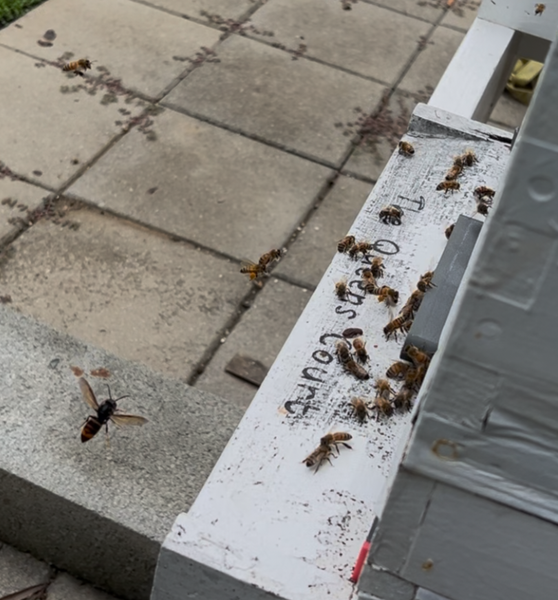
Hawking behavior at entrance of bee hive.
NCDA & CS
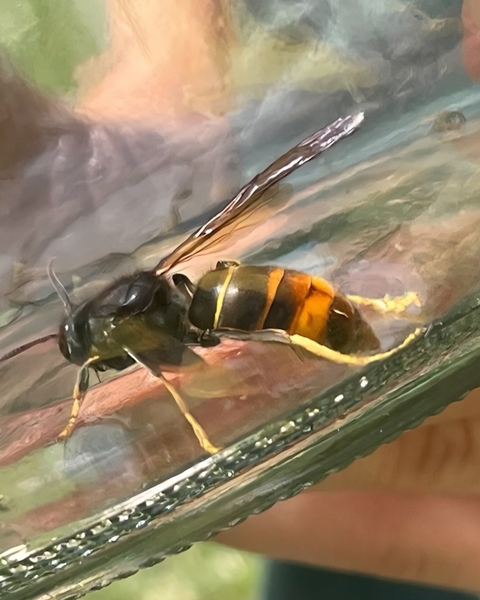
Yellow-legged hornet
NCDA & CS
Means of Control
What can beekeepers do to protect their colonies from this predator? Much of what we know is based on lessons learned by beekeepers in Europe, where the YLH has also been introduced. The first discovery of the yellow-legged hornet in Europe was in France in 2004 and has since spread across the country and become established throughout most of Europe. In 2017, Robinet reported the quick spread and how detrimental to the beekeepers this was, also noting that the trapping was not an effective tool since the spread continued. However, beekeeping continues in Europe despite the establishment of the YLH. Beekeepers have learned a few techniques to help their bees better defend themselves against these predators but have also learned that maintaining a strong and healthy hive is the most important practice.
Trapping
The primary mechanisms beekeepers use are trapping and nest removal. Trapping is most effective during the spring when reproductives are starting new nests, and in the fall when the gynes are leaving the nest in search of a spot to overwinter. Most of the summer, a typical population of a Vespa vellutina nest contains mostly workers with one queen. Late in the season, the population dynamics change where the gynes and the drones start being produced in preparation for next year (Pérez-de-Heredia, 2017). The gynes will mate and then ‘hibernate’ until the spring when they will become the foundress of a new nest. For each one of these trapped in the spring, another nest in prevented. A trap is a simple device such as a plastic jug with a homemade bait of grape juice and dark brown sugar (NCDA & CS website). It has been reported that the hornets do not fly far from the nest to feed during the summer months, so monitoring traps may help when searching for a nest. If nests can be located and removed prior to the reproductives being produced, this will help the spread next season.
Entrance Reducers
Besides trapping, the next most obvious mechanism to help defend against the YLH is to add entrance reducer to the opening of the hive. An entrance large enough for the bees to enter, but too small for the hornets may be used to protect extremely weak colonies where the hornets will enter the hive to prey on adult bees. These are already commonly used as a defense against small mammals in the winter.
Muzzle
Other defensive mechanisms that are being used by beekeepers in Europe include a muzzle and an electric harp (Diéguez-Antón).A muzzle uses the instinct of insects to crawl up when confined. These homemade devices are used to modify the entrance of the beehive. A screen cage is placed around the hive entrance, with openings large enough for the YLH and the honey bees to enter. The honey bees continue into the main hive entrance, which has smaller openings that prevent the hornets from entering. This leads to the YLH crawling upward, through a one-way funnel, into a smaller chamber where they become trapped (Diéguez-Antón, 2024).
Electric Harp Trap
The electric harp trap is a device with electrified wires that are hung vertically and parallel with enough space between the wires for the honey bees to pass through but narrow enough that the wings of the hornets will touch the wires and be killed (Diéguez-Antón). These are set up in line with the bee hives with the idea of catching the hornets as they are circling in front of the hive entrance. This is still experimental and has mixed reviews. This may be something that can be improved upon and used for future control.
Experimental Devices
There are other inventions that beekeepers have tried but their efficacy is still in question. Ornetin produces entrance reducers designed to defend against the YLH, and a specially designed trap made to fit onto a jar filled with the recommended bait. The trap has a one-way funnel entrance where the insects enter but are unable to get out. Abelo advertises the Asian Hornet Guard Protection with Trap which modifies the entrance to minmize hornet predation.
It is important to note that while beekeepers are free to experiment with mechanical or structural devices, anything that deploys any chemical control or pesticides is strictly prohibited. Please contact your regional NCDA&CS Apiary Inspector or county extension office if you wish to implement a novel method of YLH control.
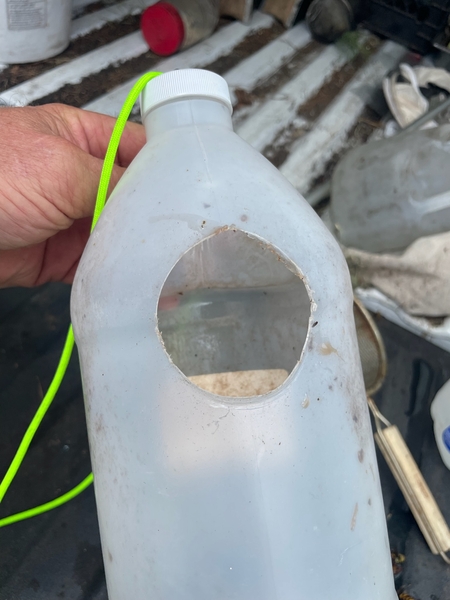
Homemade trap made from a plastic jug
NCDA & CS
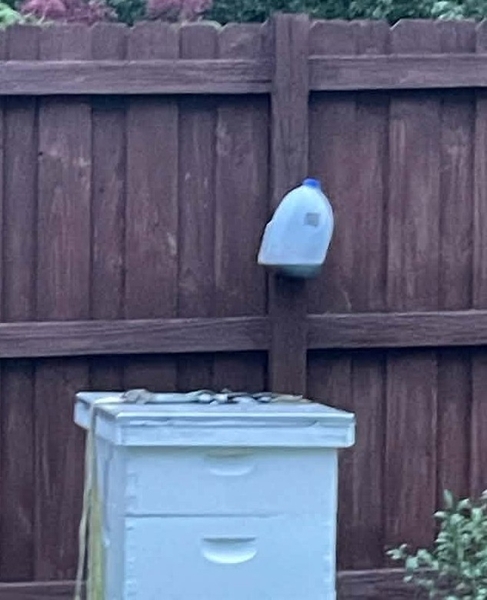
Homemade trap made from a plastic jug
Lisa Hemingway Harris
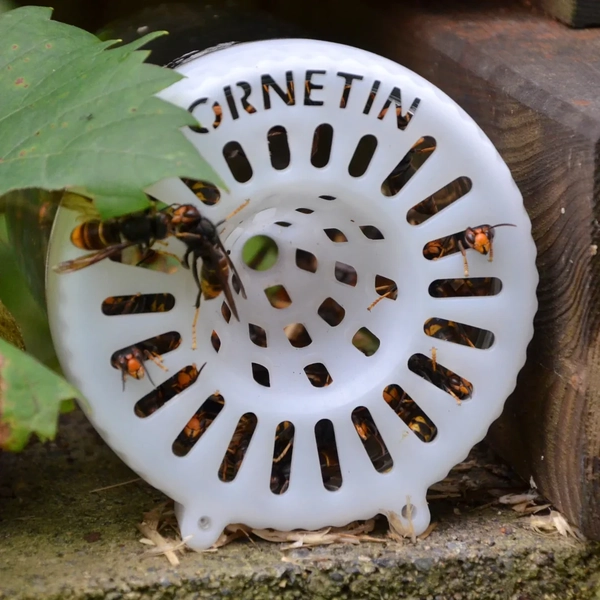
Ornetin YLH Trap
Ornetin
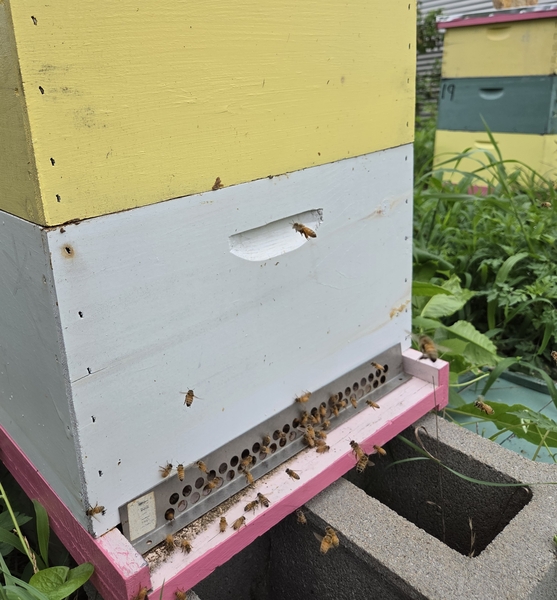
Entrance reducer (mouse guard) on entrance to protect bees.
NCSU Apiculture
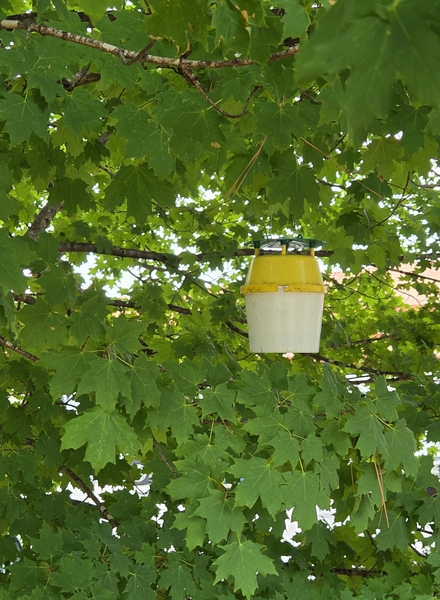
Commercial bucket trap
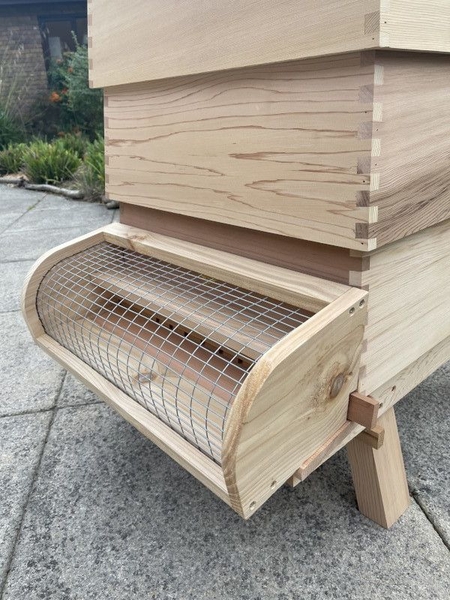
Muzzle to deter YLH
Thorne Beekeeping
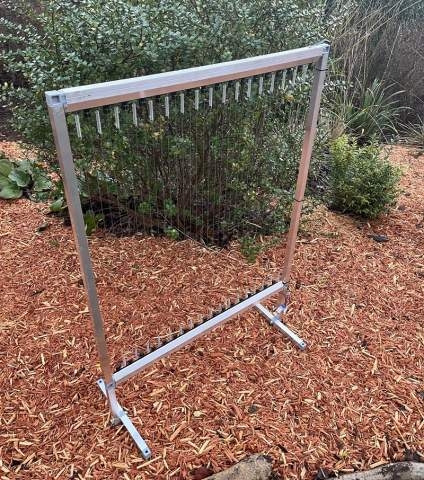
Harp trap
Thorne Beekeeping
Conclusion
The YLH is just the latest in a number of introduced exotic hive pests and parasites (e.g., Small Hive Beetle, Varroa). As with these others, beekeepers are going to have to change their management practices and expectations in order to compensate and keep their colonies healthy and thriving. As with Varroa management, monitoring will be key, so all beekeepers should place a trap in their apiaries and check it regularly to detect the local presence of wasps. Once detected in a trap, or if hawking behavior is witnessed, adding robbing screens or entrance reducers will help deter their predation, or implementing some of the other options outlined above will be necessary. Since YLH populations peak in the late summer to early autumn, when Varroa monitoring and control measures are most critical, incorporating such preventative measures should be readily incorporated. In the end, if a colony is already strong and healthy—and is not stressed by nutrition, Varroa, or queen issues—then it will be well positioned to withstand the predatory pressure of the YLH.
In the end, North Carolina beekeepers should be concerned but not panicked by this most recent introduction of an exotic hive pest. As is the case with most other beekeeping management, knowledge about the YLH is critical, regular monitoring is key, and proactive action is necessary.
The take away message for beekeepers is not to panic but be prepared:
- Monitor for YLH using bait traps (early detection is key).
- Observe behavior in the apiary and watch for hawking behavior. (Report if YLH activity is observed)
- Implement traps and other control measures if necessary.
- Continue to monitor and control varroa mite populations to help ensure colonies remain strong and healthy.
Additional Resources
Use these links to learn more about the yellow-legged hornet:
USDA-APHIS yellow-legged hornet
NCDA & CS- yellow-legged hornet information page
Clemson – Learn to identify and report yellow-legged hornets
NC State University – A side by side comparison of the northern giant hornet and other insects.
Sources Cited
Diéguez-Antón, Ana, et.al. Management of honey bee (Hymenoptera:Apidae) colonies under yellow-legged hornet (Hymenoptera: Vespidae) pressure. Journal of Integrated Pest Management, (2024) 15(1): 43.
Otis GW, Taylor BA and Mattila HR (2023) Invasion potential of hornets (Hymenoptera: Vespidae: Vespa spp.). Front. Insect Sci. 3:1145158. doi: 10.3389/finsc.2023.1145158
Pérez-de-Heredia I, Darrouzet E, Goldarazena A, Romón P, Iturrondobeitia J-C (2017) Differentiating between gynes and workers in the invasive hornet Vespa velutina (Hymenoptera, Vespidae) in Europe. Journal of Hymenoptera Research 60: 119–133.
Robinet, Christelle (2017) Rapid spread of the invasive yellow-legged hornet in France: the role of human-mediated dispersal and the effects of control measures. Journal of Applied Ecology, 54, 205-215
Veit, Jonathan. Clemson News. Clemson launches new yellow-legged hornet reporting system.
North Carolina Department of Agriculture and Consumer Services. Plant Industry – Yellow Legged Hornet.
USDA APHIS. Yellow-Legged Hornet
Publication date: Aug. 6, 2026
N.C. Cooperative Extension prohibits discrimination and harassment regardless of age, color, disability, family and marital status, gender identity, national origin, political beliefs, race, religion, sex (including pregnancy), sexual orientation and veteran status.