
The growth stage of the soybean plant determines its water requirements and susceptibility to wet and dry stress. Seasonal soybean water use can exceed 25 inches during the growing season. It is estimated that more than 60% of total water use occurs during R1 to R6 growth stages. This water must come from the soil, precipitation, or irrigation. When managing water in soybean production, consider rooting depth, soils and topography, growth stage of the plant, and the ability to control water in the field through the irrigation and drainage system.
Soybean Rooting
Soybean plants typically grow a taproot in the first weeks after emergence, and other roots branch off of the taproot as the plant continues to grow (Figure 10-1). Understanding how roots develop and the depth to which the soybean roots grow is fundamental to managing water throughout the growing season. In North Carolina, the rooting system primarily responsible for water uptake is typically in the top 12 inches of the soil, although roots expand well below this depth. About 70% of water uptake for soybeans occurs in the top 12 inches of the soil profile, with less than 30% of water uptake occurring between 12 and 24 inches deep. Rooting depth can be variable across North Carolina and can be impacted by hardpan soils, pH, rock layers, and depth to the water table. Although soybean roots can extend beyond 24 inches, most water-management decisions should be focused on the top 24 inches of the soil profile.
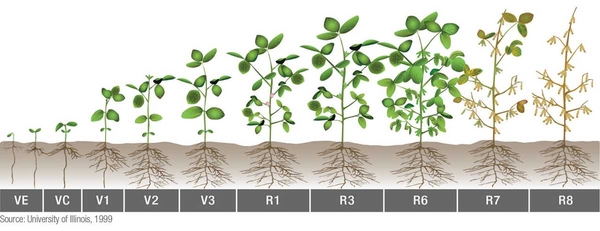
Figure 10-1. Soybean rooting by plant growth stage. Source: University of Illinois, 1999.
Soils and Topography
Soil type plays a critical role in the amount of water available to the soybean plant. The three main soil texture types in North Carolina are sands, silts, and clays. Sands hold the least amount of plant-available water, followed by silts and then clays. The soil texture is the driving mechanism influencing drought and moisture stress during the growing season. Drought stress is more likely to occur in sands than silts or clays, and moisture stress is more likely in silts and clays. Sands will require more timely irrigation in smaller amounts than silts or clays, whereas silts and clays will require more intensive drainage than sands. Coarse soils like sands typically hold less than 1.5 inches of water per foot of soil. Finer-textured soils like clays hold about 1.8 inches of water per foot of soil, and loams (a combination of sand, silt, and clay) can hold about 2 inches of water per foot of soil.
Topography plays a pivotal role in the amount and type of stress observed in the field. A low area of the field typically receives more runoff and is subjected to surface ponding, which tends to create wet conditions for the plant. In overly wet soils, the roots have no available oxygen, causing growth and nutrient uptake to slow and potentially lead to plant death. Bottomlands, valleys, and field potholes are areas prone to wet conditions. In coastal areas of North Carolina that are relatively close to sea level, high water tables (shallow, saturated areas of the soil) can prevail, creating excessive wet stress for plants. Hills in the piedmont and mountains can have the opposite effect on soybean growth because precipitation tends to run off, reducing infiltration and limiting the amount of plant-available soil water in those areas.
Growth Stages and Water
Soybean growth stage is a major factor in determining the water needs of the plant and the magnitude of stress observed from both drought and wet conditions. In early growth stages (VE-V1), very little water is required. Water needs greatly increase as the plant continues to grow roots and develop aboveground and belowground (V1-R1). During reproductive stages (R1-R5), water needs are at their highest. After the R5 stage, the plant’s water requirements decrease significantly.
Table 10-1. Typical Soybean Water Use by Plant Growth Stage
|
Growth Stage |
Water Use (inches/day) |
|---|---|
|
Germination and seedling |
0.05—0.10 |
|
Rapid vegetative growth |
0.10—0.20 |
|
Flowering to pod-fill (full canopy) |
0.20—0.30 |
|
Beginning maturity to harvest |
0.05—0.20 |
Source: Arkansas Soybean Production Handbook
Wet and dry stress have cumulative effects throughout the season and can affect final crop yields. Wet stress during the emergence period, for example, can significantly impact root development, which if followed by a drought during reproduction can exaggerate drought stress. Although each growth stage can be more susceptible to wet or dry stress, final yields are a function of all the stress that occurs throughout the growing season.
Figure 10-2 shows a unitless index of wet stress for soybeans by growth stage. These data were derived from greenhouse studies to develop crop-susceptibility factors for moisture stress in soybeans for use in the computer model DRAINMOD at NC State. Soybeans are susceptible to wet stress throughout the growing season but are extremely susceptible during the emergence period (VE) and from R1 through R5. The impact of wet stress during these growth stages is more severe on crop yields.
Figure 10-3 details the magnitude of dry stress for soybean by growth stage, also derived from greenhouse studies at NC State for use in DRAINMOD. It should be noted that both Figure 10-2 and Figure 10-3 present a unitless index for stress, and they do not represent the same scale. Each one is independent of the other. The trends and magnitudes are what are important. Soybean yields are not overly affected by dry stress early (VE-V14) or late in the growing season (R5-R8). However, at reproduction (R1-R5), the impact of dry stress on final yields increases compared to the first part of the growing season. Understanding these relationships at different soybean growth stages should drive response to water stress at the farm level.
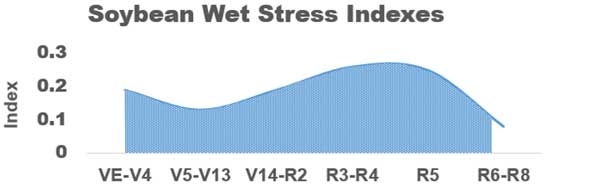
Figure 10-2. Soybean crop-susceptibility index factors for wet stress by plant growth stage.
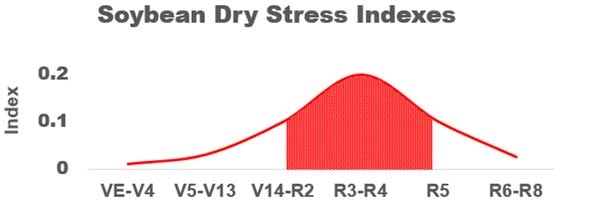
Figure 10-3. Soybean crop-susceptibility index factors for dry stress by plant growth stage.
Water Management (Evapotranspiration, Drainage, and Irrigation)
Evapotranspiration (ET) refers to the amount of water that is lost to the atmosphere through either evaporation or plant transpiration. Typically, ET is greatest during the summer months when daytime and nighttime temperatures are the highest. At this time, soybeans are in late vegetative and reproductive growth periods throughout North Carolina. During this period (late June through mid-August), soybean transpiration rates peak (Table 10-1) and water demand intensifies. Figure 10-4 depicts the typical daily water demand for soybeans by growth stage and date.
Two practices, drainage and irrigation, control the amount of water that is available in the soil to meet soybean water demand.
Drainage utilizes open ditches, tile drainage, or surface drainage (facilitated through land leveling) to manage availability of soil water during the growing season. A ditch and tile drain both remove subsurface water when heavy rainfall overwhelms the storage capacity of the soil. These systems can be designed and installed to reduce the chance for prolonged saturation in the soil; when effectively managed, they can increase the level of oxygen available for the plant during and after intensive precipitation events. The intensity of drainage is a function of the soil type, the ditch or tile spacing, and the ditch or tile depth. In general, the coarser the soil, the deeper the depth, and the closer the spacing of the ditch or tile, the higher the drainage intensity of the system. These systems are highly effective at reducing waterlogged conditions but should also be managed to not overdrain the fields. Management can be accomplished with outlet controls that can reduce or stop drainage at any time. Ideally, the system should be utilized at full capacity to reduce wet conditions in the top 12 inches of the root zone and then limit drainage to conserve water once waterlogged conditions are no longer apparent in the primary rooting zone.
Surface drainage, otherwise known as surface grading, is another drainage practice that promotes uniform water infiltration while reducing shallow depressional areas that are prone to waterlogging. This type of drainage is accomplished by using a land plane, box blade, soil pan, or other grading system to level the field to uniform surface grade. Implementation can be achieved by utilizing operator best judgment or through laser or real-time kinematic (RTK) grading systems. A combination of both subsurface and surface drainage systems is often needed to prevent wet stress in soybean production.
Irrigation is a practice utilized to add water to soybean fields when drought stress occurs. A comprehensive understanding of soybean water needs is a function of considering the actual plant-available water per inch of soil, the soybean rooting depth, and the growth stage and impact of dry stress on yield. In addition, predicted weather conditions need to be accounted for in all irrigation decisions. The greatest impact of wet and dry stress on final soybean yield overlaps during the reproduction periods (Figure 10-2 and Figure 10-3). Accordingly, it is important to consider potential future rainfall events when deciding whether to irrigate. Irrigation prior to intensive rainfall events could prevent the current dry stress but later cause a significant increase in wet stress due to rainfall, thus offsetting any yield benefits.
The best practice in soybean water management is to always monitor soil moisture levels in the field. Common ways to accomplish this would be to use the feel method, ET irrigation scheduling, or soil moisture sensors in the field. The feel method, which involves digging a shallow hole and feeling the soil for moisture, is an acceptable method on which to base irrigation scheduling. A more comprehensive method of irrigation scheduling is to utilize a checkbook-balancing approach for water needs. This approach can be accomplished by accounting for available soil moisture, plus daily rainfall or irrigation, and subtracting and estimating daily soybean ET. For more information, see Irrigation Scheduling to Improve Water and Energy-Use Efficiency. Once the soil needs irrigation, Table 10-1 or Figure 10-4 can be utilized to determine the estimated daily irrigation demand. A more complex method would involve using calculated ET information from either a weather station at the field location or a nearby weather station such as the North Carolina State Climate Office for soybean crop coefficients.
Another method for determining when to irrigate would be to use field soil-moisture monitoring devices. These instruments come in a variety of forms. A tensiometer, for example, measures soil water tension. This sensor basically measures the amount of work a soybean plant must perform to extract moisture from the soil. The more negative the reading, the less water is available for the plant. Another monitoring device is a volumetric soil-moisture sensor that measures the total water in the soil on a percentage basis. The readings acquired from both tensiometer and volumetric soil sensors are a function of soil type. To properly schedule irrigation, a manager should become acquainted with the corresponding plant-water availability for the specific reading of the instrument. In addition, the farm manager should factor in differences in soil types across a field.
In making drainage and irrigation decisions, another measurement to consider is the depth to the shallow water table. You can determine this depth by boring a shallow hole in the soil (12 to 36 inches deep) and seeing if the hole fills with water over time. The level at which water enters the dug hole is representative of the water table. A more sophisticated solution would involve installing a screened well to this depth that can be routinely checked. If water is observed within 36 inches of the soil surface, consider not irrigating until the water level drops below that depth. If a water table is within 12 inches of the soil surface, use the full intensity of your drainage system. For most North Carolina soils, you would ideally want to limit drainage with a water table between 20 and 36 inches to promote water conservation and to reduce the need for supplemental irrigation in soybeans.
Proper water management in soybeans can be accomplished through investment in and management of drainage and irrigation infrastructure. Stress during the growing season is cumulative and specific to growth stages. These conditions imply that duration and intensity of water stress at specific growth stages will influence final yield. Simultaneous management of both excessive and deficient soil water conditions from the beginning of the growing season until harvest is essential to achieve high-yielding soybeans in any given year.

Figure 10-4. Typical soybean daily water demand.
Publication date: July 31, 2025
AG-835
Other Publications in North Carolina Soybean Production Guide
- 1. The Soybean Plant
- 2. Variety Selection
- 3. Fertilization and Nutrient Management
- 4. Soil Health, Tillage, Cover Crops, and Crop Rotation
- 5. Planting Decisions
- 6. Weed Management
- 7. Soybean Diseases and Management
- 8. Soybean Nematode Management
- 9. Insect Management
- 10. Water Management in Soybeans
- 11. Late-Season Management, Harvesting, Drying, and Storage
- 12. Soybean Marketing in North Carolina
N.C. Cooperative Extension prohibits discrimination and harassment regardless of age, color, disability, family and marital status, gender identity, national origin, political beliefs, race, religion, sex (including pregnancy), sexual orientation and veteran status.