Notify me when new publications are added.
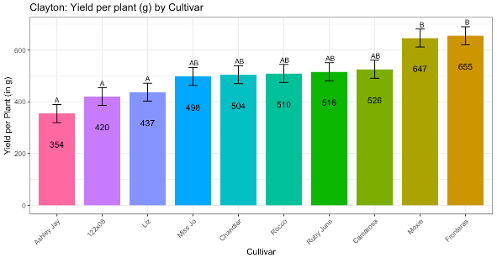
The performance, flavor and chemistry of a variety of strawberry cultivars was evaluated across three locations in North Carolina in the 2025-2026 season. In summary, the cultivars Ruby June, Belle, Fronteras and Rocco had acceptable performance in terms of yield, flavor and disease tolerance. Ruby June was confirmed to be highly susceptible to Neopestalotiopsis Crown Rot (Neo-P), but has good flavor, size and yield. Also, Rocco showed good tolerance, good yield, acceptable size and great flavor in the 2025-2026 season.
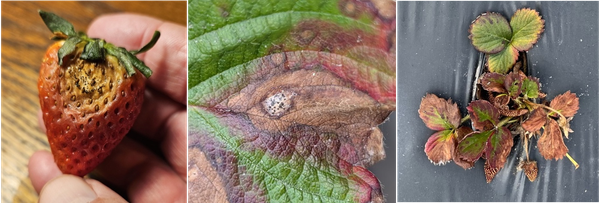
NC State conducted a strawberry Neopestalotiopsis (Neo-P) trial at the Horticultural Crops Research Station in Castle Hayne, NC. The main objective of the trial was to evaluate disease susceptibility and yield performance in strawberry cultivars inoculated with mixed strains of Neopestalotiopsis spp. The trial was established in October 2024 using annual plasticulture practices and comprised of 13 cultivars. Mixed Neo-P inoculum was applied to the plants three times throughout spring 2025. Cultivars with the highest marketable yield were Fronteras, Camarosa, and Miss Jo with 379, 332, and 327 g respectively. Cultivars with the lowest marketable yield were 921 (unreleased, Rutgers) and 122x08 (Lassen Canyon Nursery (LCN)) with 38 and 124 g. Cultivars exhibiting the highest average disease severity were 122x08, Ruby June, and Miss Jo while the lowest average disease severity cultivars were 921, Scarlet, and Rocco. In addition, a demonstration plot featuring 15 public and private breeding program cultivars were grown and evaluated alongside the larger research trial. This study will be repeated in spring 2026 to further research cultivar susceptibility and management strategies for Neo-P.

A muscadine virus survey was conducted in 2024 to assess the incidence of grapevine viruses across North Carolina (NC). This was a continuation of prior research in 2018-2020 on bunch grapes which confirmed the presence of grapevine viruses within NC vineyards. For this survey, muscadine vines were tested for grapevine leafroll associated virus complex (GLRaV-2, 3, 4, 7), grapevine red blotch virus (GRBV), grapevine virus A and B (GVA and GVB), grapevine rupetsris stem pitting-associated virus (GRSPaV), tomato ringspot virus (TRSV), and grapevine Syrah virus-1 (GSyV-1). Leaf-petiole samples were collected from 270 asymptomatic vines sampled across 8 vineyards. Samples were collected using a sterile technique with gloved hands and ethanol solution and evaluated at the NC State Micropropagation Unit. RNA was extracted from samples and then evaluated for viruses using Rt qPCR assays. The results show 37.1% incidence of GLRaV-2, 25.7% of GVB, 2.4% incidence of Xylella fastidiosa, and 0.5% incidence of GSyV-1. The total virus incidence was a 42.3% (89 vines) with co-infection incidence of 22.9% (48 vines). Additional muscadine testing will continue to understand the implication of muscadines viruses to both muscadines and bunch grapes crops.
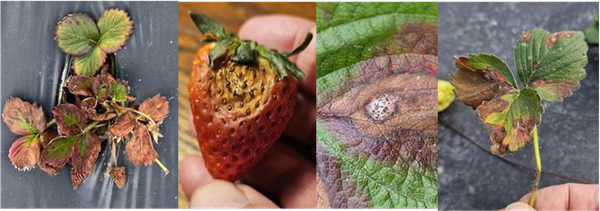
This factsheet describes a trial conducted to evaluate different strawberry cultivars inoculated with Neopestalotiopsis (Neo-P) for yield performance and disease susceptibility.
