Notify me when new publications are added.

Gray Mold or Botrytis Rot is a serious fungal disease in all strawberry production areas and is the primary disease of concern in most years. The fungus can infect fruit, leaves, crown, petals, flower stalks, and fruit caps and is most severe during cool bloom and harvest seasons with lengthy periods of clouds and rain. Best management practices include clean plants, cultural practices, sanitation, fungicidal control, timely harvest and post-harvest cooling.

This publication discusses Anthracnose Fruit Rot (Colletotrichum sp.) of blueberries in detail. Included are the common signs, symptoms, disease cycle, and best management practices for blueberry growers in NC and the southeastern region.
This publication offers fertilizer suggestions for a variety of crops, including field, pasture and hay crops, tree fruit, small fruit, ornamental plants and vegetable crops.
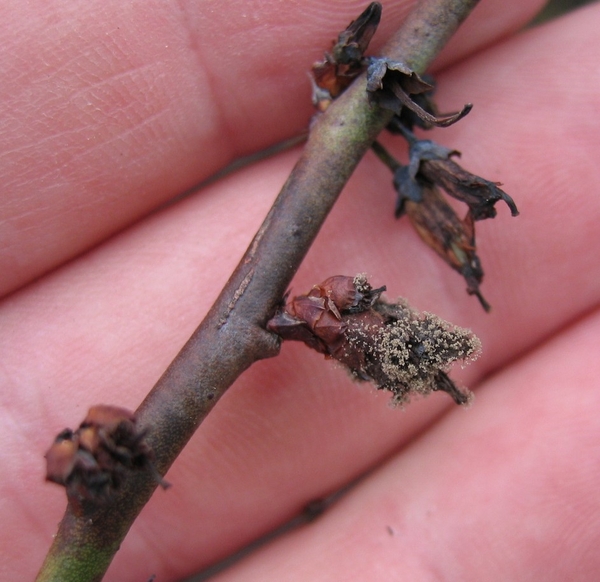
This publication discusses botrytis blossom blight and fruit rot of blueberry in North Carolina. It includes signs and symptoms, the disease cycle, and best management practices.
This publication covers insect and disease control in apples, blueberries, caneberries, grapes, peaches, pecans and strawberries.
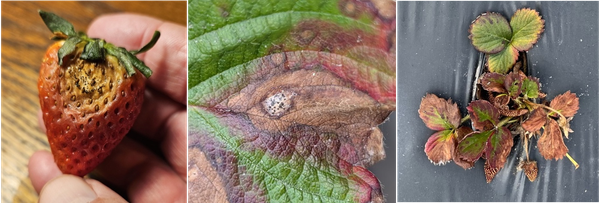
NC State conducted a strawberry Neopestalotiopsis (Neo-P) trial at the Horticultural Crops Research Station in Castle Hayne, NC. The main objective of the trial was to evaluate disease susceptibility and yield performance in strawberry cultivars inoculated with mixed strains of Neopestalotiopsis spp. The trial was established in October 2024 using annual plasticulture practices and comprised of 13 cultivars. Mixed Neo-P inoculum was applied to the plants three times throughout spring 2025. Cultivars with the highest marketable yield were Fronteras, Camarosa, and Miss Jo with 379, 332, and 327 g respectively. Cultivars with the lowest marketable yield were 921 (unreleased, Rutgers) and 122x08 (Lassen Canyon Nursery (LCN)) with 38 and 124 g. Cultivars exhibiting the highest average disease severity were 122x08, Ruby June, and Miss Jo while the lowest average disease severity cultivars were 921, Scarlet, and Rocco. In addition, a demonstration plot featuring 15 public and private breeding program cultivars were grown and evaluated alongside the larger research trial. This study will be repeated in spring 2026 to further research cultivar susceptibility and management strategies for Neo-P.
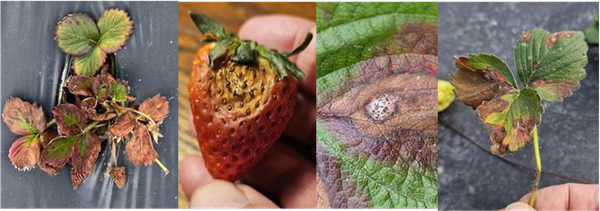
This factsheet describes a trial conducted to evaluate different strawberry cultivars inoculated with Neopestalotiopsis (Neo-P) for yield performance and disease susceptibility.
